Alarm Queue Backlog in Central Monitoring Stations
Continuous alarm volume overwhelms operators designed to handle events one at a time.
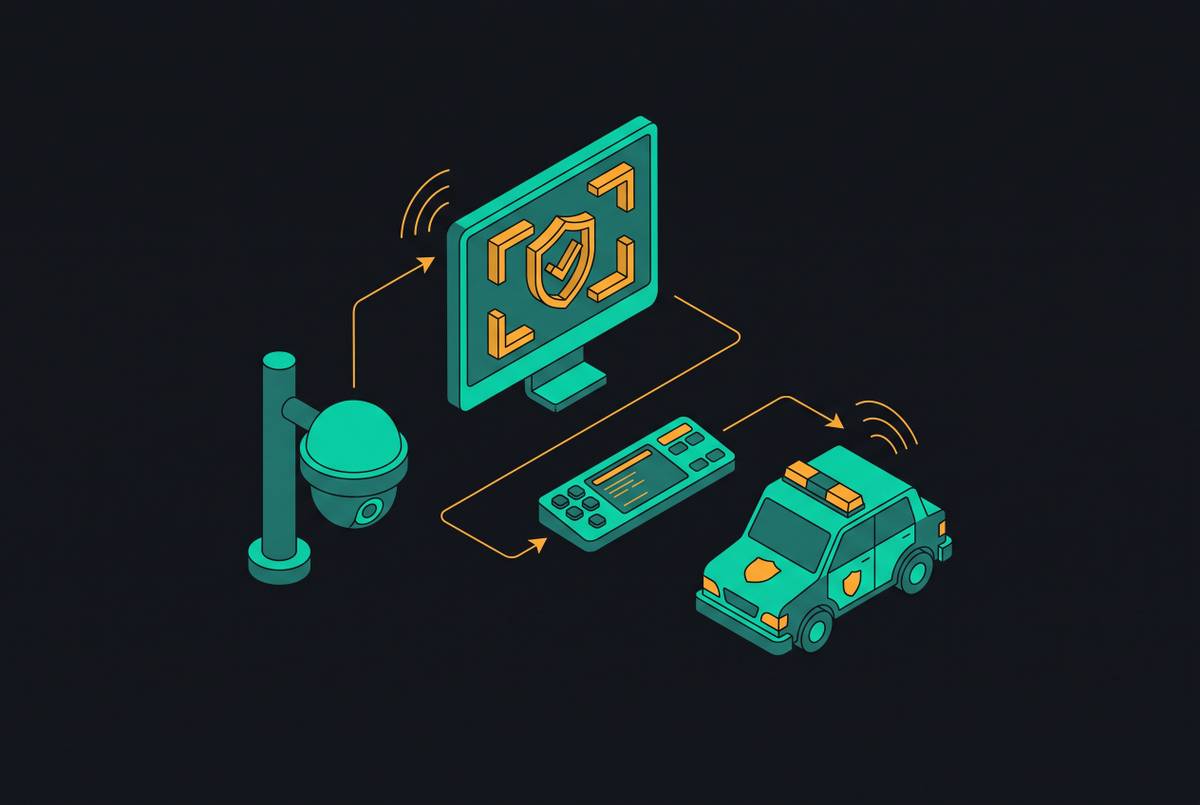
Alarm monitoring runs as a relay system, and every relay has a bottleneck. A sensor trips, the signal reaches a central station, an operator calls the premises, and only then does anyone decide whether police need to be dispatched. Each step in that chain waits on the one before it, and the whole chain waits on a human being who can only process one event at a time. That single constraint, not any particular company's mismanagement, is where the queue begins.
The scale of the problem starts with how much of what arrives is false. Research compiled for the U.S. Department of Justice on problem-oriented policing puts the false-alarm rate reaching police at an overwhelming share of total volume. The false-alarm share is the normal operating condition of the industry, and the queue an operator faces on any given shift is, by default, mostly noise. The difficulty is that operators cannot simply skip the noise, because somewhere in that same queue sits the rare signal that is not noise at all, and there is no way to know which one it is without looking.
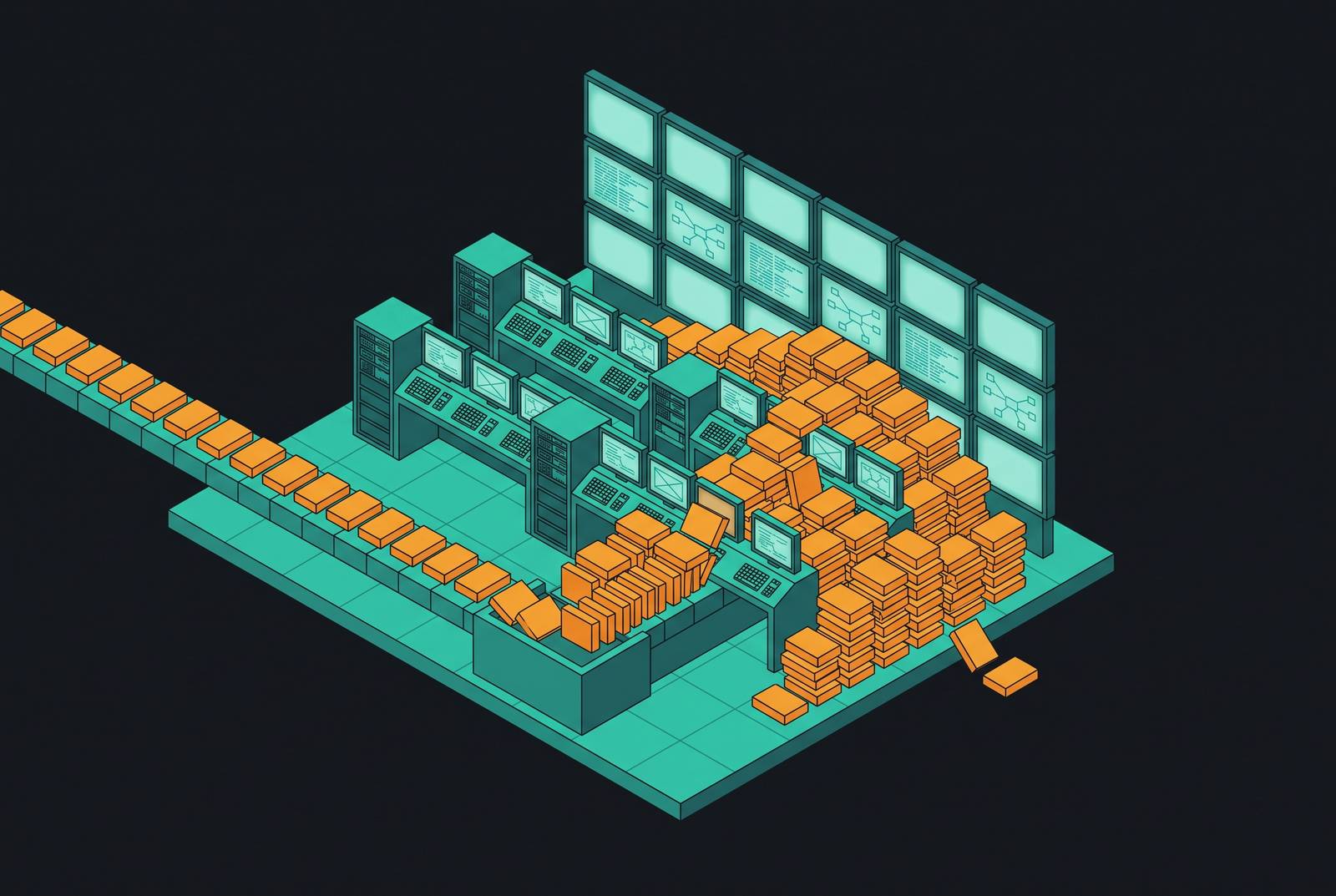
This is why the queue forms at all: arrival rate and processing capacity are decoupled from each other. Sensors trip continuously, indiscriminately, and without regard for how many other sensors just tripped. Operators work sequentially, one event after another, regardless of how fast the queue behind them is growing. When arrivals are unbounded and processing is fixed, a backlog is a mathematical consequence waiting to happen the moment volume exceeds throughput. Nothing about this requires bad judgment, poor training, or vendor failure. It is simply what happens when a continuous, high-volume input is fed into a system designed to process one item at a time.
Peak load and the backlog
A queue that drains in real time looks, from the outside, like a solved problem. The trouble is that drain rate and arrival rate are only balanced under light load, and alarm monitoring does not run under light load for long. The same logic that governs any queueing system, software or otherwise, applies here: when events arrive faster than they can be processed, the backlog does not level off. It accumulates, and it keeps accumulating for as long as the imbalance holds.
Industry analysis of a single monitoring center configuration makes the imbalance concrete: a large number of cameras per site, a false-alarm rate approaching 90 percent, a wide range of events per shift, and one operator responsible for a large number of sites at once. That combination has been described as not merely inefficient but cognitively impossible for one person to keep up with. Scale that configuration across a large portfolio of sites, and nightly alarm volume runs from the tens of thousands into the hundreds of thousands of events, a volume no finite operator staff can clear within a single shift.
What makes this worse is that peak load is not random. After-hours periods, weekends, and seasonal spikes produce the same surges predictably, shift after shift. The backlog during those windows is a scheduled feature of how the system behaves under its heaviest, most foreseeable load. Legacy video analytics add to the problem before a human ever gets involved, because systems built to detect motion rather than context cannot tell a falling leaf from an intruder, and every false trigger they generate enters the same queue as everything else. By the time volume peaks, the math has already failed: more events are arriving than any realistic staffing level can process in the time available, and no amount of operator diligence changes that ratio.
Why the standard fixes don't resolve the arithmetic
The industry's conventional responses to an overloaded queue each solve for a visible symptom while leaving the underlying ratio of events to operators untouched. The common flaw in all four responses is that they treat operator throughput as the constraint to optimize around, rather than questioning whether every alarm should require operator attention in the first place.
Hiring more operators is the most direct response, and it does increase processing capacity. But it comes at a real cost: fully-loaded labor costs per operator run into the tens of thousands of dollars annually, and the security guard workforce in the U.S. saw a turnover rate of 2024, cited by ASIS International data. That turnover means training investment resets constantly, so the capacity gained by hiring is never stable for long.
Muting or suppressing noisy cameras reduces the number of events an operator has to review, which looks like progress on a dashboard. The camera, however, is still running, and any verified threat that occurs at that location afterward goes unreviewed because nobody is watching for it anymore.
Offshoring operators changes where labor sits and how much it costs, while leaving untouched the ratio of events to operators that produces the backlog. The same number of alarms still needs to pass through the same number of people, wherever those people happen to be located.
Overage pricing solves none of this and instead reassigns the cost. The client pays more for volume that exceeds a contracted threshold, and still experiences the longest delays exactly when the queue is most backed up, since the pricing model does nothing to speed up review.
What unites all four responses is a shared assumption: that operator throughput is the constraint to be optimized, rather than a question of whether every alarm needs a human operator's attention at all. None of the four changes how many events require review. They only change who reviews them, at what cost, or with what gaps.
The cost of a real threat buried in a backlog of false alarms
When a genuine intrusion enters the same queue as hundreds of false alarms, its position in that queue, not its severity, determines how quickly anyone responds to it. An operator working sequentially has no way to know which event in the queue is real without reaching it in order, so a real threat waits exactly as long as everything ahead of it takes to clear, unless the system has been built specifically to jump it to the front.
The gap between this reality and what fast response actually looks like is stark. UL-listed stations can dispatch fire services within seconds of signal receipt for fire alarms, a standard built around minimal, predictable processing delay. Holding video intrusion events to that same standard breaks down the moment the queue in front of them holds thousands of unresolved events, because the arithmetic that makes seconds-level dispatch possible for fire simply does not exist for a queue backlogged with false positives.
The cost of that delay is visible at the municipal level. Los Angeles found that the vast majority of its annual alarm calls were false, at a cost of approximately $11 million in lost patrol time. Every one of those false calls that police respond to is time not spent responding to something real, so congestion in the dispatch pipeline slows response to actual threats even when those threats never touch a false alarm directly.
For a site owner, the practical result is that a monitored camera is not the same thing as a protected one. The site can be fully covered by cameras and still receive a response too slow to matter, because the monitoring investment buys surveillance without buying the guaranteed speed of response that surveillance implies.
The people doing the reviewing bear a cost too. Microsoft survey data shows that a significant share of analysts report manual, repetitive triage work has directly increased their burnout, and a large majority say they no longer have time for proactive work. An operator reviewing their four-hundredth alarm of a shift is working with diminished attention compared to the same operator reviewing their tenth, and fatigue of that kind is itself a byproduct of queue volume, not a separate problem from it.
SLAs and compliance standards describing the problem without solving it
The standards that govern central monitoring stations were built to establish a baseline of accountability, and they do that job well. What they do not do is measure response speed under the exact peak-load conditions where the queue backlog actually occurs.
UL 827, the Standard for Central Station Alarm Services, covers facility construction, equipment redundancy, staffing levels, signal processing, and response procedures, and monitoring centers must pass annual UL audits to keep their certification current. The standard requires signals to be received, recorded, and processed within specified timeframes, with every action documented. That is a meaningful bar, and clearing it says something real about a station's baseline operational discipline.
The Monitoring Association, formerly CSAA, represents professional monitoring companies and works alongside testing laboratories including UL, FM Global, and Intertek/ETL. Certification through that ecosystem signals a floor of operational quality, but it does not by itself guarantee how a station performs once volume surges past normal levels. Building and fire codes add another layer of obligation: IBC/IFC §907.6.6 requires most commercial fire alarm systems to be monitored by an approved supervising station under NFPA 72, which mandates that monitoring exist, without addressing how deep the queue behind that monitoring gets on a busy night.
Enterprise buyers have in turn built contracts around expectations that assume queue depth can be controlled: verification procedures, documented response times, audit trails, evidence clips, SLA transparency, round-the-clock uptime, and rebates when a station falls short. Those contracts are reasonable to want. But a station can pass its UL audit and still have a real threat waiting in the queue on a busy night, because audit compliance and actual response performance are different things. None of this diminishes what certification accomplishes. It simply means certification was never designed to answer the question a buyer actually cares about most: how long does a real threat wait behind everything false ahead of it.
Site-Specific Protocol Coverage and the Queue Problem
A large share of the volume filling any monitoring queue consists of events that never needed a human to look at them at all, if the system watching the site had enough context to recognize what it was seeing. That distinction, between events that require judgment and events that only look like they do, is where the real lever for reducing queue depth sits.
Monitoring protocols are set per account and per jurisdiction: what gets escalated, what gets auto-cancelled, and when police get called varies enormously from one site to the next. That variation means the composition of any given queue is partly a function of how well the monitoring setup understands the specific site it is watching. A delivery driver arriving during authorized business hours generates a signal that is structurally identical, at the sensor level, to an actual intrusion.
Platforms built around configurable scheduling demonstrate that this distinction can be engineered directly into the system. Sentinel, from Monitor Computer Systems, can switch AI analytics on only during unmanned hours, so a signal that would be irrelevant during business hours never enters the queue at all. That is protocol-aware filtering: it reduces the volume reaching an operator without reducing coverage of the site, because the filtering decision is made with knowledge of what is supposed to be happening at that moment.
SureView's Virtual Operator shows what this looks like as an active layer rather than a static schedule. It triages incoming traffic, runs basic action plans, reviews live and recorded video, and generates a short audit summary before anything reaches a human, escalating only when it cannot resolve the event on its own. The operator who does get the event receives something already verified and contextualized, rather than a raw signal indistinguishable from the thousand false ones around it.
The pattern across both examples points to the same conclusion: the queue is not only a volume problem, it is a context problem. A system incapable of telling authorized activity from unauthorized activity at the point of filtering pushes every ambiguous case downstream to the one resource that cannot be scaled cheaply or instantly, the human operator. That is where the queue actually forms, and it is the one layer where fixing the composition of the queue, rather than just the staffing behind it, is possible.
How the industry is responding to the queue
Conversational AI aimed at false alarms and non-dispatchable events is in the first category. Security Central, based in Statesville, NC, whose CEO Caroline Brown reports the company has been shifting from a monitoring center to a technology company, has been layering in conversational AI that enters a secure portal and handles false alarms and other non-dispatchable events. National Monitoring Center, based in Lake Forest, CA, implemented conversational AI in partnership with Replicant Inc. to cancel alarms, put systems on test, and request emergency dispatches. Both reduce the volume of outbound calls operators have to make once an event has already reached the queue. Neither changes how alarms are prioritized before an operator reviews them, because the filtering decision still happens after the event has already arrived.
AI-driven deterrence and faster operator alerting form a second category. Alarm.com launched AI Deterrence at CES 2025, using artificial intelligence to deliver adaptive verbal warnings to intruders based on their clothing and surroundings, paired with an RVM Console that alerts monitoring station operators immediately when a person or vehicle enters a restricted area, enabling operators to intervene through system hardware onsite. This speeds up the moment an operator becomes aware of a verified event, but it still routes that event through a human operator, so how much it actually helps the queue depends on how much filtering has already happened upstream of it.
The third category, AI agents that triage before any human sees an event, changes the composition of the queue rather than just the speed of handling it, in contrast to conversational AI that merely handles post-queue calls, with only the former addressing the structural problem. SureView's Virtual Operator runs basic action plans and reviews footage before escalating, so a human operator sees fewer events overall, and each one that does arrive comes with context already gathered rather than requiring the operator to assemble that context from scratch. That is a structurally different intervention from adding call-handling capacity or speeding up notification after the fact, because it reduces the number of raw, unverified events entering the queue to begin with.
Measured against the arithmetic laid out earlier, only the third category touches the actual constraint. Filtering that happens before an event reaches a human changes how large that queue is in the first place, which is the only lever that addresses the imbalance between arrival rate and processing capacity at its source.