Police Dispatch Priority for Video-Verified Security Alarms
Video verification cuts police response times and lifts alarms out of the false-alarm queue.
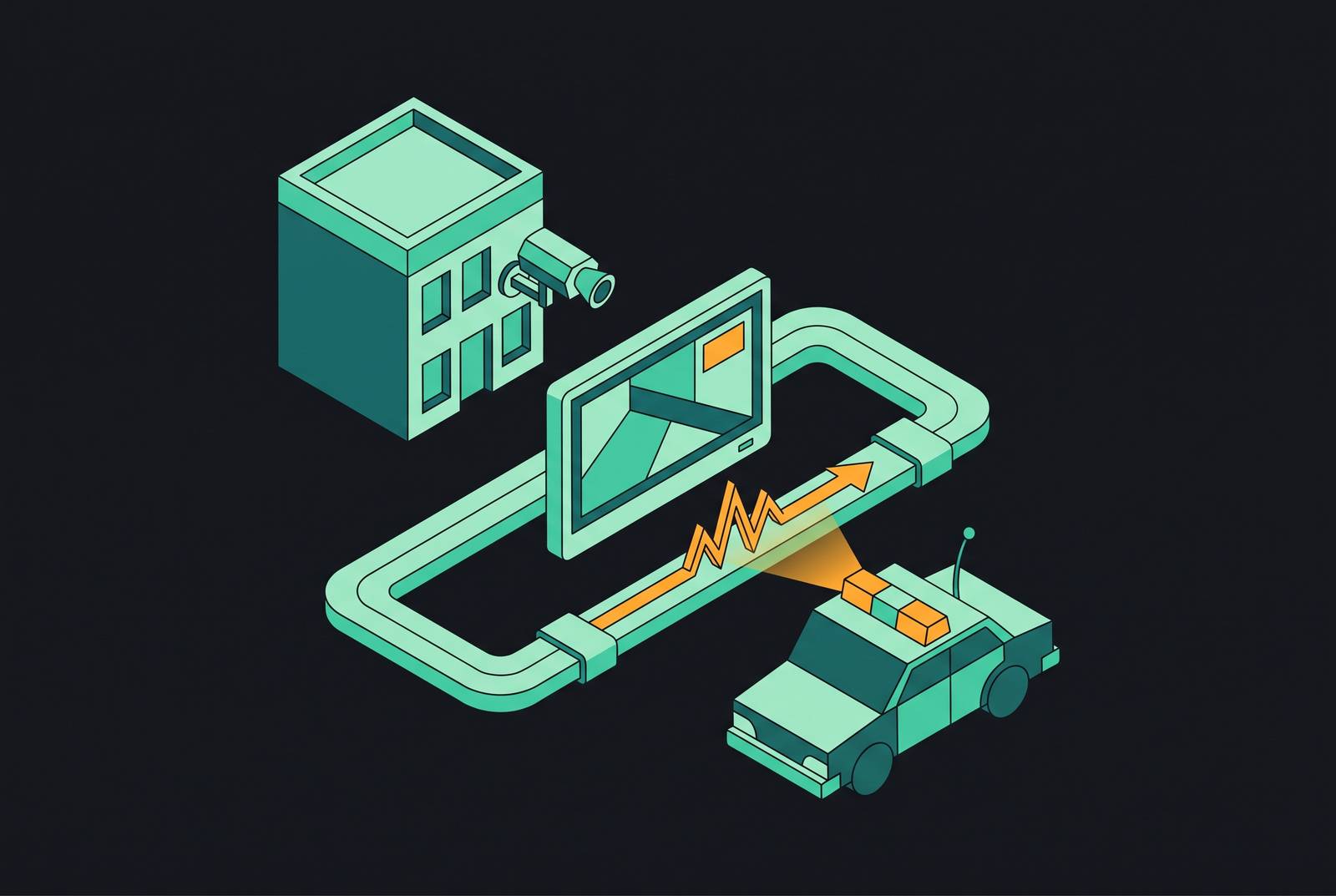
Most property owners assume that when an alarm trips, police will show up quickly. Under the way dispatch actually works, that assumption is false often enough to matter. An alarm signal with no supporting evidence sits near the bottom of a dispatcher's priority list, and it sits there because the data has trained the entire system to expect it to be nothing. The overwhelming majority of alarm calls involve no real threat, so an unverified signal reads statistically as noise before it reads as an emergency. Departments sort these calls rather than ignore them out of indifference. They're sorting them, and an alarm that cannot prove itself loses that sort every time.
That sorting has real consequences for how long a response takes. In some areas, police response times for unverified alarms can run past 146 minutes, long enough for a break-in to start, finish, and end well before an officer arrives. Budget constraints, officer shortages, and rising crime rates leave departments no choice but to put verified emergencies first, and an alarm that cannot confirm a real threat gets structurally outcompeted for attention by calls that can. Dispatch centers also field a growing share of organized retail crime cases and cyber-related incidents, which adds more competition for the same limited pool of officers and further pushes an unverified alarm down the queue. None of this is a flaw in how any individual dispatcher does the job. It's the predictable output of a system built around a signal that, standing alone, can't tell anyone what's actually happening.
Formalizing triage into law under verified-response policy
What began as dispatcher judgment is turning into written policy, and the direction of that shift is consistent across the country. Cities are raising fines on property owners and monitoring centers tied to repeated false alarms, and a growing number of municipalities now require some form of verification, whether by audio, video, or a human confirming the threat, before they'll send an officer.
Seattle offers the clearest recent marker of how far this has gone. As of October 2024, the Seattle Police Department became the 19th U.S. law enforcement agency to adopt a verified-response policy, requiring audio, video, or human verification of a crime before officers are dispatched. Seattle is unlikely to be the last major department to make that move. More mid-size cities, particularly across the West and Pacific Northwest, are expected to adopt some version of verified response in the coming years.
The consequence for property owners is direct. Under a verified-response ordinance, an alarm without verification doesn't just wait longer for a response, it may draw no police response at all, on top of a fine the owner or monitoring provider may now owe for triggering it. That raises an operational question with no room for ambiguity: once verification is required by law rather than requested as a courtesy, what exactly does a verified call have to contain to satisfy a dispatcher on the other end of the line?
Verification requirements for priority dispatch
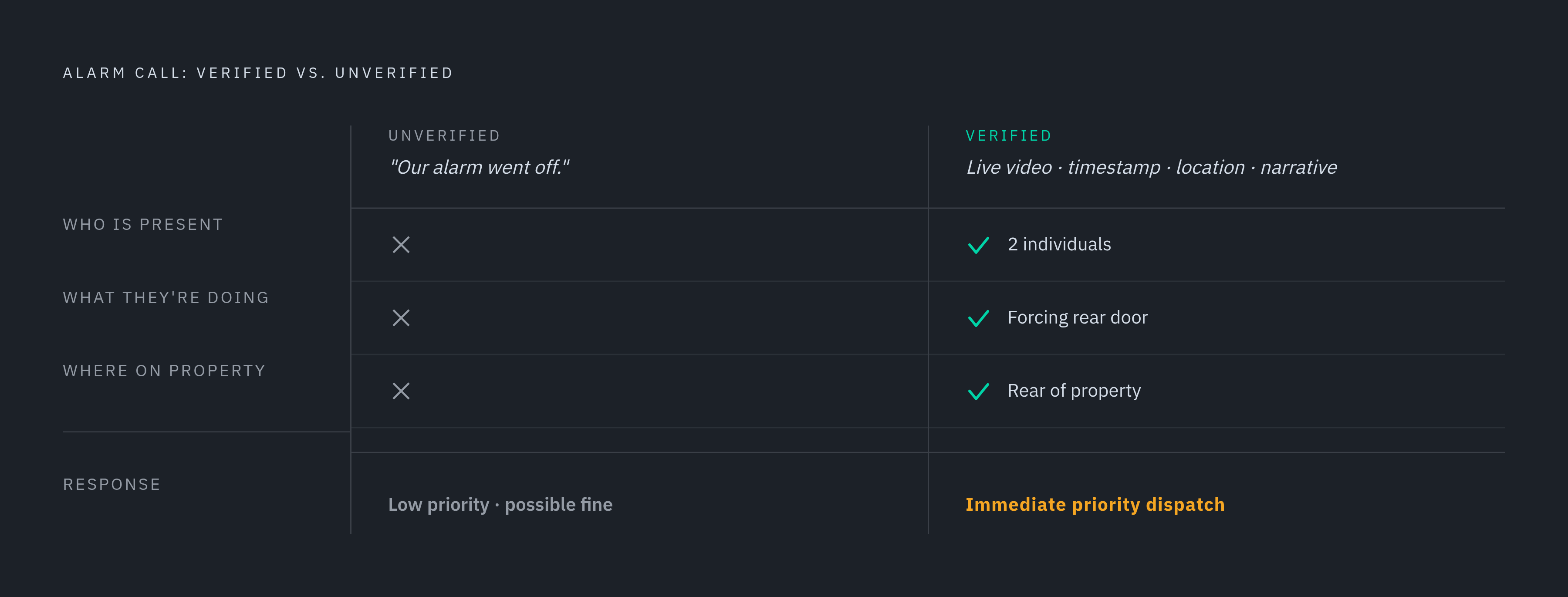
A verified alarm alone does not move a call up the priority list. What moves it up is a call that answers three specific questions a dispatcher needs answered before committing resources: who is present, what they're doing, and where on the property they are. Details like the point of entry, the direction someone is moving, and whether they're using tools to force their way in can separate a vague report from one that gets immediate priority classification.
The gap between the two kinds of calls is not subtle. A caller saying "our alarm went off" gives a dispatcher no confirmation of who's there, what they're doing, or whether it's a genuine threat. Compare that to a monitoring center reporting, "We have live video of two individuals attempting to force open the rear door of a warehouse." With that kind of detail in hand, officers know what they're walking into before they arrive, and they can bring the right resources instead of guessing.
The footage behind that call matters as much as the words describing it. A clip that starts too late or cuts out before the critical moment doesn't help a responding officer, no matter how clear the rest of it is. A verified workflow has to package the right segment, timestamped and paired with a short, specific narrative, so that whoever picks up the call can act on it the moment they hear it. Producing that kind of call, consistently and fast enough to matter, requires a monitoring workflow built from the ground up to generate it. The traditional central-station model was not.
Why the legacy monitoring workflow fails verified dispatch
The standard central-station process adds delay at nearly every step between an alarm tripping and a call reaching 911, and in an alarm chain, delay is the one thing that makes verification useless. Enhanced Call Verification procedures require an operator to place at least two phone calls to the site or to responsible parties before requesting emergency dispatch. Every unanswered ring, every voicemail, every callback attempt spends seconds an actual intrusion doesn't pause for.
The math behind that process breaks down further once volume enters the picture. Legacy monitoring platforms often cover sites running hundreds of cameras and generating thousands of events per shift, with a single operator responsible for dozens of sites at once. At that scale, giving each alarm the careful review a verified call requires simply isn't achievable. Night shifts bring fatigue, slower reaction times, and more mistakes, and every additional camera adds more motion, so more false alerts stack into an already full queue.
The outcome isn't just slower escalation across the board, it's uneven escalation. Some alarms get a careful look. Others get acknowledged and shelved. A genuine threat can sit behind dozens of false positives before anyone places a dispatch call, in a system where the Phoenix Police Department experienced a roughly 98 percent false-alarm rate on residential burglar alarms in 2018-2019. Much of the language monitoring contracts use to describe this process, terms like "best effort response" or acknowledgment windows measured in minutes, was never built for these stakes. Acknowledging that an alarm exists is not the same thing as placing a verified dispatch call to 911. A legacy workflow, run at legacy volume, cannot close the gap between those two actions.
How AI agents resolve the queue problem at scale
AI agents don't take over the judgment a dispatcher expects from a human monitoring center. They remove the backlog that keeps a human operator from applying that judgment while it still matters. The core shift is moving away from binary sensor triggers, where any motion sets off an alarm, toward contextual classification, where the system evaluates what caused the motion before it ever sends a signal. That filtering step removes weather, animals, and shifting shadows, which together account for most nuisance alerts, before a human ever sees themc9.
Always-on AI analytics can analyze video as it is captured, generate metadata, and flag relevant events, nearly eliminating false alarms caused by weather or animals, among the most common nuisance triggers. Processing that happens at the camera itself, rather than waiting on a round trip to a distant server, compresses the time between detection and alert to almost nothing, and that local detection keeps working even if the network connection drops. Detection zones can also be set per camera and adjusted for the season or time of day without rewiring anything physically, so a warehouse loading dock at 2 a.m. can run a different alert threshold than a retail storefront at noon, cutting false positives off at the source rather than downstream.
What comes out the other end is a queue that's already been through a filter. They're reviewing a short list of events that have already cleared a contextual bar, which is what makes the next step, human review, fast enough to produce a verified call before the window for a meaningful police response closes.
What the human operator contributes that AI cannot
Dispatchers give priority to a human caller who can answer follow-up questions in real time. AI pre-filtering is what makes that call arrive quickly. The human on the line is what makes it credible and legally actionable. Neither layer does the other's job.
Security Operations Center specialists review flagged alerts within seconds to identify a trespasser, an attempted forced entry, or an active theft in progress. Many incidents never reach that point at all: live two-way audio deterrence, an operator speaking directly to whoever's on camera, resolves a large share of events before police involvement is even necessary. When deterrence doesn't work and escalation is the right call, the operator already has the footage, the timeline, and the site context assembled, so the dispatch call doesn't start from zero.
Human review also removes a category of risk that unverified protocols used to create by default: property managers being sent out personally to "check on a noise" or an unexplained alert, walking into a confrontation with no idea what's actually happening. When an operator has already verified what's on site, nobody on the property side has to take that risk themselves. The evidence package the operator builds, timestamped clips, a short narrative, an exact location on the property, gives dispatchers and responding officers what after-the-fact footage without context never can. Officers who arrive already understanding what they're walking into can prepare accordingly, and that preparation is a safety benefit for the responding officers, not only for the property being protected.
Site-specific context and AI triage accuracy
An AI system can only classify an event correctly if it has been taught what normal, authorized activity looks like at that particular site. Without that baseline, it produces a different flavor of false positive, one that looks like a real threat because the system has no way to know it isn't. Verification, in other words, depends on more than the technology, it depends on the response plan built around it: a plan that specifies when to contact law enforcement directly and when to contact the client first, tailored to what that particular property actually needs.
Context changes the calculation site by site. An operator verifying a fence-line crossing at a construction site after hours is weighing a different set of risks than one watching a parking garage at a multifamily property, even though the raw motion event on screen might look identical in both cases. Schedules, rosters of authorized personnel, and known activity patterns (a vendor arriving late, an employee working overtime, a routine delivery) are what let an AI agent tell a real intrusion apart from ordinary access. Without those inputs, every motion event after hours is ambiguous by default. Detection zones can be customized per camera and adjusted seasonally without any physical rewiring, but somebody still has to define what "normal" looks like at that site, at that hour, before the system can act on it.
A monitoring provider that applies the same generic detection template to every property it covers will get verification wrong in both directions, producing false positives that erode a dispatcher's trust over time and false negatives that let a genuine threat pass unflagged. Site-specific configuration isn't an optional refinement.
Verified dispatch across commercial, multifamily, and industrial sites
Verified dispatch delivers the same basic benefit everywhere it's used: a faster, better-informed police response. What counts as a verified threat, and what an operator has to confirm to call it one, changes enough by site type that the category of property shapes the entire monitoring protocol built around it.
Commercial sites such as auto dealerships and construction sites carry their own specific risk profile. Construction sites in particular face theft losses that can eat up a meaningful share of a project's total budget when left unaddressed, and copper theft rose sharply through 2025, which makes after-hours perimeter verification especially high-stakes on active job sites. The complicating factor at these sites is that legitimate after-hours activity, a foreman returning to grab equipment, a scheduled delivery, happens often enough that schedule-based context is essential to telling a real intrusion apart from routine access. Video-verified alarm systems, like those Pioneer Security operates, give a monitoring center real-time visual confirmation before it dispatches authorities, and police departments treat those verified calls as confirmed crimes in progress rather than routine alarm traffic.
Multifamily properties face a volume problem of their own. Residents setting off sensors during ordinary movement around the property creates noise similar to any other site, but a missed real threat in a parking deck or a package room lands on tenants directly, not just on the property owner's balance sheet. Perimeter monitoring, parking structures, and package rooms are natural fits for this kind of coverage because they combine high event volume with a real, ongoing share of genuine incidents that need fast, verified escalation. Verification also keeps property managers from being sent to confront an unknown situation themselves, a safety consideration that carries particular weight on a staffed residential property.
Industrial sites, including warehouses, truck yards, and factories, typically run large camera counts, which makes the per-camera cost of AI-assisted monitoring a direct factor in whether covering the entire site is financially realistic. The core verification scenarios at these properties are fence-line crossings, dock access after hours, and vehicle approaches, and the response plan has to reliably tell shift workers and contractors apart from actual intruders. Remote locations, thin staffing, and high concentrations of valuable assets make the speed of AI triage paired with verified dispatch especially consequential here: a threat sitting in a legacy monitoring center's queue can wait unaddressed until the next shift change.
What a monitoring service must deliver for verified dispatch
Verified dispatch depends on a specific chain holding together end to end: AI filtering that cuts volume down to what a human can actually review, site-specific context that makes that filtering accurate rather than generic, and a trained human operator who can turn a flagged event into a call a dispatcher will act on immediately. Any monitoring service evaluated against this standard should be judged on whether it can produce, consistently, the kind of call described earlier: who is present, what they're doing, and where exactly they are on the property, backed by timestamped footage and a short, specific narrative.
A provider that can't answer those three questions on demand, at the volume its client sites actually generate, is not offering verified dispatch regardless of what its marketing materials call it. Police departments have made their expectations explicit through ordinances like Seattle's, and those expectations are only getting stricter as more mid-size cities follow the same path. The property owners who benefit from priority response going forward will be the ones whose monitoring provider was built, from the ground up, to produce a call that earns it.