False Alarm Rate Impact on Real Threat Response Times
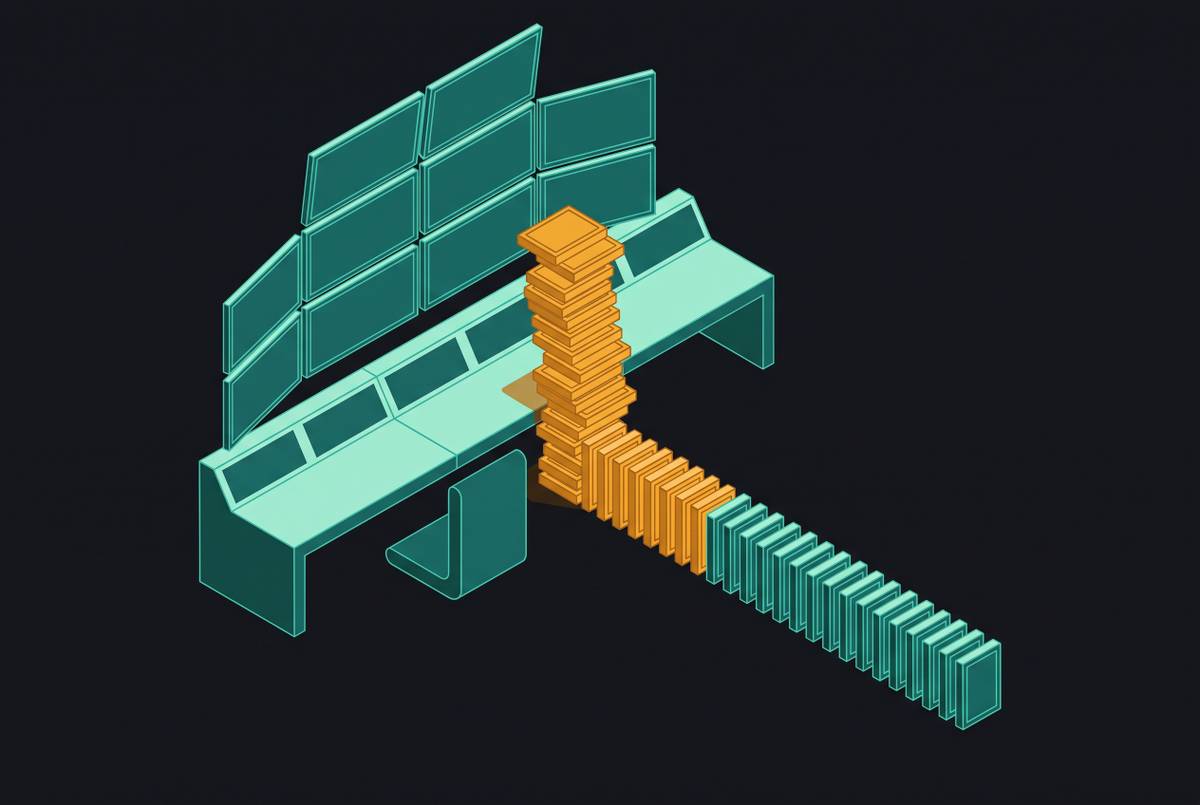
High false alarm rates delay human review of genuine threats by burying them in queues of noise.
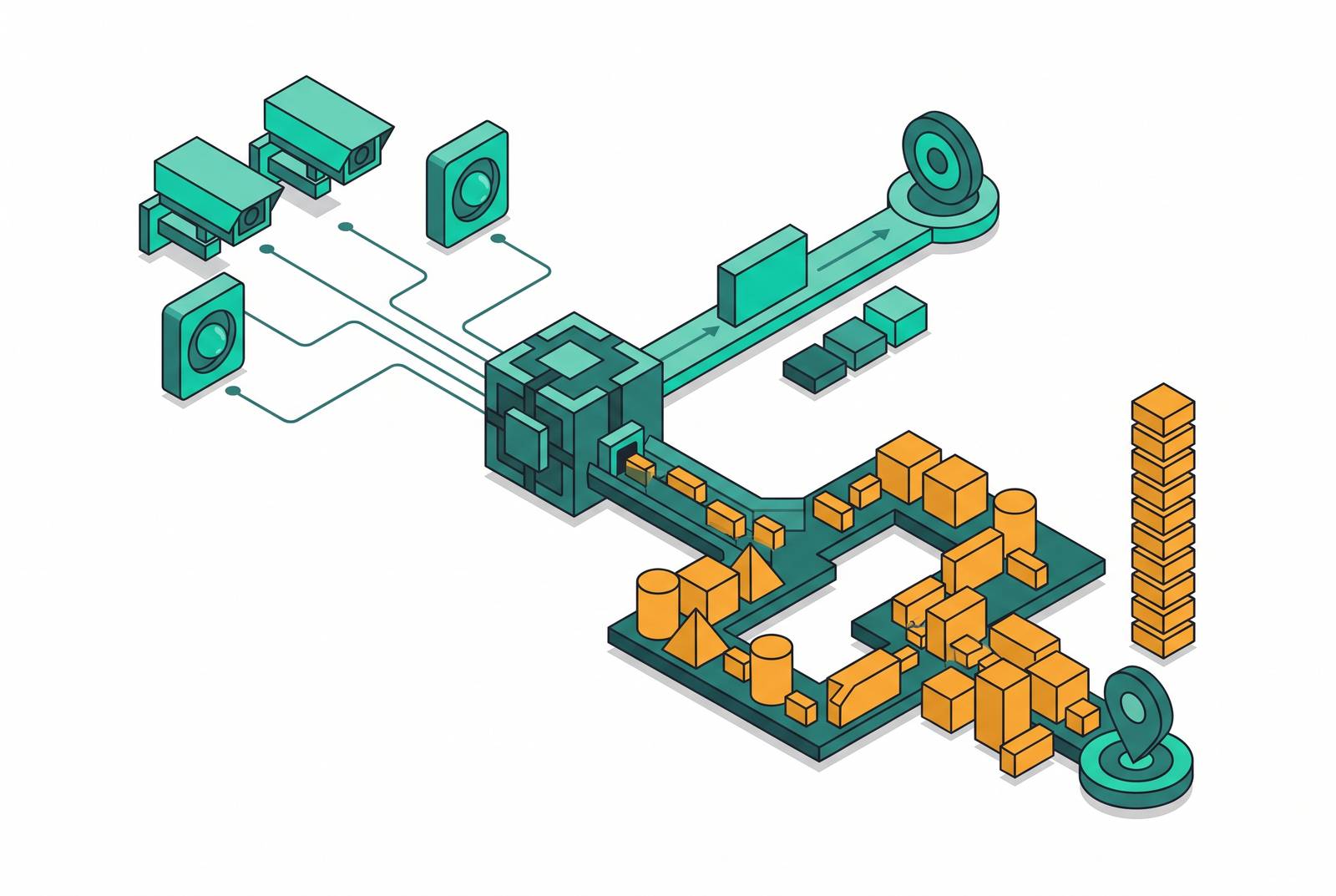
Picture a break-in in progress at 2 a.m., captured cleanly on camera, sitting in the same review queue as forty motion alerts triggered by a raccoon, a delivery truck, and a tree branch moving in the wind. That real event does not get pulled to the front of the line. It waits its turn, because the system generating the alert has no way to tell it apart from the noise around it until a person looks at it. The relevant number for any building owner evaluating a monitoring contract is how long a verified threat sits behind false signals before a human being actually sees it.
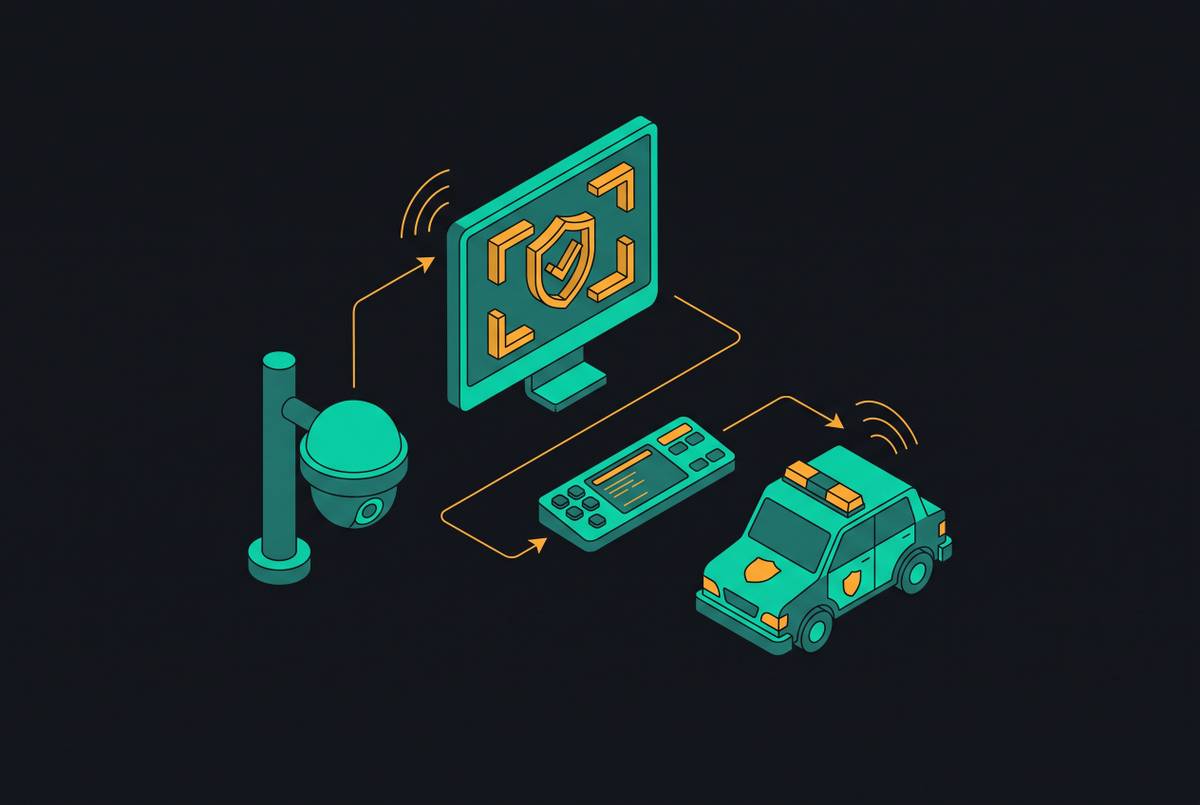
The traditional alarm model was built as a relay that passes signals along rather than filtering them. A sensor trips, the signal reaches a central station, an operator calls the premises, and if nobody answers, police get dispatched. That chain was never designed to tell a real intruder apart from a shadow, a gust of wind, or a cat. It just passes the noise along and lets whoever is next in line, the operator, the responding officer, absorb the cost of sorting it out. LAPD's own figures show that 97 percent of its alarm calls turn out to be false. That is not a flaw at the margins of the alarm monitoring business. It is close to the entire business. And because the ratio runs that high, the queue standing between a real threat and a human reviewer is made up almost entirely of noise. A genuine event does not jump that line. It inherits the same wait as everything ahead of it.
How alarm volume degrades operator attention
The damage does not stop at delay. A queue stacked with false alarms changes how carefully each one gets reviewed, including the one that turns out to be real. A peer-reviewed study of 42 working video monitoring operators, published in Applied Ergonomics, found that they caught only about half of the target behaviors they were tasked with spotting during a 90-minute review session. Visual attention breaks down well before a typical shift ends, and that decline is baked into how review work functions.
You see alarm fatigue the same way in other high-volume monitoring fields, like hospital ICUs, where monitor alarms can hit more than 350 per patient per day. After enough repeated false signals, people start responding slower, dismissing alerts without checking them, and treating a real event with the same skepticism they've built up toward the noise. That pattern reflects how human attention adapts: the brain downgrades the urgency of a signal that has cried wolf often enough, and no amount of operator coaching undoes that adjustment. For queue math, the consequence is direct. By the time a genuine threat reaches a human reviewer, that reviewer's capacity to catch it has already been worn down by everything they had to look at first.
The queue at operating scale in a real monitoring center
Scale turns this from a cognitive quirk into an arithmetic wall. Motion-based detection and basic rule triggers fire constantly, and a facility running dozens or hundreds of cameras multiplies that output into a queue that never stops growing. This is the default outcome of any detection system that produces more alerts than a person can realistically evaluate in the time available.
A common response to this problem is to say operators can simply be trained to prioritize, to learn which alerts matter and skim past the rest. That answer skips over what prioritization actually requires. It takes judgment, judgment takes sustained attention, and attention is exactly the resource the queue is burning through. No amount of training adds hours to a shift or restores focus that has already been spent sorting through hundreds of false triggers. The math doesn't change because the operator gets better at the job. It changes only when the volume reaching that operator changes.
Police department responses to chronic false alarm volume
Police departments sit at the end of this chain, and they have started refusing to keep absorbing the cost of it. Many facilities still structure their security around the assumption that a dispatch call reliably brings a response, and that assumption is weakening. U.S. police departments respond to tens of millions of alarm calls every year, and that volume consumes an estimated $1.8 billion in emergency response resources annually, as if tens of thousands of officers had no job but answering alarms that turn out to be nothing.
Salt Lake City adopted a verified response policy in 2000, the first major U.S. city to do so, requiring confirmation that an alarm reflects an actual event before police will respond, and its alarm-related dispatches dropped immediately and sharply. So verified response can work as a policy lever for a department trying to cut false alarm volume. It also shows how fragile that kind of policy can be politically: Dallas, San Jose, and Madison all later reversed their own verified response rules. Dallas and Madison backed off after pressure from businesses and homeowners who objected to the policy, while San Jose reversed mainly after a spike in burglaries made the policy harder to defend. For a facility that still depends on a traditional dispatch model, the practical risk is that the probability of nobody showing up when something real happens keeps climbing because the responder on the other end has been conditioned, by years of false alarms, to treat that signal as unreliable.
Monitoring SLAs and the gap between acknowledgment and actual threat response
The service-level agreements that monitoring vendors publish measure the fastest segment of the process, but they say nothing about the slowest one: the queue a real event has to clear before anyone official even starts the clock. Standard SLA language splits acknowledgment time, the moment the monitoring center logs an alert, from dispatch time and arrival time. So a vendor can advertise a fast response on paper even while a genuine threat sits unacknowledged in a review queue for a long stretch beforehand, and the SLA just doesn't count that stretch.
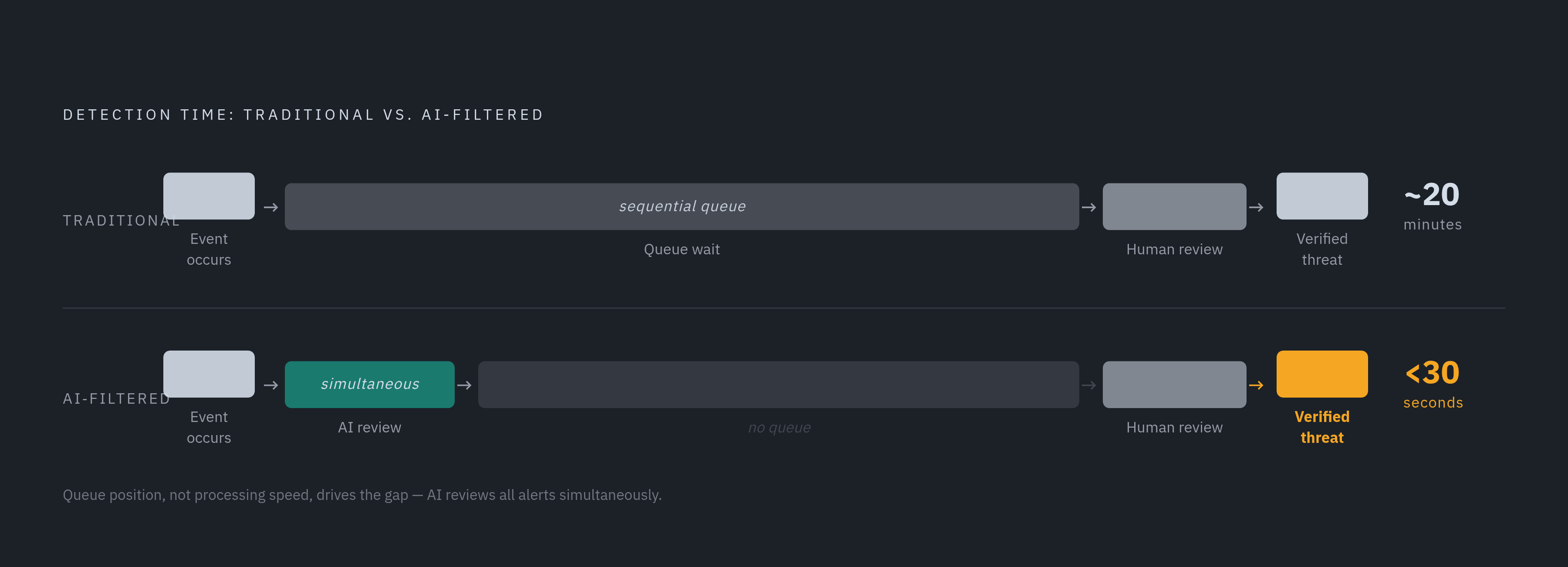
Before AI filtering became available, human operators scanning camera feeds took an average of 20 minutes to detect an incident. If an SLA starts timing at acknowledgment, it treats that entire 20-minute window as though it didn't happen. The acknowledgment-time benchmark that most buyers compare across vendors only describes what happens inside the monitoring center once an alert has already surfaced. It says nothing about how long a real threat waited in the queue to get there. Buyers evaluating a monitoring contract should ask for the time between when an event actually occurs and when a verified human reviews it. Those are two different clocks, and treating them as one is where the promised response time quietly falls apart.
How AI filtering changes the pre-dispatch timeline
Shortening the wait a real threat faces means keeping noise out of the queue in the first place, not processing the existing queue faster. Behavioral analysis looks at how something moves, whether it loiters, moves erratically, or accesses an area it shouldn't, instead of flagging every pixel that changes on screen. That's a difference in kind, not degree: one approach reasons about behavior, the other just reacts to motion.
An AI system built to process every alarm first and send only verified events to a human operator turns the queue from "everything every camera recorded" into "the handful of events someone actually needs to act on." A human reviewer's attention goes toward the second category instead of getting spent filtering the first one down to it. The measured effect is stark: an AI-powered system can flag a genuine incident in under 30 seconds, against the 20-minute average for a human reviewing feeds unaided. The gain isn't raw processing speed so much as queue position. An AI system reviews every alert at once rather than working through them one at a time the way a person has to.
Modern AI detection stacks cut the total number of alerts reaching a human substantially compared to rule-based motion detection, and that reduction is what separates an operator who trusts the system from one who has learned, correctly, to tune it out. Edge computing adds another piece: running the analysis directly on the camera instead of sending footage to a remote server for processing removes the round-trip delay that used to make real-time reasoning impractical, getting response time for urgent events down close to zero added latency. The standard objection, that AI systems generate their own false positives, is fair, but it misses where those false positives land in the process. An AI system's false positives get reviewed by a human before anyone dispatches police. A traditional system's false positives get dispatched first and sorted out by police afterward. The cost of being wrong sits in a structurally cheaper place in the AI-first model.
AI filtering and the need for site-specific context
An AI system with no knowledge of a specific site will recreate the same false-alarm problem it was supposed to fix. It flags routine, authorized activity as a threat, and operators learn to distrust it exactly the way they learned to distrust plain motion detection. Buying "an AI system" answers nothing on its own. What matters is what information about the property that system is actually working from.
A property running on defined schedules, with known personnel, set delivery windows, and regular vehicle routes generates plenty of activity that looks suspicious to a model with no context for what's normal there: a contractor arriving at 5 a.m., a truck idling in the yard, an employee propping open a door. A well-built verification chain uses site-specific inputs so that when a sensor trips, the system can check whether that activity, at that location, at that time, is expected, and escalate only what falls outside that pattern. Loitering detection shows the stakes clearly: a resident carrying trash to a dumpster is brief and purposeful, while someone pacing the same parking structure for several minutes is not, and telling those two apart requires knowing what residents actually do there and when. A generic model has no basis for making that call reliably. The configuration layer that makes this possible, schedules, authorized access lists, camera zones, and escalation contacts tied to specific people, is what turns raw detection into alarm triage that means something. Without it, the only way to control noise is to turn sensitivity down, and real threats start getting filtered out along with the false ones.
Faster verified threat response across commercial, multifamily, and industrial sites
Queue math costs the most where a 20-minute delay has consequences that can't be undone, and that describes most commercial, multifamily, and industrial properties, not an unusual subset of them.
In commercial retail and office settings, after-hours threats like theft, break-ins, and vandalism play out on a short clock. A 20-minute detection window often means the event is already finished by the time anyone responds. What these properties need is a documented chain running from detection to dispatch, with audit logs showing not just that an alarm was acknowledged, but that a specific event was verified and escalated, with a timestamp attached to each step.
Multifamily residential properties face a volume problem layered on top of the timing problem. Common areas, parking structures, lobbies, package rooms, perimeter walkways, generate continuous footage that adds up to more than a single operator can realistically review hour after hour. Research across surveillance work and air traffic control consistently finds that operators hold meaningful attention for roughly 15 to 30 minutes before fatigue starts cutting into detection accuracy. A property with cameras running all night cannot depend on sustained human attention as its main line of defense. Telling a resident taking out the trash apart from a stranger pacing the same spot for several minutes is precisely the kind of judgment call that needs site knowledge, not just a sensor that reacts to motion.
Industrial sites, logistics yards, and truck lots carry some of the highest stakes of all, and they often have minimal staff on-site overnight. Warehouses, equipment storage sites, and contractor yards are where a delay in the queue turns directly into stolen equipment, lost cargo, or site damage that nobody can reverse once it's happened. In all three settings, the common thread holds: the facilities that do best are the ones that stop treating "we have monitoring" as the finish line and start asking what happens, specifically, between the moment an event occurs and the moment a verified human being actually sees it.