AI Monitoring Accuracy Metrics Security Buyers Should Demand
Demand site-specific accuracy metrics, not vendor benchmarks, before installation.

An AI triage plus human response model for commercial video surveillance uses automated video analysis to filter alarms before routing verified threats to live operators for review and response. Security buyers should evaluate this setup through field-level measures of false escalations, detection, response speed, site knowledge, and availability. These operational metrics, rather than benchmark accuracy, show whether a retail or warehouse monitoring system can support reliable intervention.
Why benchmark accuracy numbers mislead security buyers before a camera is ever installed
Lab AUC and operational reliability answer different questions. The former describes performance under benchmark conditions, while the latter concerns whether a system recognizes threats on a particular site and gets them to someone who can act. A vendor can present strong laboratory results without establishing that its system will perform reliably on the buyer’s cameras. The gap begins before installation, when a benchmark result becomes a purchasing assumption.
Mohammadreza Rashidi’s Benchmark AUC Is Not Deployable Reliability found that off-the-shelf anomaly detectors performed above chance when trained and tested within the same surveillance dataset, but averaged essentially at chance across datasets. The audit used real surveillance footage and included no synthetic scenes. Its strongest tested backbone also had the largest cross-dataset decline, so even the more sophisticated model failed to cope with the change in setting. The failure concerned the representation of the scene.
That finding establishes why a laboratory result cannot stand in for evidence from a buyer’s location. Lighting, traffic patterns, and environmental conditions change between sites, and the benchmark does not establish how a service handles those differences. For buyers, the corrective is site-specific tuning backed by measurements taken where detection becomes an operational decision.
What false positive rate actually measures — and why the vendor's number and the operational number are rarely the same
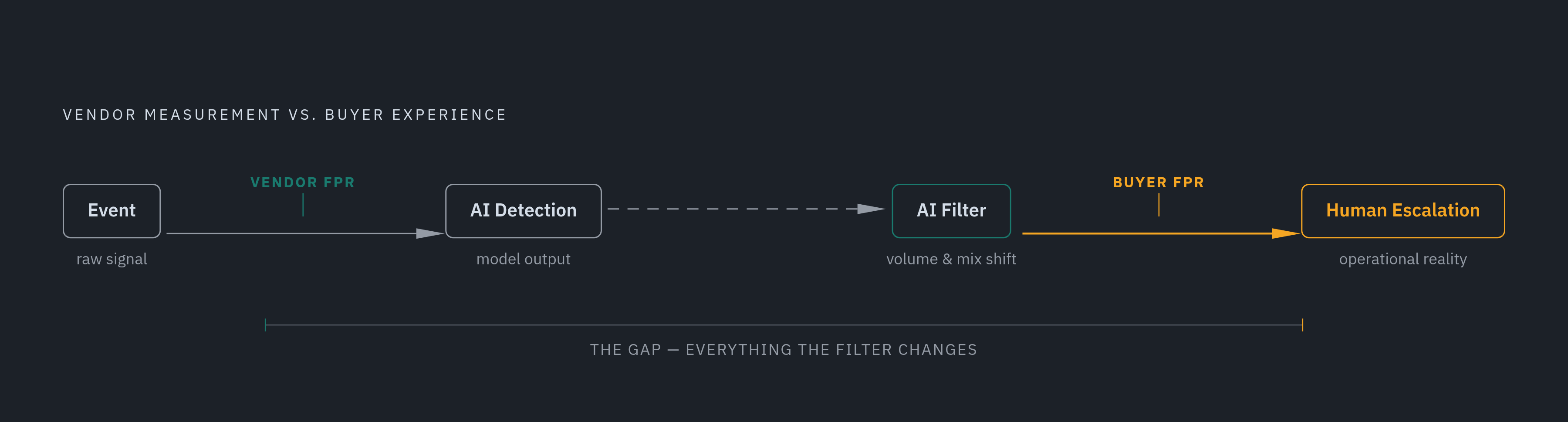
A false positive is activity classified as a threat when it is not one. For a security buyer, however, the crucial question is where that error is counted. A vendor may measure errors at raw detection output, while the buyer experiences them as unnecessary alarms sent to an operator. Those are different points in the workflow. Filtering between them can make the operator’s workload very different from the detector’s output.
The operational measure buyers should demand is the share of alarms escalated to a human that turn out to be non-threats. Its denominator is all human escalations. This definition makes the reported rate interpretable. Without it, two numbers labeled “false positive rate” can describe different populations and provide no useful basis for comparison.
An AI system that forwards a high volume of unverified detections reproduces the central weakness of traditional monitoring. Operators must sift through noise, and they make more mistakes as that work piles up. The audit found that even a favorable operating point for an off-the-shelf detector could produce a false-alarm volume beyond human triage capacity.
The contractual target should make non-threats a small minority of human escalations, rather than imposing an unsupported universal percentage. Buyers also need detection results beside that target, because low escalation volume does not by itself show that threats are being caught. The measurement boundary shows whether AI cuts out work that people need not review or creates another stream for them to check.
How do buyers know the system works on their site before deployment?
Footage chosen by the vendor cannot show buyers how the system will work on their site. Every new installation introduces cameras, lighting, activity patterns, and environmental noise that differ from the setting used to establish the original result. The cross-dataset audit makes this an acceptance issue. Buyers need evidence from the site they plan to protect before they accept an accuracy claim.
Wind-driven vegetation can generate movement that is unusual to a generic model but routine for a particular camera view. Animals can create the same mismatch between visual novelty and security significance. A system that has not learned the local baseline may repeatedly classify those events as suspicious, consuming the attention that monitoring is supposed to preserve.
A required site-acceptance period should measure false positive rate and detection rate against known events in the buyer’s own footage. The reference must be what actually happened there. A vendor-provided dataset cannot establish whether the service distinguishes that site’s harmless activity from its threats. Measuring both rates also exposes whether an apparent reduction in nuisance alarms comes with missed events.
The buyer’s questions should cover the calibration process, its duration, and the accuracy targets the vendor will commit to in writing after calibration. A willingness to undergo this test is useful evidence in its own right. For a service such as Verdun, site acceptance would test whether its AI-first filtering design works as intended at the buyer’s site. Architecture explains the approach, but field validation establishes its performance.
Mean time to verified escalation — the response-speed metric that separates filtering from queuing
Fast detection is not the same as fast escalation. A system can recognize an event quickly but leave it waiting behind unrelated alarms before it reaches an operator. Legacy monitoring’s structural weakness is that queue, where a real threat may wait 20 minutes or more after the event fires. Adding AI without removing unnecessary human review leaves that bottleneck intact.
Mean time to verified escalation should measure the interval from event trigger to escalation of a verified threat to a human operator. The endpoints must be explicit. AI verification before handoff and human review after handoff are separate steps, and a vendor should not describe the first as completion of the second. The operational purpose is to get a usable determination to someone who can act.
Verdun illustrates the filtering-first approach by having AI agents review every alarm and escalate only verified threats to human operators. How well that design works still needs to be measured, especially as the number of alarms rises.
Buyers should specify the mean across all alarm types and ask what happens during peak alarm volume. Results from times with few alarms do not show how the system works at peak load. If escalations slow sharply when alarms surge, the queue may still be there, at a different step in the system. The contract should make that behavior visible, including any slowdown concealed by an overall mean.
Detection rate by event type — why a single accuracy number hides the categories where systems actually fail
An aggregate detection rate combines categories that may have very different operational value. Strong performance on common events can obscure weak performance on the event a site most needs to catch. That creates false assurance.
Buyers should request detection rate and false positive rate separately for relevant categories, including perimeter crossing, loitering, vehicle intrusion, and person-down. Detection rate asks how many known events of a given type the system catches. The accompanying false positive measure shows how often its alarms in that category are wrong.
The appropriate categories depend on the property. The main threats at a truck yard are vehicle intrusion and cargo theft during off-hours, while a multifamily property has different concerns around loitering and access control. A retail site needs evidence relevant to after-hours break-in and organized retail crime. An average across unrelated categories cannot resolve those differences.
A vehicle entering a yard may be an intrusion or an authorized delivery, depending on the site’s rules and schedule. The visual event alone is insufficient. Per-event reporting links how well the system detects threats to its protocol coverage, because it needs to know what normal activity looks like in each category to classify an event correctly.
How site-specific protocol coverage determines whether an AI agent's decision is meaningful
Protocol coverage measures how completely the monitoring system knows the rules and conditions under which it must interpret activity. These include authorized activity, shift schedules, and the environmental baseline for each camera zone. Without that knowledge, a system cannot reliably distinguish permission from intrusion. Recognizing a person or vehicle is only the start of the decision.
Authorized activity makes the distinction concrete. Employees arriving early, delivery vehicles entering a yard, and scheduled maintenance can all generate events that a context-blind system treats as threats. The system must assess whether the movement conflicts with the site’s protocol, at that location and time.
This extends the earlier argument about site acceptance. Initial calibration adapts the system from a generic setting to a particular property, while ongoing protocol coverage keeps up with changes at that property. A system can perform well on day one and become less reliable as schedules or conditions evolve. Accuracy therefore requires ongoing maintenance.
Buyers should be able to document, for every camera zone, the authorized activity the system knows, the schedules it references, and the environmental conditions against which it has been calibrated. Completeness is the metric. They should also ask how schedule changes, new personnel, and seasonal shifts reach the system, and how quickly performance adjusts afterward. An answer limited to initial setup leaves the continuing validity of AI decisions unresolved.
Platform uptime and monitoring continuity — the availability metric most SLAs leave unspecified
Accuracy applies only while monitoring is functioning. A system may classify events well when available yet miss a threat because it is offline, degraded, or undergoing maintenance. Good results while the system was running do not show that it covered the whole time the buyer expected protection.
Most monitoring contracts leave the uptime commitment unspecified. Without an enforceable target, the buyer has no contractual basis for treating availability as a measured service property. The uptime commitment concerns whether the monitoring platform is operating when an event occurs.
Buyers should demand a platform uptime target expressed as a percentage of annual hours, with a defined measurement method and a consequence for falling below the threshold. Planned maintenance needs explicit treatment as well. The vendor should state what coverage remains during those windows and whether they are excluded from the calculation. Leaving those windows out changes how much coverage is guaranteed, even if the headline uptime figure stays the same.
What a monitoring SLA should actually contain — and how to evaluate a vendor's answer
A monitoring SLA should turn these measures into enforceable commitments. It should specify the false positive rate at human escalation, mean time to verified escalation, detection rate by relevant event type, protocol coverage scope, and platform uptime. Each needs a definition tied to the service the buyer receives. Without those definitions, contractual language can preserve the same ambiguity as a sales presentation.
The terms for escalation should state what counts as a non-threat and where timing starts and ends. They should cover all alarm types and make performance during volume peaks explicit. Detection commitments for each event type should cover the threats the property faces. Protocol provisions should document both what the system knows and how that knowledge is updated, while availability terms should state their measurement method and exclusions.
Site acceptance should precede the point at which contract terms lock. Its accuracy targets should be evaluated on the buyer’s footage against known events, giving the written commitments a field-level basis. For AI-first services, including Verdun, that evaluation links the proposed filtering architecture to observable results at the operator handoff.
The buyer does not need to become an AI expert. The job is to ask where each metric is measured, what conditions it covers, and whether the vendor will defend it in writing. A deflecting answer returns to benchmark statistics when the question concerns operational reliability.