Environmental Noise Filtering by AI in Commercial Video Feeds
AI filters routine motion before alerts overwhelm monitoring center operators.

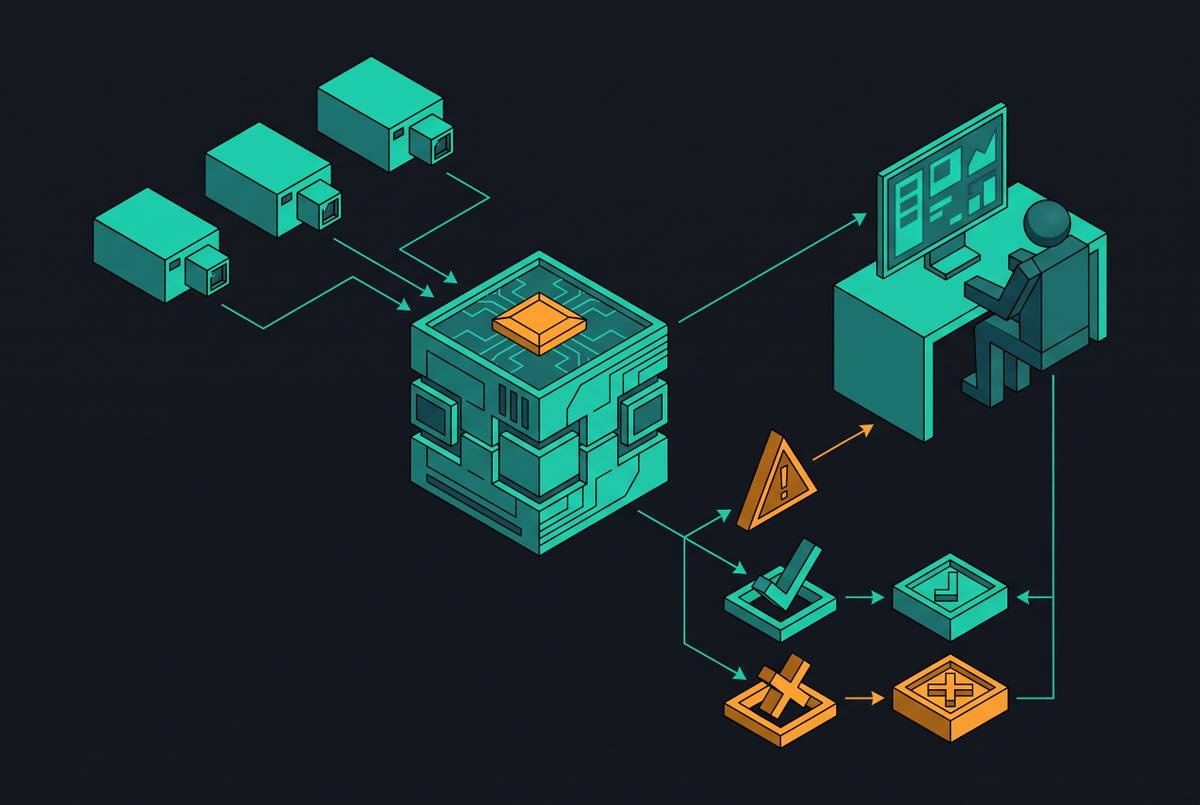
Environmental noise filtering by AI in commercial video feeds separates routine movement and authorized activity from possible intrusions before alerts reach live operators. The model works by combining automated video analysis, site-specific protocols, and human verification. For retail, warehouse, and other commercial surveillance systems, that division of labor keeps environmental alarms from delaying the events that require human judgment and response.
Why commercial video feeds generate so many alarms that are not threats
Traditional motion-based sensors detect changes, but they cannot tell what the intent, context, or object class is. In a commercial environment, those limits matter because movement is a normal condition. HVAC airflow, shifting light conditions, insects, animals, and moving vegetation can all generate alarms without any security threat. Headlights, work by contractors, and power fluctuations also set off legacy sensors as though they were security events. So the vast majority of commercial alarms come from environmental conditions and everyday activity, while intrusions account for very few.
The problem begins with what the sensor is designed to recognize. A trigger establishes that something changed, but it leaves the cause and the need for intervention unresolved. A lighting shift and a genuine intrusion can consequently enter the monitoring center as alarms requiring the same initial attention. Their security significance is very different, yet that difference has not been resolved before they reach the operator. The system passes the work of interpretation downstream because its detection layer cannot perform it.
Contractors may have work they are allowed to do, vehicles may be expected, and moving air may shift objects in the camera’s view. When each trigger is treated as a possible threat, the monitoring process has to sort normal work from intrusion after detection has already taken place. The mismatch is between sensors built to detect movement and environments that require an explanation of what moved and why it matters.
How the noise backlog becomes a queue failure at the monitoring center
Once those alarms reach a monitoring center, the limiting factor becomes the rate at which operators can assess them. Human assessment alone has a ceiling on how many events it can clear in a given period. When environmental alarms arrive faster than operators can review them, the backlog grows. A genuine intrusion then waits behind events that have no security significance. The delay comes not from the difficulty of that intrusion alone, but from the accumulated work ahead of it.
This is more serious than time spent dismissing nuisance alerts. If the queue never reaches a threat, that event may never be escalated. Adding operators raises the processing ceiling, but it leaves the incoming ratio of noise to signal unchanged. The architectural distinction is whether routine alarms must consume human attention before the system can dismiss them.
Verdun addresses that queue problem by deploying AI agents to review and filter every alarm before it reaches a human operator. Its model separates environmental noise and authorized activity from events needing response, so genuine threats do not have to wait behind routine triggers. The relevant change is the placement of assessment before the human queue, rather than an increase in the number of people clearing it. Filtering at that point changes the workload arriving at the monitoring center.
Verification also matters beyond the center itself. When public safety agencies receive large volumes of unverified calls that are overwhelmingly false, they deprioritize those calls. An unverified alarm can therefore enter a lower-priority dispatch queue than a verified event. Noise removal gets the events that matter to operators, while verification gives responders the evidence they need to act.
How does AI filter commercial video alerts before routing them to live operators
Modern AI filtering begins by identifying what moved rather than forwarding every movement as a security event. Object classification distinguishes people and vehicles from animals, insects, vegetation, and shadows. That first layer removes an important limitation of motion-based detection, but a class label is not a threat assessment. A person can be authorized, and a vehicle can be expected. The filtering decision therefore requires more than recognition of the object.
The next layer evaluates the movement in context. Relevant features include where the object appears in the frame, its direction of travel, and whether its movement matches a recognized non-threat pattern. HVAC-driven debris, headlights sweeping across a wall, and a flag moving in wind show why the cause matters. Each produces visible change, but its pattern can support an environmental explanation. The system uses that analysis to decide whether to filter the event or escalate it before a human sees the alert.
Hanwha Vision's 2026 trend report describes a shift from AI systems that automate object search, tracking, and alarm generation to AI Agents that conduct complex situational analysis. These agents can automatically execute an initial response and recommend follow-up actions to the monitoring operator. The distinction is between identifying an event and reasoning about its significance sufficiently to support a next step. In services such as Verdun, this analytical layer is paired with trained human operators who handle edge cases and ambiguous situations that generic classification cannot resolve.
That reasoning remains dependent on the video supplied to it. Filtering accuracy reflects both the analytical model and the quality of the images it receives. Better software alone is therefore only a partial solution when upstream image quality is ignored. The model needs images it can use to tell an environmental pattern from activity that needs attention. Analytical capability and image quality are complementary requirements.
Why generic AI filtering fails without site-specific context
Even a clear image and an accurate classification cannot establish whether activity is authorized at a particular property. A generic model may recognize a contractor vehicle correctly and still flag its arrival as suspicious. If contractors work nights at that site, an after-hours pattern may be entirely normal. Employees entering before a scheduled alarm window ends create the same problem. The missing information is not the object’s identity as a person or vehicle, but the relationship between that activity and the site’s operating rules.
Construction sites make that dependence especially clear. They are frequently active in low-light conditions and exposed to changing weather, which makes traditional motion analytics difficult to use effectively. AI-assisted monitoring can help operators distinguish unauthorized after-hours activity from environmental movement. However, that distinction depends on a definition of after hours that applies to the actual site. A general expectation about commercial schedules cannot establish whether work is permitted there at that time.
Without that reference, a pattern the system has not seen before gives it another reason to escalate. The system may filter out alarms caused by vegetation and shadows while raising alerts for work that is allowed but that it does not understand. Queue pressure then shifts from environmental noise to AI-generated uncertainty. Site-specific context is a technical requirement for implementing AI classification because recognizing activity and deciding its disposition are separate tasks.
Automatic learning does not eliminate the need for that distinction. Passive learning can pick up site patterns over time, but false alarms keep coming during the calibration period. On high-activity sites, that period can be long enough to undermine operator trust in the system. Learning what commonly happens is useful, but it does not remove the immediate need to know what activity is authorized. Site context gives the filter rules to work from, so a person has fewer unfamiliar events to sort out.
How site-specific protocols convert context into filtering decisions
Site-specific protocols use what is known about a property to help decide which alarms need attention. They draw on set schedules, lists of authorized personnel, known vehicle registrations, and rules for who can enter each zone and when. Together, these establish what normal activity means for the property. The classifier identifies what is happening, while the protocol establishes whether it fits the permitted conditions. That connection is what allows the system to move from a general description to a meaningful disposition.
A scheduled delivery illustrates the difference. If a vehicle is on the authorized list and arrives during its scheduled delivery window, the system can suppress the alarm without operator review. If the same vehicle arrives outside that window, it escalates. The object class has not changed, but the event’s relationship to the protocol has.
This structure also defines the boundary of automation. When an event cannot be resolved against the available context, escalation remains appropriate. Without protocols, however, even a strong classifier must send ambiguous events onward because it lacks a basis for dismissing them. That recreates overload at a higher classification tier, with operators reviewing recognized objects. Protocol-driven filtering cuts that needless work while leaving people to review events the system is still unsure about.
At Verdun, the site-specific reference is supported by human operators who understand each property’s nuances and can calibrate what its AI triage should escalate. Its AI agents use that context to filter out authorized activity and environmental noise before events reach operators. The schedule, access rules, and facility protocols supply the meaning that a general-purpose model cannot derive from object class alone. Reliable filtering depends on both recognizing the event and knowing the conditions under which it is acceptable.
What the operator's role becomes once AI has handled the noise
With environmental noise and authorized activity filtered upstream, the operator’s task shifts from volume management to judgment. The incoming workload consists of genuinely uncertain situations and threats requiring a response. Operators assess those events, decide on response paths, and provide law enforcement with verified, actionable information. People are still needed to make decisions that routine classification and site rules cannot settle. The system changes what reaches the person.
Hanwha Vision's 2026 trend report describes monitoring operators transitioning into commanders who make final decisions requiring nuanced judgment and complex analysis. That role includes consideration of legal and contextual implications. It also includes AI governance responsibilities, with operators tracking and supervising autonomous actions. The human role covers both the difficult event and the actions taken by the automated layer.
Faster response follows from this division of work in a specific way. The operator sees an event after environmental filtering and comparison with site context have established that human judgment is needed. Speed is consequently more than a shorter wait for someone to open an alarm. It also reflects the removal of routine interpretation from the operator’s immediate workload. Attention begins with deciding whether an event is a threat, with another HVAC draft or scheduled delivery already filtered out.
The resulting model has complementary layers. AI provides continuous, scalable attention across cameras and alarms, while human operators supply contextual judgment, legal authority, and interpersonal communication. For the commercial security buyer, this means fewer false dispatches, faster verified response, and operators who spend their time on events that matter, with environmental noise already filtered out.