Overage Billing Structures in Traditional Monitoring Contracts
Variable alarm volume creates a billing problem providers transfer to buyers through long contracts.

Overage billing in traditional monitoring contracts is the predictable output of selling a fixed-price service against a signal load that is inherently variable, and the gap between the two always lands on the buyer's invoice.
Turning Variable Alarm Volume Into a Billing Problem
Flat-rate monitoring contracts price a kind of stability that alarm activity never actually exhibits. Flat-rate pricing works when consumption is predictable, the way a water bill or a phone plan can be forecast within a narrow band month to month. Alarm volume does not behave that way. Power restorations after an outage, a storm front moving through a region, a seasonal shift in foot traffic around a commercial site: any of these can spike inbound signals well past what a monthly allowance was built to absorb.
Compounding the problem is the composition of the signals themselves. The overwhelming majority of activations that reach a monitoring center are false, so the baseline load a contract has to cover is many times larger than the genuine-threat volume a buyer imagines they are paying to insure against. A contract that looks reasonably priced against "real" alarms is actually priced against a mountain of noise the buyer never sees broken out. The provider builds its pricing around that number, a statistical average drawn from its own portfolio data. The buyer has no way to audit it before signing, and no way to know whether their specific site will track above or below it once the contract starts.
What a monitoring contract's base rate covers
The monthly base rate on a commercial monitoring contract covers a defined scope of service, and that scope is narrower than most buyers assume when they sign. Commercial contracts typically bundle several distinct cost categories together: monitoring plan level, contract length, equipment inclusions, and add-ons such as cellular backup or police dispatch. All of it gets compressed into a single advertised number, and that compression is what makes it hard to see how each piece is actually metered.
The exclusions matter more than the inclusions, because that is where overage exposure lives. You bought monitoring to handle a legitimate alarm event, but that exact kind of incident can generate a separate invoice line nobody flagged during the sales conversation. The base rate quietly assumes a certain volume of events, so anything past that threshold shifts into per-event or per-dispatch territory that the glossy pricing sheet never previewed.
Contract length widens this exposure. A commitment running three years or longer locks the buyer into a usage allowance calculated at the moment of signing, with no built-in mechanism to adjust as the buyer's camera footprint expands or their site's activity level changes. A business that adds cameras, extends operating hours, or simply grows its footprint over that three-year term is stuck with an allowance sized for a version of the business that no longer exists.
Converting Usage Risk From the Provider's Problem Into the Buyer's
Overage billing functions as a risk-transfer mechanism, and understanding it that way, rather than as sloppy drafting or an accident of complexity, explains why it persists across the industry. The provider keeps the revenue upside of a long-term contract while pushing the cost of unpredictable demand onto the client who has the least information about what that demand will look like.
Contract length itself is a financial asset for the provider in a way it is not for the buyer. When monitoring companies get bought and sold, long remaining terms support acquisition premiums and more favorable valuation multiples, so providers have a structural incentive to lock in commitments well beyond the period needed to deliver good service. Meanwhile the buyer signs those same long terms before they know what their site's actual alarm behavior will be.
Base rates get obscured through several tactics working in combination: monitoring fees folded into bundled package prices, automation or video add-ons made effectively mandatory, and pricing structured in layers that resist simple line-by-line decomposition. Infrastructure shifts add another layer of cost transfer. Providers are moving away from traditional copper landlines, and that shift generates conversion costs they routinely pass downstream, either as new add-on charges or as the occasion for a contract renegotiation that resets the billing baseline in their favor.
The common response to all of this, that buyers can simply negotiate better terms, holds up poorly in practice. A buyer signs before they have any usage data of their own. The provider, by contrast, holds years of portfolio-level data on what alarm volumes look like for sites of a given type, size, and industry. That asymmetry, not bad faith on either side, is what makes negotiation at signing a weak corrective.
Inside the Monitoring Center When Alarm Volume Exceeds Operator Capacity
This is where the structural mismatch becomes a measurable difference in how fast a real threat gets a human response. Incoming alerts feed into queue management software that is built to prioritize by severity and protocol. Industry tools illustrate how this works in practice: Micro Key Solutions' Millennium Monitoring platform runs a color-coded, priority-filtered queue that sorts events in milliseconds, while AvantGuard's Storm Queue recognizes repeat signals coming from a single area during a mass-signal event and pushes those customers needing immediate assistance higher in line. The logic is sound. The problem is capacity. When multiple signals arrive simultaneously, during a power restoration, a severe storm, or any coordinated event across a service territory, lower-priority signals wait behind higher-priority ones, sometimes for an extended stretch.
The industry's own language gives this away. Monitoring companies often qualify their service claims with a phrase like "quality monitoring center," and that qualifier is doing real work: it exists specifically to exclude the centers that cannot hold staffing ratios steady during high-volume periods. If a center cannot maintain its ratio when volume spikes, it cannot maintain its response times either, and buyers rarely learn which category their provider falls into until a high-volume event actually happens.
Operator fatigue adds a second failure mode on top of pure queue math. A continuous stream of low-information alerts across a single shift wears down the attention a human operator can give to any one signal, the predictable endpoint of asking a person to process thousands of mostly-noise signals in a row. Some monitoring platforms have responded by automating low-priority signals out of the queue. Security Systems News has reported that Micro Key Solutions' SMS module routes low-priority signals directly to the end user by text message instead of sending them into a queue for operator review, but this is a workload-reduction feature, not a documented fix for queue saturation specifically. No source documents a monitoring fee reduction that accompanies this practice.
That last point is the one buyers should sit with longest. A site can be billed for crossing into overage territory at the exact moment its monitoring center's actual response to that site has degraded to an automated text message. The buyer pays more precisely when they are receiving less.
Why Overage Fees Do Not Fix the Queue
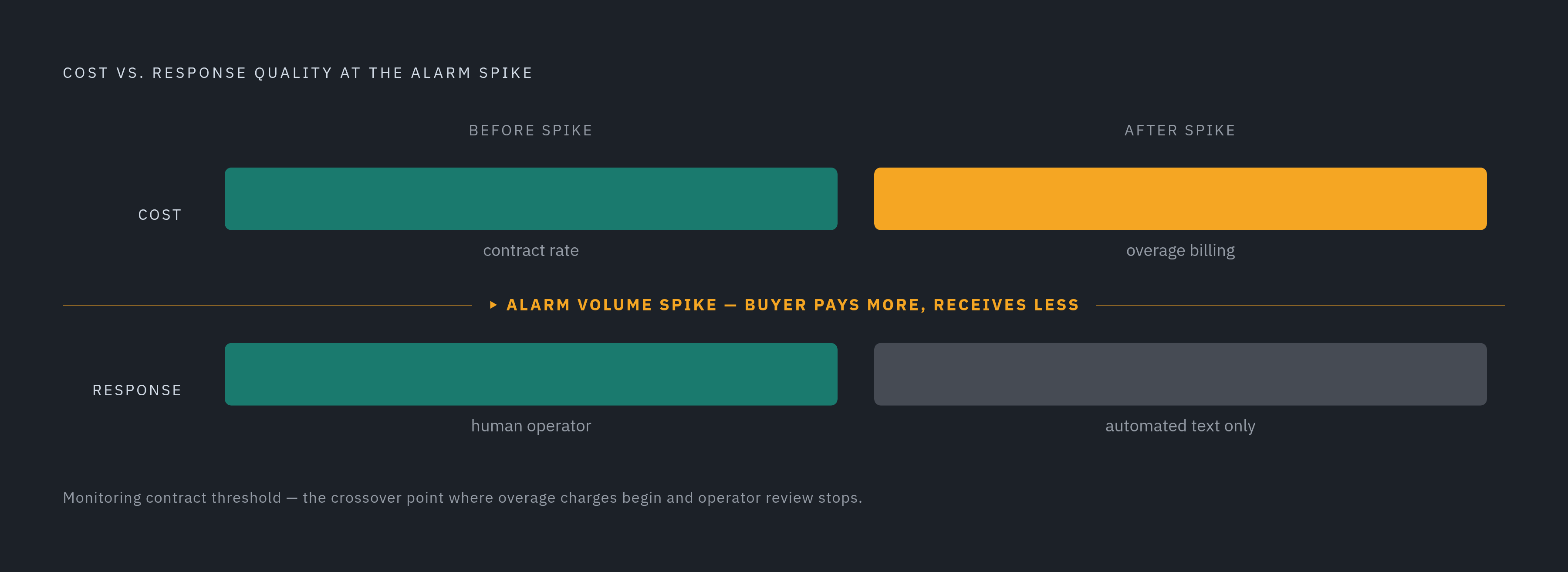
Overage fees recover revenue the provider loses to excess processing load. They do not add operators, shorten the queue, or speed up how quickly a verified threat reaches a trained human being. The queue runs on two inputs: available operator headcount and prioritization logic. Neither one changes when a billing meter ticks over into overage territory. Paying more does not move a buyer's site to the front of any line, because the overage fee and the queue position are calculated by entirely separate systems that were never designed to talk to each other.
A common counterargument holds that buyers can simply avoid overages by reducing their own alarm activity, muting noisy cameras or raising detection thresholds until volume falls back under the allowance. That response misses what it actually trades away. Lowering alarm sensitivity to control cost does not fix the underlying architecture; it shrinks the scope of what is being monitored. A camera muted to avoid triggering billable events is a camera that has effectively stopped contributing to the security posture the buyer is paying for. The blind spot created this way is the buyer's own choice, but it is a choice forced by a billing structure that never gave them a better option.
That is the real limit of overage billing as a model. It is a cost-recovery layer sitting on top of an architecture that was never built to flex with demand. Charging more for the same delayed, degraded response is not a correction, and no clause buried in a renewal agreement changes that math. The question that matters next is what a monitoring architecture would need to look like to avoid creating this bottleneck.
What buyers should audit when evaluating a monitoring contract
A buyer who understands the structural problem can evaluate any monitoring contract against a sharper question than "what is the monthly rate." The more useful question is what happens to a site specifically when the monitoring center itself is at capacity, because that is the condition under which overage billing and degraded response arrive together.
What volume triggers per-event or per-dispatch billing above the baseline alarm allowance, and how was that baseline calculated. Just as important is the provider's explicit policy for what happens when inbound signal volume exceeds operator capacity, including which alarm categories get automatically downgraded to a keyholder text message and what threshold triggers that downgrade. A contract's definition of response time also needs scrutiny on its own terms: whether the service level agreement measures time to acknowledgment, time to verification, or time to dispatch, and whether that commitment holds during peak-volume periods or only under average conditions, since an SLA that quietly only applies to calm days is not protecting the buyer when protection matters most. Site-specific protocol coverage belongs on the list too: what the operator is actually permitted to do, in what sequence, for that particular site, and whether that protocol is available for review before a signature goes on the contract. What gets kept for each alarm event, and whether the monthly reporting distinguishes alarms that were automated away from alarms an operator actually reviewed, is another item worth confirming directly. Finally, the cancellation and renegotiation terms matter as much as the headline rate: what notice period is required, and whether the contract auto-renews into another fixed term without the buyer's active consent.
Best practice calls for asking the provider to demonstrate each of these metrics directly. A buyer should be able to see how the system records a given trigger, who receives the resulting alert, how the response timer is actually calculated, and what evidence the system retains afterward. One larger question underlies all of these individual ones, produced by the same capacity limits: whether the monitoring architecture can scale to verify alarms without queuing them. No contract clause fixes a center that is structurally unable to keep pace with its own alarm volume, no matter how the billing is worded.
The alarm signal universe is overwhelmingly noise because most traditional monitoring centers lack an efficient way to filter it before a human ever looks at it, and that gap is precisely what an AI-augmented model is built to close. In that architecture, AI agents review every alarm first, dismiss environmental noise and authorized activity on their own, and escalate only verified threats to a human operator. The operator ends up handling fewer signals, but each one carries far higher confidence, and routine false positives stop generating the overage exposure that drives traditional billing. Verdun is built around this separation of AI-driven filtering from human operator response, and that removes the queue bottleneck that makes overage billing close to inevitable under the older model. Its approach puts AI agents in front of every incoming alarm, continuously and at whatever scale the site's camera footprint requires, so a verified threat reaches a trained operator without waiting behind a backlog of routine activations, and the billing reflects what the system actually delivered, not a flat-rate average that quietly erodes once load exceeds what the center was ever staffed to handle.