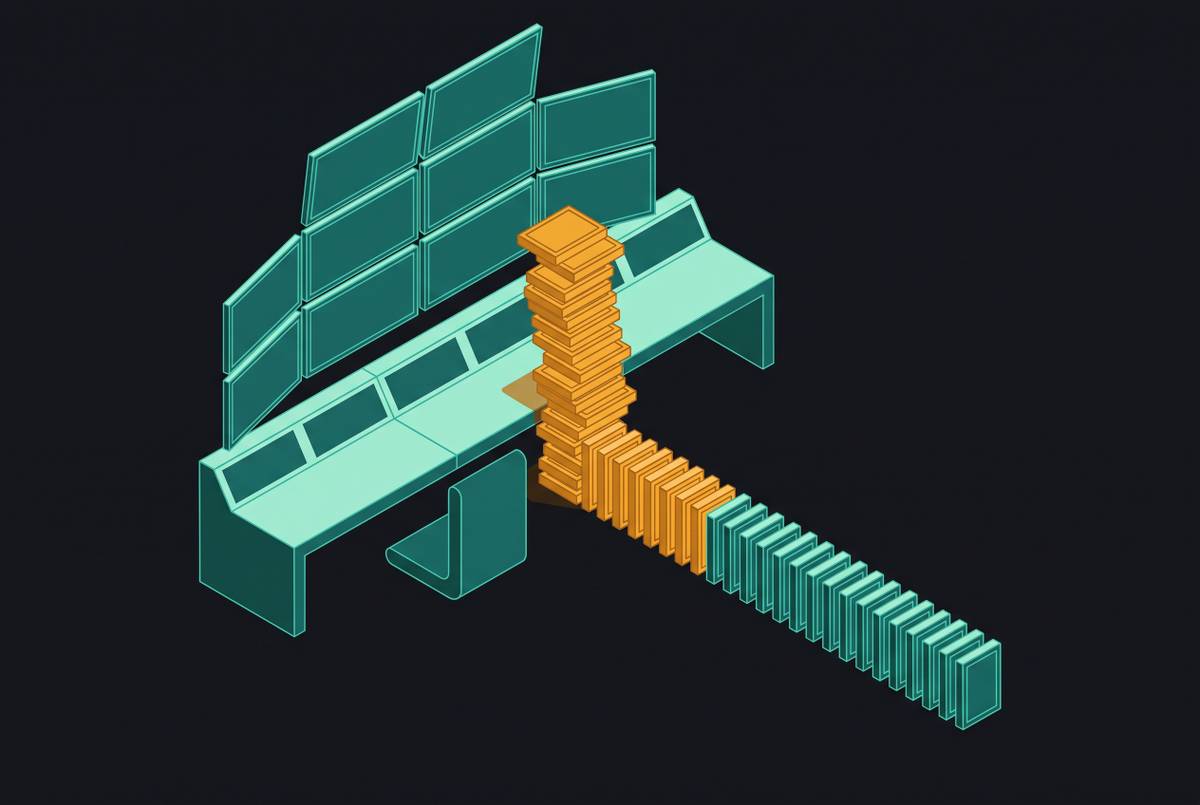
Monitoring Center Staffing Ratios and Peak-Hour Coverage Gaps
Staffing ratios hide queue depth problems that worsen exactly when burglaries spike.
Muting a noisy camera reduces false alarms by removing the coverage that camera was providing. The camera generating repeated environmental triggers, wind on a tree line, a shadow crossing a loading dock at dusk, is often the same camera watching the exact approach path an intruder would use, and turning off its alerts does not turn off the risk sitting behind it. Alert fatigue causes real missed alerts, but silencing notifications trades a queue problem for a blind spot, and the two are not equivalent costs. The only way to reduce false alarm volume without losing coverage is to filter what reaches a human before it ever triggers a notification, not to stop watching the camera that keeps talking.
Why Staffing Ratios Stop Working
A buyer evaluating a monitoring service asks a familiar question: how many operators do you staff per shift, and how many accounts or cameras does each one cover? The vendor answers with a number, the number sounds reasonable next to competitors, and the buyer moves on to pricing. That exchange feels like due diligence, but the ratio it produces just describes headcount against accounts at a single moment, and it says nothing about what happens when alarm volume spikes and every operator's queue fills at once. A ratio is a snapshot of capacity under the assumption that demand arrives evenly. Monitoring demand does not arrive evenly.
The question itself is the wrong one to ask, because the number of operators on duty does not determine whether any single alarm gets reviewed promptly. What determines that is the depth of the queue sitting in front of it at the moment it arrives. Two monitoring centers can report identical staffing ratios and produce wildly different outcomes, because one has a shallow queue most of the time and the other has a queue that routinely backs up for twenty minutes during the exact hours burglaries happen.
The ratio persists as a buyer metric because it maps onto staffing logic borrowed from other service industries: nurses per patient, agents per caller, teachers per classroom. Monitoring centers share none of that structure. Every alarm, whether it is a genuine break-in or a cat tripping a motion sensor, enters the same sequential queue and waits its turn behind whatever arrived first. Remote monitoring services like Verdun address that structural mismatch directly, filtering alarms through AI agents before they ever reach a human operator, which changes what the ratio measures in the first place: queue depth becomes a function of how many false positives were already removed upstream, not of raw headcount against raw camera count.
How a monitoring center's queue architecture works at baseline
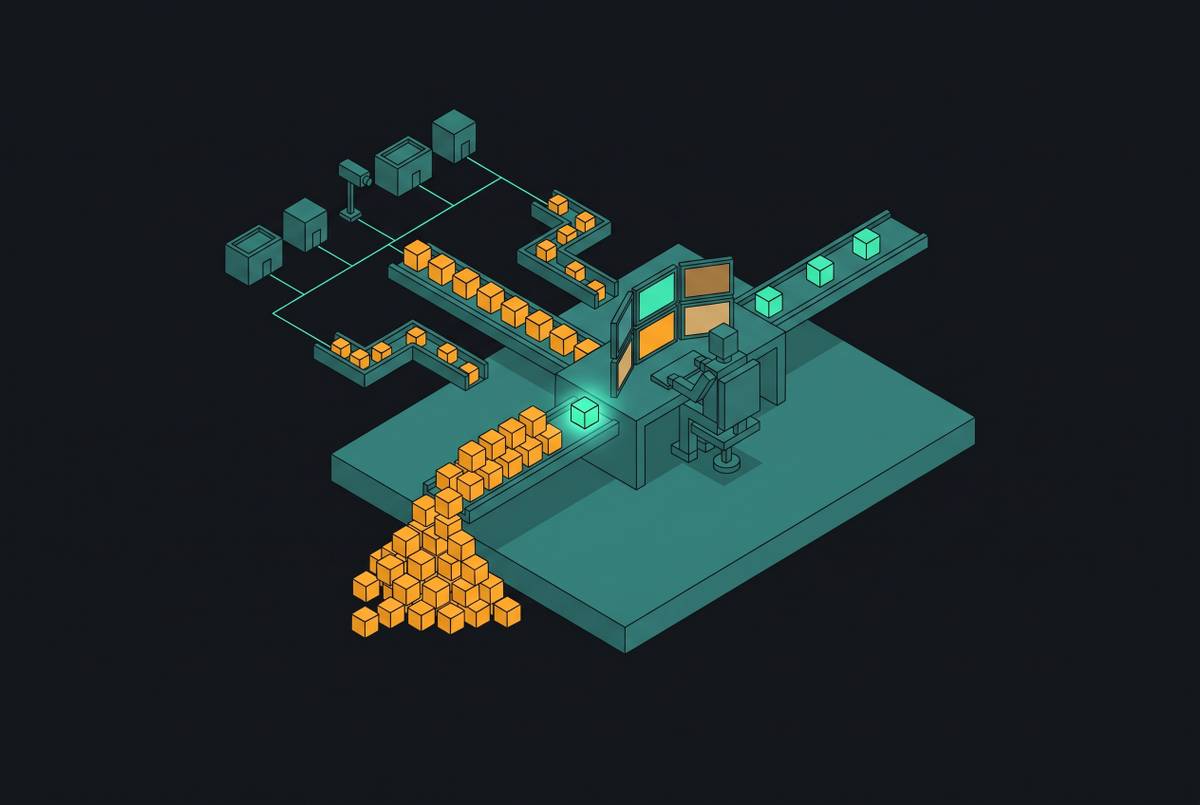
A monitoring center's queue works on a simple principle: every alarm that arrives joins a line and waits for the next available operator, regardless of what triggered it. Panic buttons and holdup signals typically get priority sorting ahead of the line, but a routine burglar zone trip, the kind that makes up most of the traffic, enters in arrival order like everything else.
When an operator picks up an alarm, the screen shows the zone that tripped, the time, the call list for that account, any special handling instructions, and the passcode needed to confirm identity on a callback. The operator works through that information in sequence, one alarm at a time, not several in parallel. That sequencing reflects a deliberate design choice. Legacy monitoring was built around the idea that one human reviews one alarm at a time, because having multiple people review the same event simultaneously wastes the one resource the system cannot manufacture on demand: trained attention.
When volume is normal and staffing is adequate, this architecture works well enough that nobody notices its limits. The staffing ratio looks fine because the system is operating well within its throughput ceiling. The vulnerability in this design is invisible precisely because it only activates once volume exceeds what operators can process in real time, and once that threshold is crossed, queue depth grows faster than any fixed number of operators can drain it.
Operator attention under high camera counts
Even before a queue backs up, the amount of camera footage assigned to a single operator affects how much of it actually gets watched with meaningful attention. One effect works against the other. The exact threshold varies by operation, but the direction is consistent: attention is a depleting resource, not a fixed one.
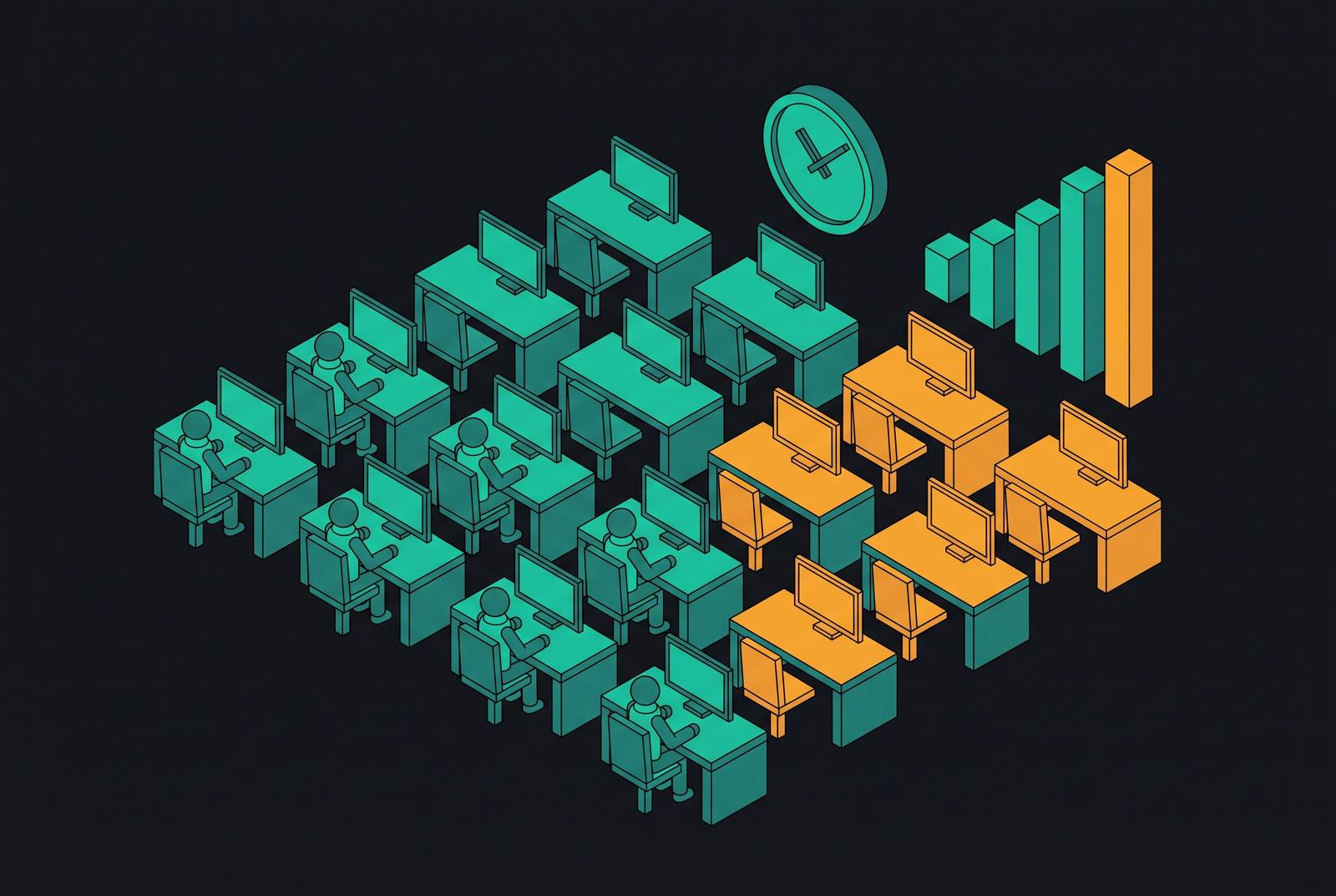
When camera counts per operator get higher, coverage shifts from continuous to probabilistic. An operator assigned more feeds than attention allows is not failing at the job, they are working inside a design that assumes partial coverage is acceptable because most feeds, most of the time, show nothing worth flagging. That assumption holds until the moment it doesn't.
The practical consequence is that a monitoring center can report a staffing ratio that sounds responsible on paper while its operators are, at any given moment, meaningfully attending to only a fraction of their assigned feeds. The ratio measures assignment. It does not measure attention.
False alarms as the engine of queue collapse
False alarms are frequently described as a quality-of-life annoyance, something to tolerate alongside the real work of monitoring. That framing understates their function. False alarms are what fills the queue to the point that genuine threats wait behind them. The overwhelming majority of alarm activations reaching monitoring centers and prompting dispatch requests are not threats at all, and each one consumes the same operator time as a genuine emergency would: the same call list, the same verification steps, the same minutes on the clock.
Commercial properties generate false alarms at higher rates than residential ones. An out-of-date call list is the clearest example: an operator dials a contact who left the company two years ago and cannot help, burns several minutes confirming that, and moves to the next name while the queue behind that alarm keeps growing. This is among the most common account-level failures monitoring centers encounter, and it compounds with volume.
The municipal consequences of this dynamic are no longer contained inside individual monitoring centers. A growing number of jurisdictions have adopted verified response policies because unverified alarm volume was consuming police resources disproportionate to the threats it represented. Pittsburgh's experience illustrates the scale of the problem: alarm calls generated in 2023 produced only a small fraction of actual police reports relative to the volume of calls, while consuming thousands of officer staff hours in the process. The same dynamic that strains monitoring center queues internally is straining municipal dispatch systems at the same time, for the same reason.
How peak-hour alarm volume breaks the ratio entirely
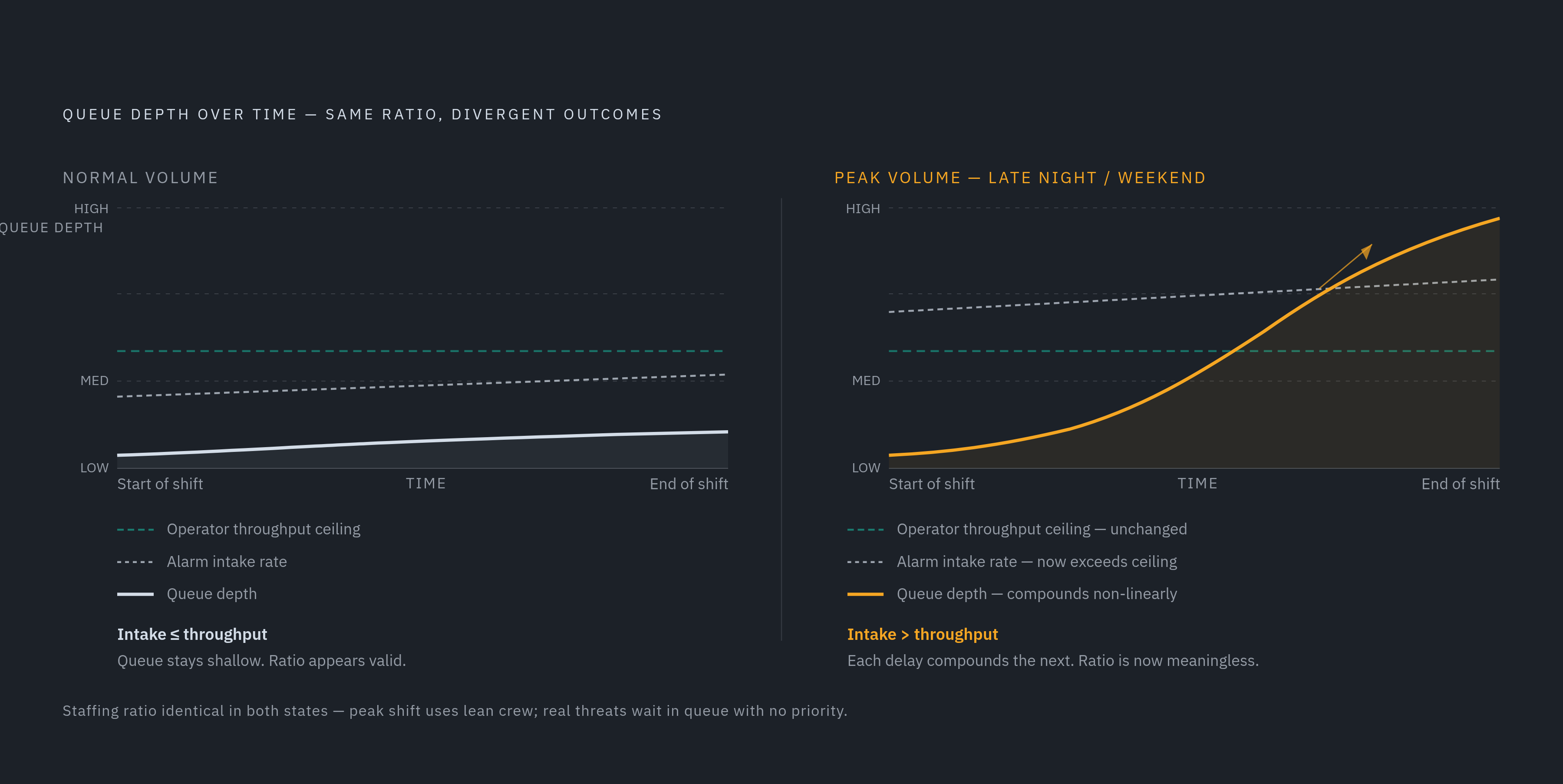
The staffing ratio stops functioning as a useful measure at the exact hours it matters most. Peak alarm hours, late night, early morning, weekends, holidays, are when alarm volume is highest: after-hours activity increases, environmental triggers spike, and system malfunctions cluster around the same windows. Monitoring centers run their leanest shifts during those same hours because off-peak staffing is built around expected average demand, not the demand that actually shows up.
Picture a queue as a line at a single checkout counter. Monitoring queues behave the same way. When alarm intake outpaces operator throughput, wait times do not rise in a straight line, they compound: each alarm that takes longer than average to resolve delays every alarm behind it, and the backlog grows faster the longer the imbalance lasts.
A real threat arriving during that window gets no special treatment by virtue of being real. Strip that filtering layer out: the same ratio then produces an unworkable queue.
How verified response policies expose the queue problem
Milwaukee formalized its own verified response policy through a General Order in 2025.
So these policies turn the monitoring center's internal queue problem into an external, consequential one. A monitoring center that cannot verify an alarm quickly, because that alarm is sitting in a backed-up queue, cannot supply the audio, video, or guard confirmation that verified-response jurisdictions now require before dispatching an officer. A real threat waiting behind a stack of false alarms does not just wait longer, it risks producing an unverified report that, in a verified-response jurisdiction, receives no police response at all or a response delayed well past the point of usefulness.
This matters because it exposes what verification speed actually depends on. Where verified response applies, alarms confirmed with video receive priority treatment, and the responding officer arrives already knowing what the suspect looks like and where they are. That advantage only exists if verification happens fast enough for the information to still be useful when the officer arrives.
What SLA language in monitoring contracts measures (and what it hides)
Standard monitoring contracts measure uptime and acknowledgment, not the speed of an actual threat response, and the space between those two things is exactly where peak-hour queue collapse happens, unaccounted for in the paperwork. Acknowledging an alarm and resolving it are different events. An operator working through a saturated queue can acknowledge an alarm within seconds, but then needs many more minutes to finish verification, all while working through everything that arrived before it.
A "99.5% uptime" commitment, similarly, describes server availability. It says nothing about alarm review times when the system is fully operational but the human queue behind it is saturated. A buyer reading that figure is reading a technical infrastructure metric and mistaking it for a performance guarantee.
The question buyers should ask instead is specific: what is the guaranteed time from alarm ingestion to a human operator beginning verification, measured at peak hours, and what contractual consequence follows if that commitment is missed? That single question does more to reveal actual coverage than any uptime figure or staffing ratio a vendor can offer.
Why Fixes for Queue Overload Don't Fix the Architecture
Monitoring centers facing queue overload typically reach for a handful of familiar responses, each a rational move within the constraints of the legacy architecture, though none of them touches the throughput ceiling underneath it.
Muting noisy cameras shrinks false alarm volume and shallows the queue, but it does so by removing coverage; it does not improve verification. The camera generating too many environmental false alarms is frequently the same camera watching the approach path an intruder would use, so silencing its alerts trades a queue problem for a blind spot.
What a structurally different architecture requires to work
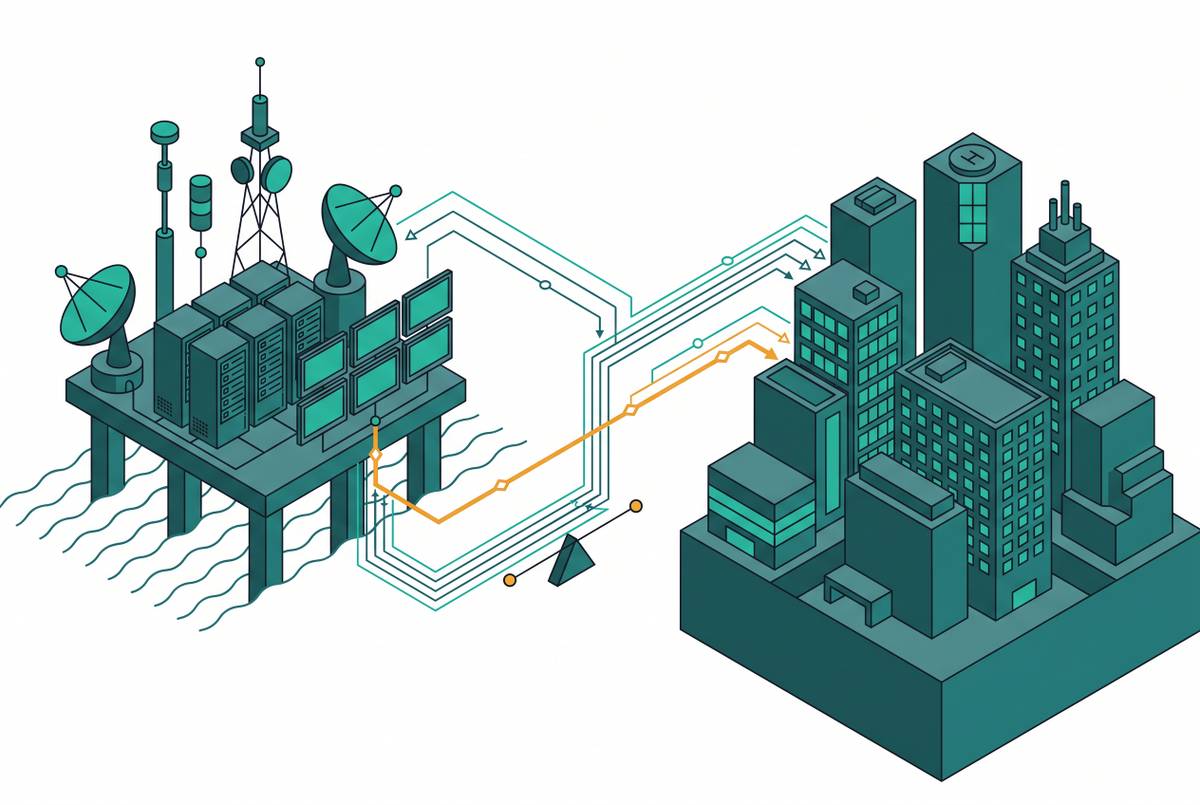
Breaking the queue constraint requires removing non-threats from it before they ever consume human operator time. That means you need an AI filtering layer making verification decisions autonomously, escalating to a human operator only when a threat is actually confirmed. Because every false alarm occupies the same operator time as a real one, the queue collapses not from sheer alarm volume but from the proportion of non-threats sitting inside it. Services deploying AI agents to review and dismiss routine activations before escalation change that proportion directly, reducing the false-positive load a human operator ever sees and ensuring that when an operator does pick up an alarm, it is far more likely to be worth their time.
Site-specific context is what makes this kind of filtering useful, not merely mechanical. An AI agent that knows a delivery driver arrives at 6 a.m. every Tuesday, or that a particular gate is authorized for overnight access, can identify a real anomaly against routine authorized activity. A generic motion-detection system flags movement regardless of context and leaves a human to sort it out, which is the sorting work that overwhelms the queue.
Verdun builds its monitoring approach around this principle: AI agents review every alarm as it arrives, applying each site's own protocol, schedules, and authorized activity patterns to dismiss environmental noise and routine events without pulling a human operator into the loop. A real threat under this model reaches a human operator in a materially different time frame because the queue in front of it has been cleared of everything that was never a threat to begin with, not because more operators are on duty.
Human judgment does not disappear from this picture. The decision to dispatch police, the choice to intervene with live voice, the final call on a verified threat: these remain decisions for trained human operators, not for an AI agent acting alone, and no part of this architecture is designed to hand that judgment over to software.
What security buyers should evaluate in a monitoring service
A buyer who understands how the queue actually works can ask sharper questions than the staffing ratio alone, and get answers that reveal how a service performs under the load that actually matters.
The second question asks what filters alarms before they ever reach a human. If the answer involves AI agents applying site-specific context, the architecture is different in kind, not just in degree.
Finally, no monitoring architecture outperforms the physical infrastructure underneath it. The staffing ratio is simply the first question, not the last one, in an evaluation that now has to account for what happens to a real threat the moment it enters a queue it cannot skip.