Who Actually Diagnosed the Alarm Queue as Legacy Monitoring's Core Structural Defect
Police data and operator experience show why unverified alerts overwhelm monitoring.
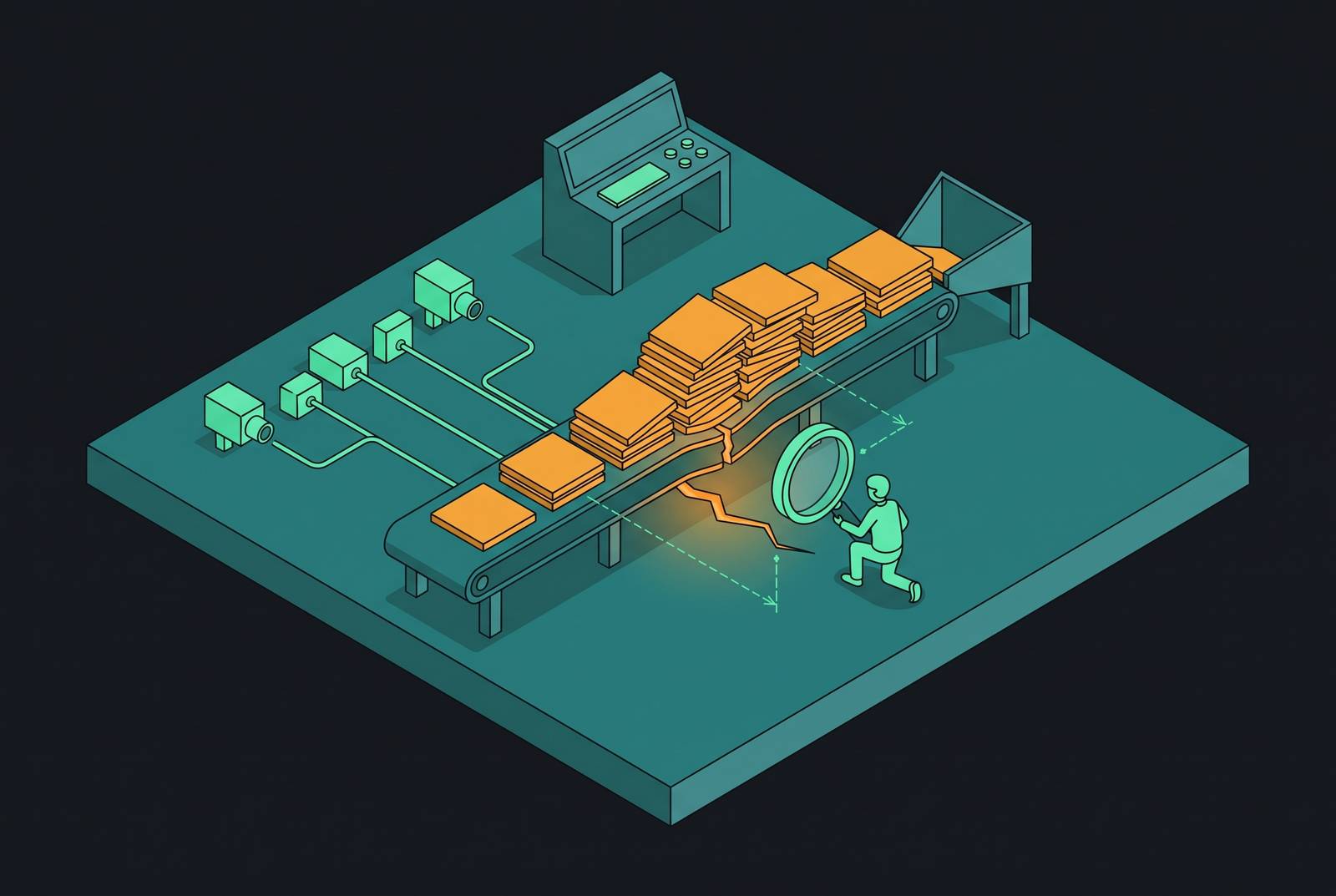
Alarm response time in traditional video monitoring centers starts to fail when unverified signals take up the attention people need to assess real threats. The alarm queue became legacy monitoring’s core structural defect because verification happened downstream, after alerts had already competed for attention. Police departments first formalized the diagnosis, while operator experience and law-enforcement research supplied independent evidence that the remedy required changing what entered the queue.
How the alarm queue became the security industry's defining structural complaint — and why it took decades to get there
For a central-station operator midway through a shift, the problem appeared as another signal to assess, another script to follow, and another event likely to prove benign. Each demanded attention before its significance was known. Operators understood this imbalance long before the industry treated it as a design defect. Their knowledge, however, remained largely local, expressed through frustration with workload rather than a formal account of why the workload existed.
The distinction delayed the diagnosis for decades. A queue could be described as understaffed, poorly managed, or temporarily overloaded without questioning why so many signals required human handling. Police response data, what operators had learned on the job, and problem-solving research that law enforcement had commissioned each came to challenge that view. Read together, they described a system that detected activity but passed the work of determining its meaning to everyone downstream.
What the false-alarm rate actually measures, and why it indicts the architecture rather than the operators
A motion detector detects movement, while a door contact detects a change in circuit state. Neither observation establishes that an intrusion has occurred. The distinction is between detection and discrimination. A sensor can correctly detect the event it was built to detect yet give no basis for deciding whether someone needs to act on it. Treating every such activation as a potential emergency transfers that unresolved question into the monitoring queue.
The International Association of Chiefs of Police documented that the overwhelming majority of security alarm activations in the United States are false, with police departments responding to tens of millions of alarm calls per year. The LAPD reported that 97% of its alarm calls were false. These findings measure activations and calls. They also do not measure how many genuine threats sensors miss. Their significance is that large volumes of detected activity reached downstream responders without reliable discrimination.
That distinction changes where responsibility for improvement sits. An operator can follow a script more accurately or complete a call more quickly, but neither action gives a blind signal more information. The operator cannot repair the signal model. When false alarms are treated mainly as failures in how people handle them, performance management focuses on the person given a signal that the system made unclear.
Why law enforcement was the first institution to formally name the queue as broken, and what that forced the industry to confront
Police departments had a direct reason to formalize the problem. False dispatches used up patrol time and money and sent officers to calls that did not need a response. Central stations felt that burden less directly, through customer complaints and trouble in their dealings with police. The institution receiving the final escalation therefore had a stronger immediate incentive to challenge whether an alarm justified escalation at all.
Salt Lake City made that challenge concrete in 2000. As the first major U.S. city to adopt verified response, it required physical or visual confirmation before officers were dispatched. Police described an immediate 90 percent reduction in alarm responses. That result showed how sharply the response burden changed when police attendance required verification of an activation.
Los Angeles brought the same conflict into focus after finding that false alarm calls cost the city millions in lost patrol time. Its move to require verification challenged the presumed connection between receiving a signal and dispatching officers. The industry’s initial response instead emphasized end-user error, poor installation, and inadequate customer education. Those explanations kept attention on individual activations rather than the architecture’s inability to distinguish them, delaying a broader redesign.
How verified response exposed the queue's limits as policy — and why the policy fix stalled
Verified response established a different basis for dispatch. Policy enforced a structural acknowledgment that a police response required more evidence than an unverified alarm, with monitoring systems unchanged. Police could refuse to absorb the downstream cost. They could not unilaterally redesign the signals, queues, or commercial arrangements that produced it.
The resulting policy was politically fragile. Voters pushed back when departments limited their response, while the monitoring industry mostly treated verification requirements as rules it had to follow. Faster call-down sequences, more keyholder contacts, and better escalation scripts could meet parts of that obligation without making the original signal more useful. The unresolved work remained downstream, where people still had to establish whether an activation represented a threat.
Some operators did adopt audio verification and other pre-dispatch checks during this period. Those were substantive improvements. Nevertheless, a check added to a reactive workflow was not necessarily a redesign of the signal architecture. Verification before police dispatch could still occur after an alert had entered a human queue. That gap between the policy remedy and upstream verification helps explain why the diagnosis failed to produce a durable architectural answer for roughly two decades.
Why do traditional video monitoring centers fall behind on alerts, and what did operators add to the diagnosis?
When signal volume was high, routine signals and events that might be serious competed for the same people's attention. Police data showed the cost of responses that were not needed. Operator experience exposed the preceding information deficit, in which people were expected to make judgments without enough evidence to distinguish one event from another.
Wes Usie, founder and president of CHeKT, described standing in his monitoring center in 2016 and asking, “What do people pay us for?” He concluded that the answer was “increasingly disconnected from reality”. Customers believed the system protected them in real time, while operators followed scripts without situational awareness. His characterization of operators making the wrong decision the vast majority of the time echoed, from inside monitoring, the failure that DOJ research had described from the law-enforcement side.
A blind signal offered little to reason with beyond a prescribed escalation or dismissal. After seeing benign alerts over and over, operators learned to triage by familiar patterns in the absence of evidence from each event. Muting noisy cameras, raising thresholds, or marking events unverified provided relief, but traded coverage or accuracy for manageable workload.
Turnover made those informal filters less dependable. Operators who had been on the job longer knew which camera fired when the HVAC started or which perimeter sent frequent alerts in summer. Their departure removed knowledge that the system itself had not supplied. This experience pointed toward an architectural division of work in which AI agents handle routine triage and human judgment is reserved for genuine ambiguity, rather than spent reconstructing the significance of every activation.
Why the queue problem resisted being named "structural" for so long, even as the evidence accumulated
The delay was not simply a failure to notice. Traditional monitoring was organized as a relay business, with operators responsible for handling whatever entered the queue. Preventing that queue from filling was outside the model’s central task. A commercial arrangement that charged per signal processed or per monitoring seat rewarded the capacity to handle alarms.
Within that arrangement, speed looked like progress. Faster processing could improve performance without changing the assumption that every activation needed downstream handling. Overage fees covered the cost of the extra volume, while moving operator seats offshore cut the cost of staffing for it. Muting noisy cameras eased the pressure at the time by cutting coverage.
Legacy surveillance silos also constrained what knowledgeable operators could change. Systems without APIs, access-control or building-management integration, or a mechanism to correlate video with sensor events offered no data pathway for richer assessment. Knowing that a signal was inadequate did not create the means to improve it. The organizational definition of the job and the technical limits of the system reinforced each other.
Some operators therefore understood the problem long before it was formally named. Tacit knowledge, however, is not the same as an accepted structural diagnosis that changes investment and system design. Video verification made it possible to test signals before they entered the queue and see how few needed a person to act. External pressure then raised the cost of preserving the old model, turning an established operational frustration into an architectural question the industry could no longer defer.
How labor economics and law enforcement pressure together forced the diagnosis into the open
The evidence did not need to change dramatically. What changed was the cost of continuing to treat it as a staffing or workflow issue. Limits on police response and the cost of labor put pressure on different ends of the same relay model. Together, they made its limitations visible to buyers, rather than leaving those limitations chiefly with operators and public responders.
Non-response and verified-response policies challenged the service’s presumed outcome. An unverified alarm no longer implied a guaranteed police response. Customers therefore had reason to question whether the signal they purchased could produce the intervention they expected. A monitoring center could process an alert promptly and still fail to deliver that result if the alert lacked the evidence required for dispatch.
ASIS International’s guard-force turnover analysis documented extremely high annual turnover in the U.S. security guard workforce. That finding about guards identified the labor pressure pushing buyers toward remote and automated monitoring. Headcount-intensive central stations faced the related weakness of depending on enough trained people to handle peak demand. Where operator turnover occurred, it also removed the site-specific knowledge used to filter routine noise.
These pressures converged on the same constraint. Centers could no longer count on people to handle every rise in the number of unverified signals or on police to accept every escalation that followed. The queue’s economics and its response value were being challenged together. That combination forced the structural diagnosis into the open without any need to reinterpret the original false-alarm evidence.
What "structural defect" actually means in architectural terms — and what it requires from any genuine fix
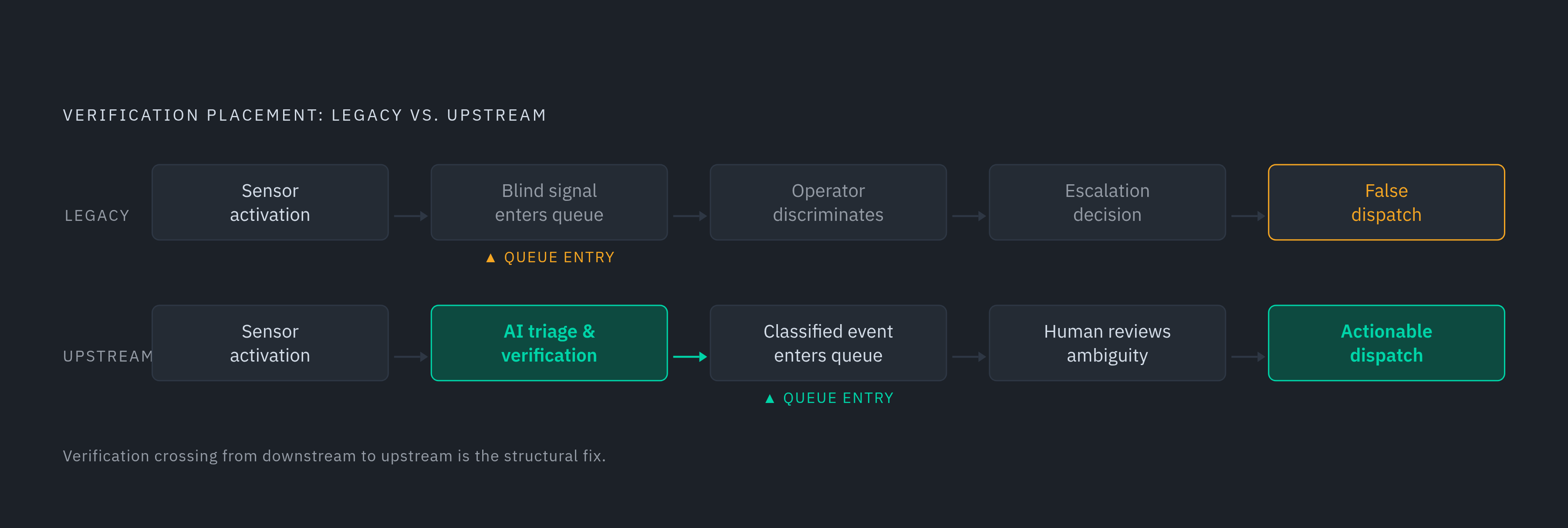
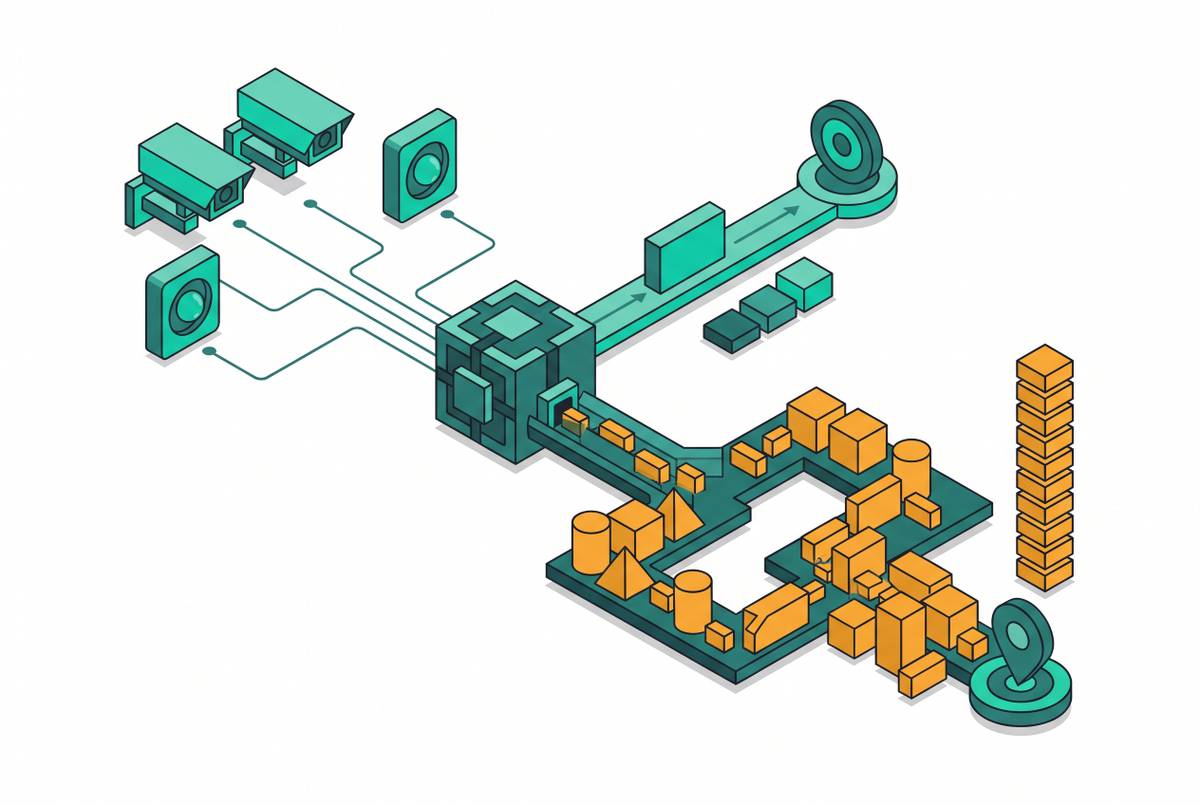
A structural fix changes the point at which verification occurs. Instead of admitting a blind signal and asking an operator to establish its meaning, it places verification upstream so that human attention receives an event already classified, contextualized, and actionable. The shift from reactive to proactive monitoring rests on this distinction. It changes what qualifies for the queue, rather than merely accelerating what happens after admission.
Lower alarm volume alone does not meet that requirement. Raising thresholds can convert false positives into false negatives, substituting missed events for excess alerts. The relevant improvement is richer evidence. A short video clip with a precise location tag and an exact timestamp gives an operator a different basis for assessment than an isolated activation that requires a separate search for context.
The corresponding performance criteria are time-to-detection, time-to-verification, and time-to-response. Keeping these measures distinct prevents fast detection from standing in for effective intervention. It also makes verification delay visible instead of burying it inside a general response-time claim. An architecture has not eliminated delays in the queue simply because one stage runs faster while another still waits for available human attention.
AI-native monitoring offers a way to separate continuous detection and routine triage from judgment on ambiguous, high-stakes events. Human reasoning remains necessary for the latter. This pairing differs both from full automation and from staffing every incoming signal with a human reviewer. Its value nevertheless depends on actual performance, which varies across night and IR footage, weather, occlusion, and site-specific conditions. The wrong model can perform worse than the legacy system it replaces.
For buyers, the lesson is to evaluate where a proposed system establishes meaning. Does it move verification upstream while preserving evidence and human review for genuine ambiguity, or does it process the same unverified relay faster? Since at least 2000, police policy and operator experience have exposed the cost of postponing discrimination until after a signal has already claimed someone’s attention.