What a Flooded Alarm Queue Does to Response Time Minute by Minute
Backlogs delay real threats and train operators to dismiss them.
Alarm response time failure in traditional video monitoring centers begins when alarms arrive faster than operators can assess them. A flooded queue first consumes attention, then encourages habitual dismissal, so a genuine threat inherits both the backlog and the skepticism created by false alarms. The structural remedy is to resolve routine alarms before they reach a human, rather than rely on more seats to process the same noise.
How a monitoring queue works when the alarm rate is low
At a manageable alarm rate, an operator receives a clip or signal, assesses it, closes it out, and moves to the next item. The sequence is simple and largely linear. Assessment time stays predictable because the operator has enough attention to investigate. Arrival order works as a practical processing order only while waiting adds little delay.
That model depends on arrivals staying within the operator’s processing capacity. People have only so much attention and time to assess alarms. Sandia National Laboratories’ physical security queueing research describes how an operator can fail to clear the queue when too many nuisance alarms come in. Traditional motion sensors detect activity without interpreting its cause, so the burden of separating threats from harmless movement falls on that limited human capacity.
Why nearly every alarm that arrives is false before the queue even opens
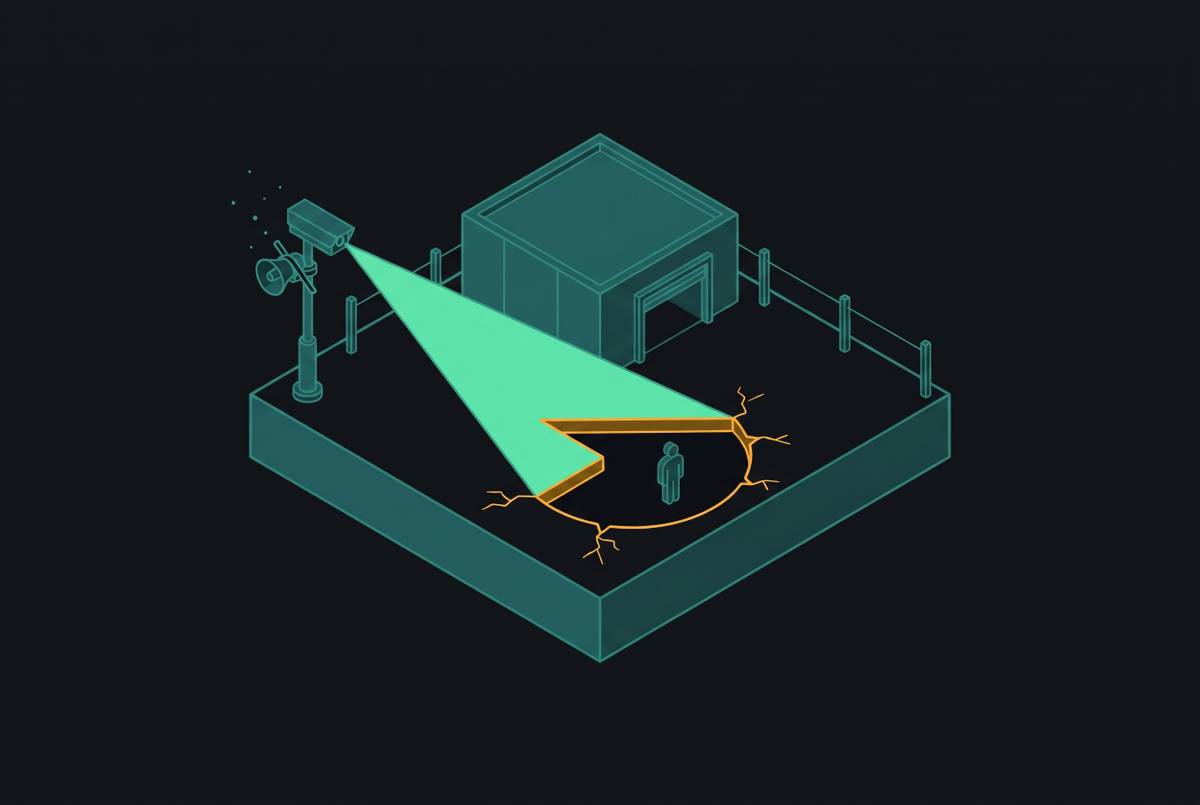
The imbalance begins before the operator touches an alarm. Traditional systems trigger when a motion threshold is crossed or a contact is broken, without establishing why it happened. A stray cat, a shifting shadow, and an intruder can therefore generate signals that enter the same assessment process. Wind, rain, headlights, temperature changes, forgotten codes, and propped doors add more events requiring review. The queue records activation.
As a result, the operator inherits an overwhelmingly false-positive environment. Traditional alarm monitoring models can generate false alarm rates of up to 98% of activations representing no real incident. False alarms are the dominant workload, yet the queue offers no inherent indication of which remaining event deserves immediate attention.
Seattle PD received thousands of residential and commercial alarm calls in 2023, and the vast majority turned out to be false. Those calls show that non-events can pass through the assessment process and consume public response resources as well. The operator’s task is therefore not simply to notice an alarm, but to extract a rare threat from a stream whose usual outcome is nothing requiring intervention.
The first wave of a busy shift and why monitoring centers fall behind on alerts
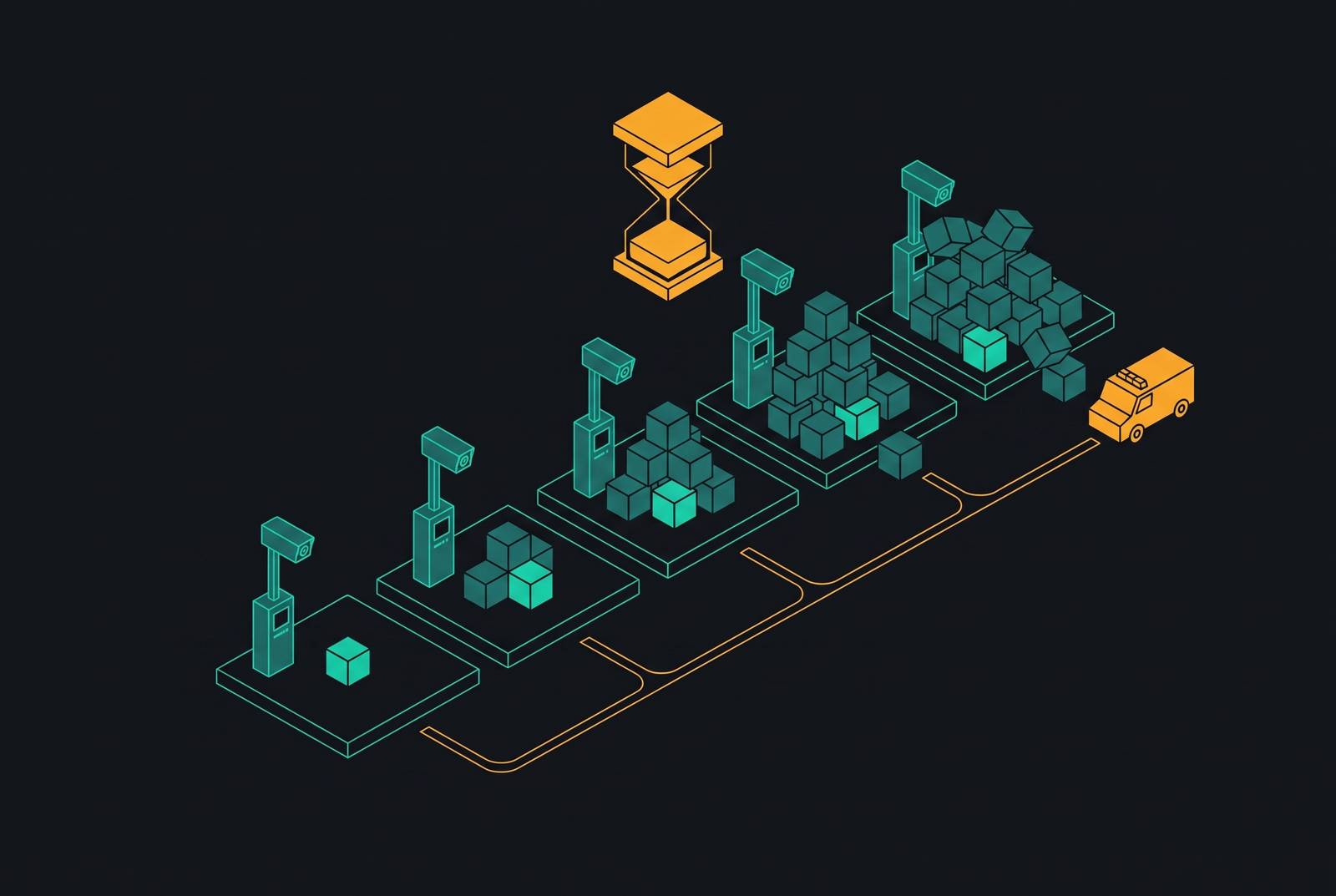
During the opening minutes of a busy shift, arrivals begin to outpace completed assessments. Each pending item adds an unresolved demand behind the work already in progress, consuming the cognitive headroom that careful investigation requires. An operator can still be working conscientiously while the system accumulates delay faster than that operator can remove it.
Sandia’s research states that even low nuisance and false alarm rates, together with their queueing effect, can increase detection and response time. That delay reduces the time available for a response force to interrupt an intruder. The same research distinguishes assessment time from total alarm processing time, which also includes waiting in the queue. A quick review does not mean a quick response.
Queue depth then becomes part of the conditions under which every judgment is made. An operator facing a long backlog is under different pressure from one facing only a handful of pending items. Faster clearance becomes a rational response to visible demand, but it leaves less time to investigate each event. The timeline is a sequence. The transition depends on the arrival rate and available assessment capacity, rather than a universal minute at which attention fails.
The second wave of false alarms and the shift toward habitual dismissal
As false alarms repeat, overload gives way to adaptation. The operator learns that the next activation is unlikely to represent a threat, and its apparent urgency declines. This reflects how human attention responds to repeated signals that rarely require action. A queue dominated by non-events encourages skepticism even while the monitoring task depends on recognizing the exception.
Alarm fatigue in hospital ICUs illustrates the same pattern. Monitor alarms can exceed 350 per patient per day, calling for attention again and again even though some need no action. In physical security, alarms that keep coming in the same way make dismissal feel more familiar over time. An operator can be statistically justified in expecting another false alarm and still be poorly positioned to recognize the genuine event that breaks the pattern.
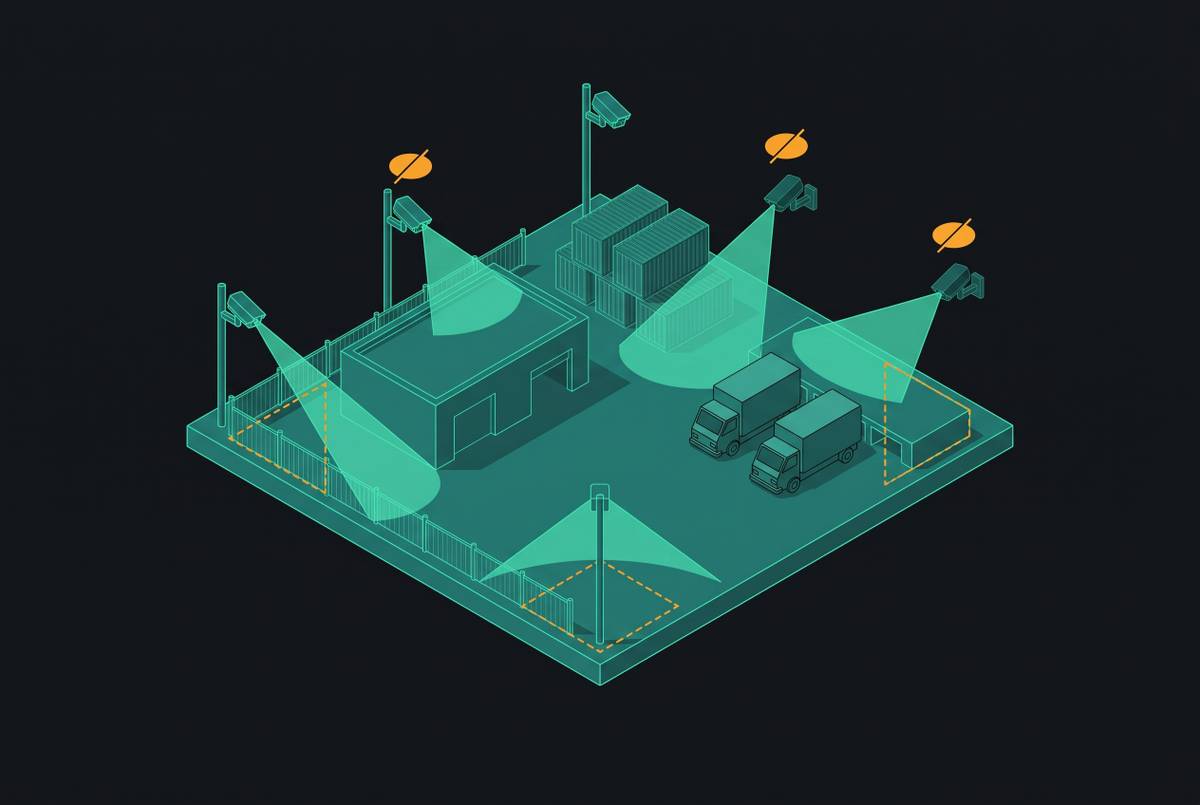
Adding detection can intensify this stage if every new sensor or rule sends more signals into the same queue. Broader coverage then produces more assessment work without making the individual alarm more trustworthy. Confidence falls as the signal stream expands. Muting noisy cameras, applying coarse filters, or throttling alerts acknowledges that the existing flow exceeds what operators can tolerate. Those steps ease the pressure by giving up some coverage while leaving open which events need someone’s judgment.
The moment a real threat arrives in a queue that has already adapted to expect nothing
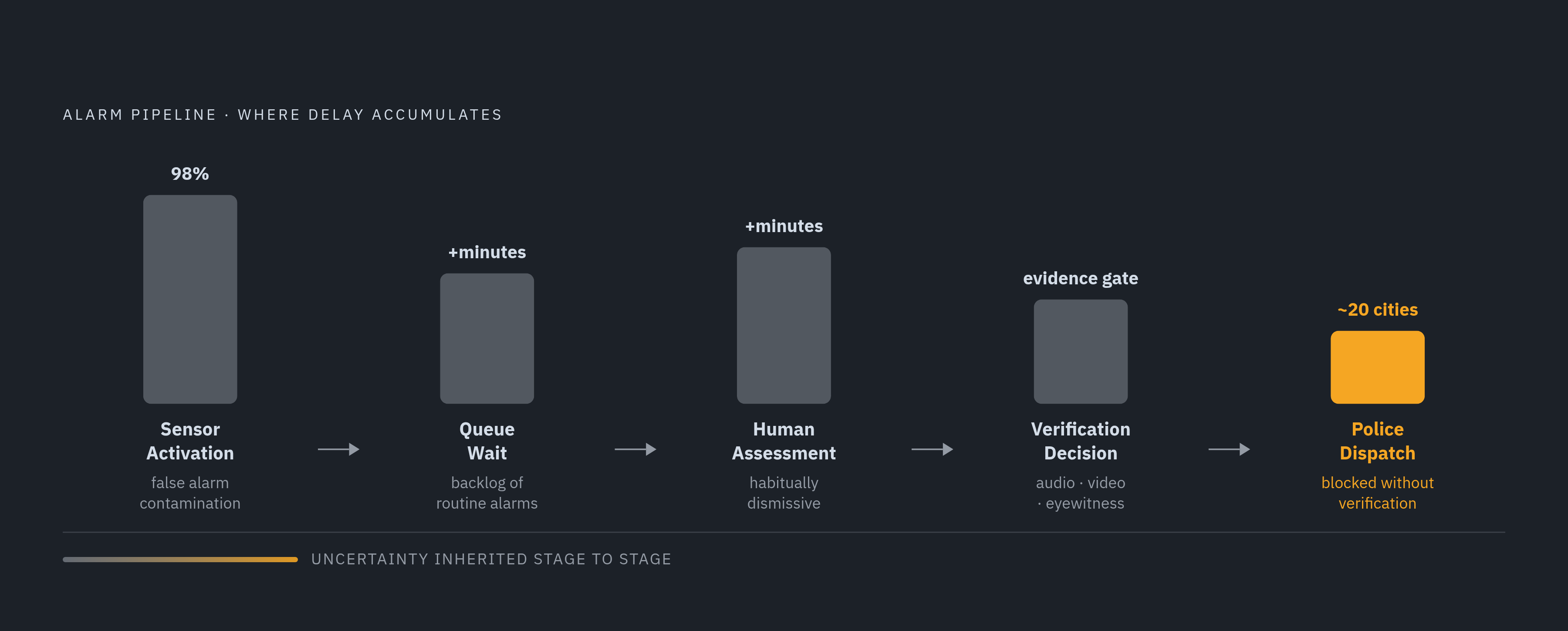
A genuine threat enters the same sequence as the false alarms and encounters an operator working under the expectations those alarms created. If it occupies position 20, the queue has no inherent mechanism to distinguish it from positions 1 through 19. It waits behind the backlog unless something separates it from routine activity. By then, delay exists before any judgment about the event has been made.
When the clip finally reaches the operator, assessment begins under the same time pressure and habituated skepticism as the preceding reviews. A real event can be dismissed through the same familiar process used for harmless movement. Alternatively, it can be recognized correctly but too late for the original response window. These are distinct forms of failure.
Detection, assessment, and dispatch all consume part of the interval available to interrupt an intrusion. Baltimore, Seattle, and Houston have implemented versions of non-response or verified-response policies, so an unverified alarm can also encounter a barrier to police dispatch. Without the required verification, the event may produce no dispatch at all.
Why adding operators is a workaround that never clears the queue
More operators can reduce the number of alarms assigned to each person. That is a real capacity benefit. It does not, however, change the false-positive rate or the absence of urgency information in each incoming signal. Each new operator still has to pick out rare threats from a stream of mostly false alarms. Staffing can relieve the immediate backlog without removing the conditions that produce fatigue and habitual dismissal.
Sandia’s research shows that systems with only one or two operators can become overwhelmed as nuisance alarm rates increase, decreasing system performance. That finding establishes a capacity problem while leaving open the possibility that additional staffing helps. The structural limit is more specific than that. Adding seats distributes assessment work while leaving its source intact, and coordination between operators introduces its own latency. If the incoming burden continues to rise, staffing remains a workaround that must keep absorbing it.
Camera muting sacrifices coverage, while overage fees move the burden into the customer’s budget. Neither establishes whether an alarm is a threat. The relevant distinction is between making the existing workload tolerable and reducing the amount of routine work that needs human review.
GardaWorld acquired Stealth Monitoring in October 2024, and Alarm.com acquired CHeKT in February 2025. Those purchases show interest in better monitoring and verification, but their size alone says nothing about how a given queue deals with events as they come in. The operational test remains unchanged. Verification must alter what reaches the operator, rather than simply add another stage to a flooded reactive process.
What the queue looks like when AI agents resolve routine alarms before they reach a human
Instead of asking an operator to assess every activation, agentic AI resolves routine cases before they enter the human queue. An agentic system can plan multi-step tasks, invoke external tools, and execute consequential actions with minimal human supervision. The NIST AI Agent Standards Initiative, established February 17, 2026, addresses security, identity, and interoperability for this category of system. Those concerns are relevant because autonomous resolution goes beyond attaching another detection label to a clip.
Applied to alarm triage, the distinction is between identifying motion and reasoning about why it occurred. Object detection alone can bring back the original false-positive problem by flagging activity without working out what it means. Context is the dividing line. When a system can resolve routine activity with high confidence, only ambiguous or high-stakes cases need to surface for human judgment. The queue is then defined by the need for assessment, rather than simply by the order of sensor activations.
That changes the operator’s working conditions as well as the volume. A genuine threat no longer has to wait behind routine events that the system has already resolved. Removing those events also reduces the repetitive dismissals that condition the operator to expect nothing. Humans retain the escalation decision. This is a different human-in-the-loop model from one in which AI supplies downstream verification while people still have to process every initial alarm.
Models trained on clean footage can degrade on night or infrared footage, low light, weather, occlusion, and site-specific edge cases. Those are not incidental conditions for physical security monitoring. A system that fails there can recreate the workload it was intended to remove, or resolve an event incorrectly. For buyers, the lesson is to interrogate performance on messy real-world footage rather than accept benchmark performance as evidence of operational suitability.
What verified response requirements reveal about where the industry is heading
Municipal policy is making the quality of verification a condition of response. Seattle’s 2024 policy requires supporting evidence, including audio, video, eyewitness testimony, or panic button activation, before police respond to alarm company calls. Sensor or motion activation alone is explicitly excluded. Detection by itself is no longer enough. A monitoring system must turn that activation into evidence that meets the response requirement.
Non-response or verified-response policies cover roughly 20 major U.S. cities, and limits on resources and high false alarm rates are pushing more cities toward those policies. RSPNDR CEO Mark Zimmerman described the industry’s promise of free, preferred access to public safety resources in plain terms. “That was definitely not a valid promise by 2020, and it is getting less valid every day.” The external response system is withdrawing an assumption on which reactive monitoring depended. Sending an alarm does not establish that anyone will attend.
Salt Lake City reported an immediate 90% reduction in alarm responses where verified response was adopted. That figure describes a change in dispatch activity, a measure distinct from a corresponding reduction in threats. For buyers, the distinction is consequential. An unverified alarm that produces no police response cannot deliver the intervention expected from that response, even if the sensor and monitoring connection both functioned.
Verified-response rules, with AI as one technology option, require the outcome that upstream triage is intended to support, which is confirmation of a real event before dispatch communication. The relevant criteria are whether routine alarms are resolved before consuming human attention, whether difficult footage receives reliable assessment, and whether a genuine event reaches an operator with enough evidence and time for escalation. A monitoring service that cannot connect detection to verified action is increasingly incompatible with the response policies outside its control.