AI Agent Roles in a Human-in-the-Loop Monitoring Workflow
AI agents filter false alarms so humans can focus on real threats.
The legacy monitoring center is built around a single scarce resource: a human operator's attention. Every alarm, whether it represents a genuine threat or a wind-blown branch, must pass through that resource sequentially. The failure of this model is not a matter of poor hiring or inadequate training. It is an architectural condition, and it cannot be fixed by adding staff.
The traditional workflow is a relay. A sensor trips, a signal enters the queue, an operator reviews the footage, the operator makes a call, the operator authorizes dispatch. A real threat does not go to the front of the line. It waits its turn behind dozens of environmental triggers, authorized activities, and sensor glitches.
This is the point that most discussions of false alarms miss. The false-alarm rate is not a nuisance at the edge of the monitoring model. Most alarm activations are false, according to the problem-oriented policing research cited in the market analysis. The system was built around a signal source that mostly produces noise, and every unit of that noise consumes the same operator attention as a genuine emergency.
The binding constraint is worth naming precisely. It is not signal transmission speed. The bottleneck is the operator response clock. Everything downstream inherits its limits.
The first is high false-alarm rates, which are not a byproduct but the expected output of a system that flags everything that moves. The second is missed real incidents, which occur because genuine threats are buried in the volume. The third is the absence of contextual understanding. An operator staring at a grainy clip of a door opening has no way to know whether the person entering is an authorized employee or an intruder. The fourth is operator stress and fatigue, which compounds over long shifts of low-signal alarms and time-critical response pressure.
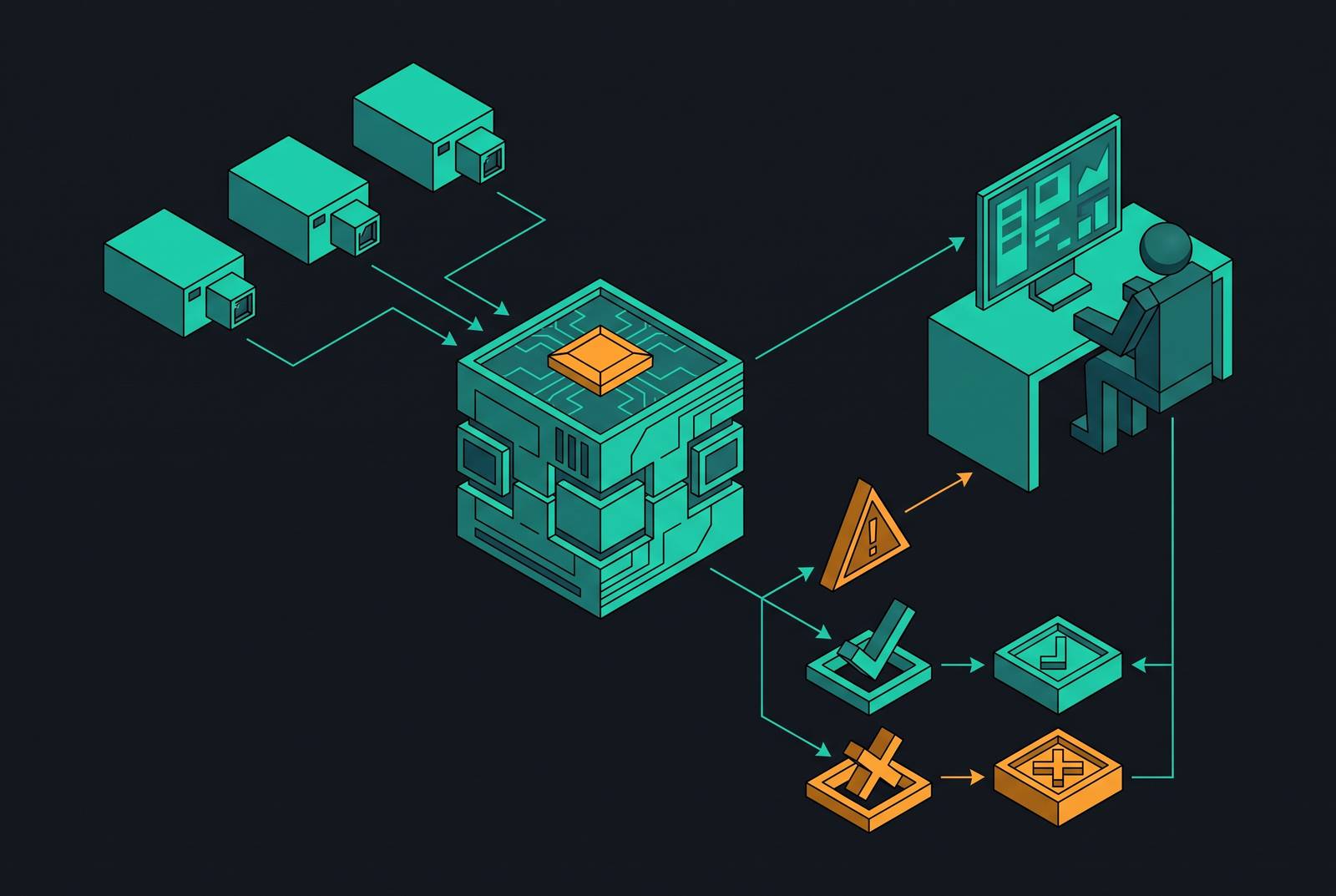
That fatigue deserves to be understood as a structural output rather than a personnel problem. The operator is not failing. What the queue needs is not more operators. It needs a pre-filter that runs at machine speed, reviewing every alarm in parallel before a human's attention is ever required. Verdun sidesteps the queue entirely by deploying AI agents to review every alarm in parallel before it reaches a human operator, eliminating the bottleneck at its architectural root rather than trying to staff around it.
What AI agents can actually do that human operators cannot do at scale
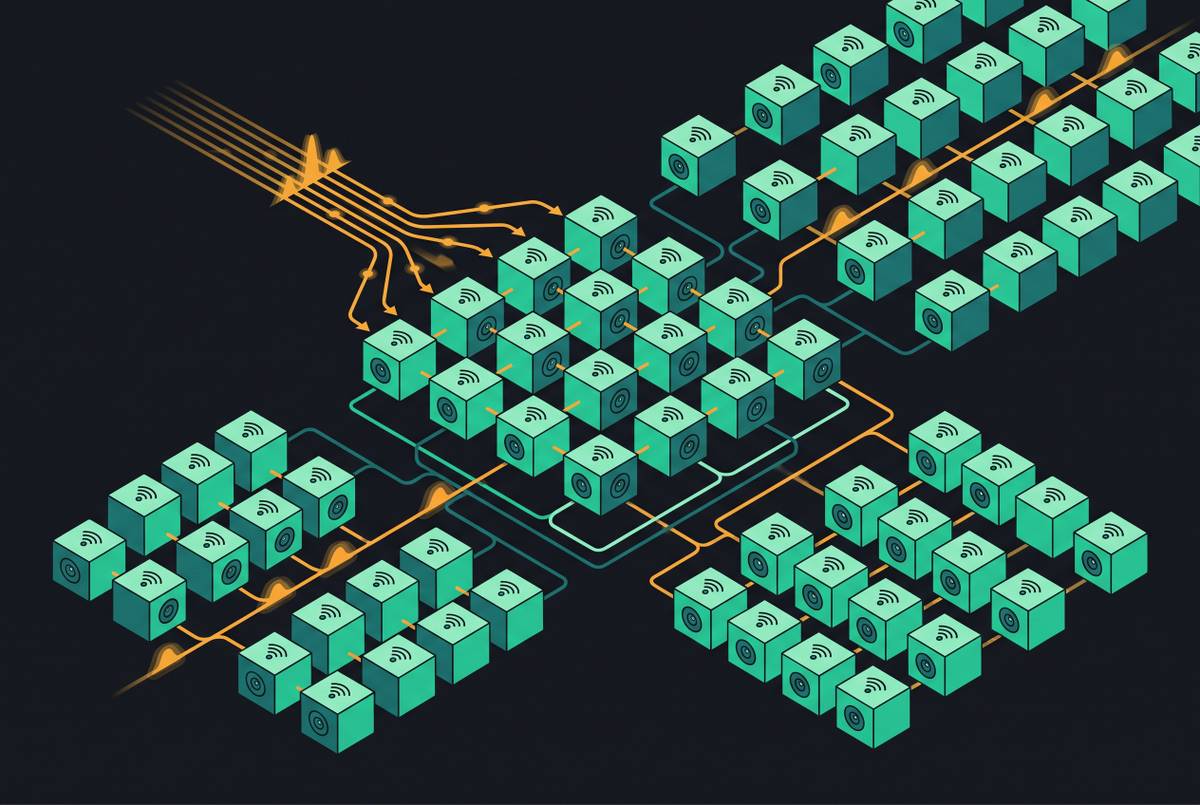
The capability that breaks the queue problem is not faster detection. It is parallel review. This is not an incremental improvement on the human operator. It is a different class of capability.
The shift at the core of this is from rule-based detection to agentic reasoning. It autonomously conducts situational analysis, executes an initial response, and prepares a recommended action set. The operator receives a verified, contextualized event, not a raw signal.
Consider what this looks like in physical security. A badge entry is paired with a tailgating person wearing a delivery uniform. All of this happens before a human is paged. The human arrives at a decision, not a diagnosis.
The scale argument is settled in the cyber SOC context, and it applies directly to physical monitoring. A standard SOC processes tens of thousands of alerts daily, the vast majority of them false, according to Sentinel-RL's SOC architecture research. A system that generates its own category of false positives, AI false positives that humans must now filter, has only moved the problem rather than solving it.
This is why the shift from flagging to agentic reasoning matters for the queue. A reasoning system that applies site-specific context before escalation is producing a fundamentally different output, one that has already been filtered through what the site actually knows about its own activity. What AI agents should not do is the subject of the next section, and it is where the architecture of trust is decided.
Where the AI agent's authority must stop and the human's must begin
The division of labor only works if the boundary between AI action and human judgment is architecturally enforced rather than left to system discretion. A boundary that depends on the AI's good behavior is not a boundary. It is a suggestion, and suggestions do not hold under the operational pressure of a live incident.
The Sentinel-RL architecture makes the principle explicit in the cyber SOC. LLM agents are restricted to writing queries, summarizing alerts, and drafting reports. The actual decision to take a containment action, whether isolating a host, blocking an IP, or dispatching a response, is handed to a trained policy and then requires human approval. The reason is structural, not philosophical. The same boundary applies in physical security. An AI agent can verify a threat, prepare a response recommendation, and initiate a talk-down or alert. The decision to dispatch law enforcement belongs to a human operator who can weigh context the agent cannot access: a known tenant working late, an authorized drill, a medical event.
This boundary is not a concession to AI's limitations. It is a design choice that makes the system more reliable. The Springer chapter on generative and agentic AI failure modes documents the pattern: goal misalignment, flawed planning, and breakdowns in human-AI collaboration. Systems that pursue goals with system-wide consequences require defined human-approval boundaries. The boundary is not something to engineer around. It is a safeguard to design for, and it is what makes autonomous action safe to deploy at speed.
The speed claim is more than theoretical. Sentinel-RL's integrated containment loop completes a full detect, investigate, recommend, and human-approve cycle in a median of 6.3 seconds. The human-approve step is not a bottleneck. Removing the human from the response decision does not make the workflow faster in the ways that matter. It removes the judgment layer that converts a fast alarm into a correct action.
The architectural boundary between AI triage and human response is not just an operational convenience. It is the foundation of trustworthiness. AI agents filter, contextualize, and recommend. If the human's role is decision-approval rather than triage, the next question is what the response timeline actually looks like.
What response speed looks like when each layer does only its job
When AI filters and humans decide, the time from event to verified response compresses dramatically. The compression comes from removing the queue, not from making any individual step faster. Each layer does only what it is uniquely equipped to do, and the handoffs between layers carry decision-ready outputs rather than raw signals.
The AI-augmented target collapses several sequential steps into a single pipeline. AI detection runs in one to two seconds. The Sentinel-RL architecture demonstrates the same principle at the cyber-SOC level, where a full detect, investigate, recommend, and human-approve cycle completes in a median of 6.3 seconds when AI handles investigation and preparation. The human step is not where the time goes.
The standards framework shows where the remaining latency can be removed. Two minutes is material for life-safety outcomes, and it is a gain available only to workflows that have already filtered the alarm to the point where direct data delivery makes sense. Sending unverified noise into a CAD system solves nothing.
Speed matters most when it is calibrated to verified threats. Verdun's design target is a real threat reaching a human operator in under 90 seconds. That target is achievable precisely because AI handles the filtering that previously consumed the window. The timeline is the proof of the architecture.
What site-specific context is what separates AI reasoning from AI pattern-matching
An AI agent making triage decisions without site-specific context is not filtering noise. It is generating a new category of it. The distinction between reasoning and pattern-matching rests entirely on what the agent knows about the site it is monitoring, and that knowledge has to be current, specific, and structured.
The ANSI/TMA AVS-01-2024 standard makes the point through its classification framework. It replaces the binary intrusion/no-intrusion signal model with a five-tier system, from Level 0 (no call for service) through Level 4 (confirmed threat to life). AVS-01 is an evidence-quality framework, not a callback procedure. It was ratified by the IACP executive committee in late October 2024, and it formalizes what contextual grounding produces: a dispatch decision based on what is actually known, not what a sensor tripped. Slower routing than 30 seconds collapses the AVS-01 advantage, and stale or absent site context is what causes that delay.
The distinction between reasoning and pattern-matching shows up most clearly in the data the agent has access to. The contextual reasoning example from physical security, the badge, the tailgate, the delivery uniform, the Visitor Management System query, the schedule verification, the policy-breach log, only works because the AI agent has access to current schedule data, access records, and defined site protocols. Schedules of authorized activity, known access patterns, defined restricted zones, and the identity of people who are supposed to be present: these are what allow an AI agent to distinguish a maintenance worker at 2 a.m. from an intruder, rather than flagging both.
Stale account data is a systematic failure mode independent of AI sophistication. A perfectly fast AI filter still loses time and generates bad recommendations if zone descriptions are generic, if "Zone 3" means nothing while "Second Floor West Corridor" means everything, or if emergency contacts are outdated. AI grounded in site-specific data can resolve many of those same events faster and without a call.
The implication for buyers is straightforward. An AI monitoring system is only as accurate as the site-specific data fed into it. And that capability requirement is not uniform across site types, which is where the next section turns.
How the division of labor plays out differently across commercial, multifamily, and industrial sites
The AI-filter and human-decision structure holds across every site type. What changes is what the AI agent must know and what the human operator must be prepared to decide. The boundary is constant. The context that feeds it is site-specific.
Commercial office buildings demand granularity in the AI layer's spatial understanding. The AI layer must be configured with that map, and the human layer must be staffed to use it. A manned desk observing AI-filtered alerts is fundamentally more effective than passive camera rotation, because the human's job shifts from watching to deciding.
Multifamily residential sites put the human layer's judgment under different pressure. The AI layer's contextual grounding here is resident and visitor schedules, delivery windows, and authorized maintenance access. Without this, an after-hours package delivery and an after-hours intrusion look identical to a pattern-matcher. The boundary protects not just safety but the social contract between the property and the people who live there.
Industrial and manufacturing sites generate alarm volume of a different order. Loading dock doors, production area entries, and warehouse exits generate constant alarm traffic from deliveries, shift changes, and normal operations. The AI agent's job is to run every event through a Detect, Reason, Act, Resolve chain against camera feeds and contextual data before escalating. On a tower crane project with a defined no-go zone near overhead power lines, an AI camera continuously monitors hook position and automatically alerts the lift supervisor and crane operator the moment the hook enters the restricted zone. A human reviews the pattern, not every frame.
The pattern across verticals is consistent: the AI layer's accuracy scales with the specificity of the protocols it operates against, and the human layer's value scales with the quality of the verified, contextualized event the AI hands it. The protocol layer is what makes the AI agent meaningful at each site type, not just the camera count. What makes the workflow trustworthy is the combination of layers, each held to a distinct standard, which is the final question.
What a trustworthy human-in-the-loop workflow actually requires from both layers
Trust in a human-in-the-loop monitoring workflow is earned when each layer is held to a distinct standard of performance and neither layer is asked to compensate for a structural gap in the other. The standards are complementary, and the workflow is only as strong as the boundary between them is clear. The AI layer's standard can be stated precisely. Every alarm is reviewed. Only verified threats are escalated. The human layer's standard is equally precise. Response protocols are followed. The measure of success is decision quality and speed on verified events, not total alarm volume processed.
The same requirements appear in the cyber-SOC literature, which strengthens the case that they are general properties of trustworthy automation. Sentinel-RL's enterprise-readiness analysis covers false-positive economics, reversibility guarantees, audit compliance, and a defined human-approval boundary. An audit trail without rationale is a log, and a log does not answer the question of why a decision was made.
The failure modes to watch for in deployed systems follow directly from the standards. An AI layer that generates its own false positives at scale has shifted the noise problem rather than solved it. Agentic AI systems face reliability challenges, goal misalignment, flawed planning, cascading failures across layers, that make the human-approval boundary not a limitation to engineer around but a safeguard to design for, as the Springer chapter documents.
The legacy model's false solutions, muting noisy cameras, offshoring operators, absorbing overage costs, each trade away one dimension of quality without touching the queue problem. A workflow that adds an AI label to a legacy queue structure is the same failure in different packaging. It is what the AI is allowed to decide, what it is not, and how that line is enforced. That is the question a skeptical buyer leaves with, and it is the right one.