The Alarm Queue Is the Root Failure Mode Legacy Monitoring Was Never Designed to Fix
Monitoring centers drown in false alarms until triage moves ahead of the operator.
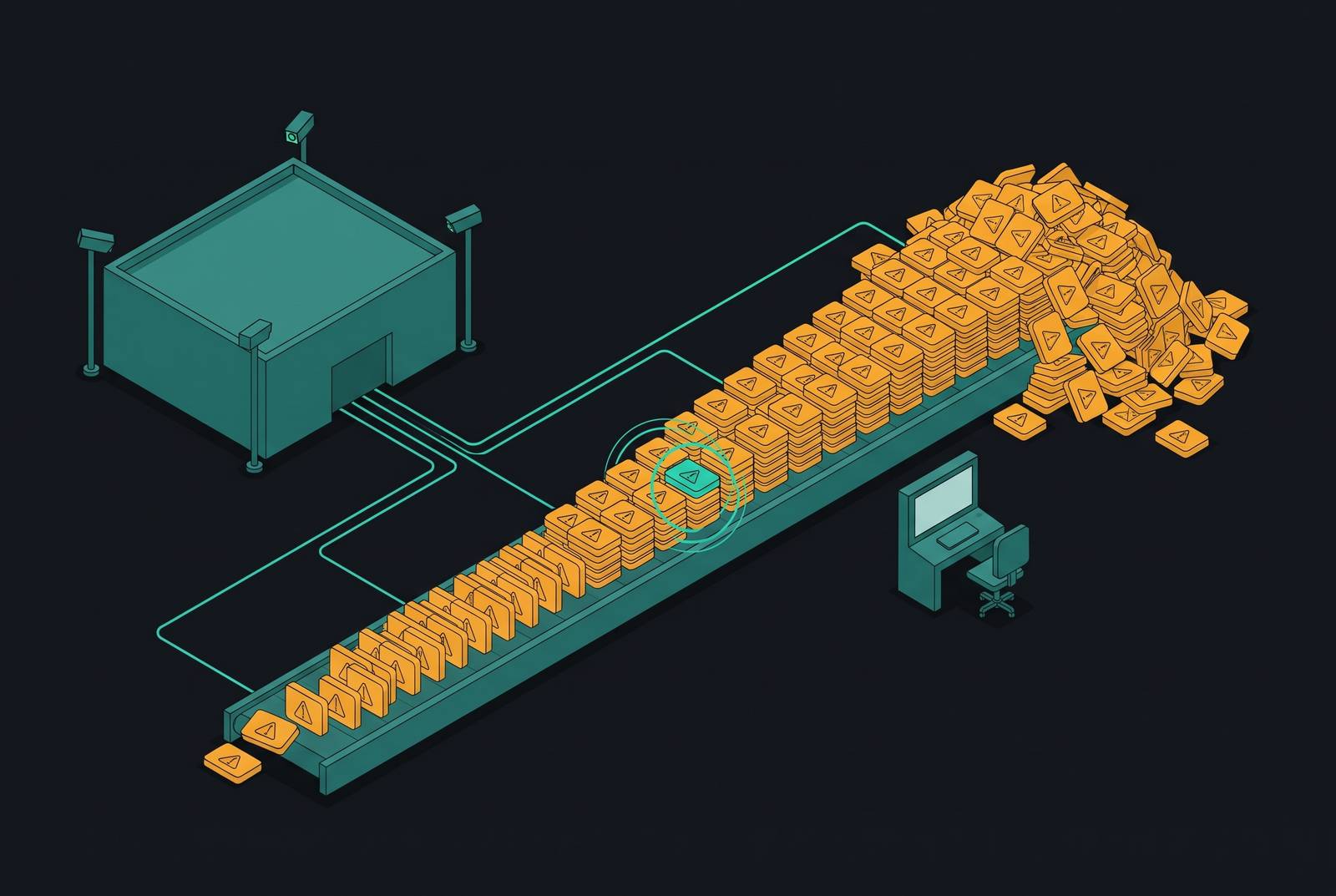
Alarm response time failure in traditional video monitoring centers begins with an architecture that sends raw detections to humans before deciding whether they require action. During high-volume periods, routine events compete with real threats for the same limited attention, delaying response and degrading review quality. The structural fix is not more operators or better optics, but a rebuilt triage layer that evaluates context before events reach a human.
Why the alarm queue exists in the first place
Legacy monitoring assigns detection to machines and judgment to people. A detected movement becomes an alert, and each alert becomes an operator task. Before that handoff, the architecture provides no de-duplication, context-check, or severity ranking to distinguish routine activity from a possible threat. The queue is therefore the design’s expected output. It holds the decisions the detection layer cannot make.
This arrangement makes human review capacity the constraint on the entire service. As the system detects more events, it creates more work but is no better at deciding which work needs attention. More staff can absorb some of that load, but staffing does not change the relationship between a raw signal and a required review. The architectural failure is upstream of the backlog, in a system that treats detection as sufficient reason to interrupt an operator.
What legacy detection actually sees — and why it cannot see more
Motion-based detection registers that something moved. A delivery truck at 3 a.m. and a delivery truck at 3 p.m. generate identical signals, even when a site’s schedule makes one expected and the other unusual. A raccoon and an intruder can trigger the same review obligation, as can a cashier and a shoplifter. The detector supplies activity without its operational meaning. It cannot suppress an event on the basis of context it does not understand.
This is comparable to an email filter that flags every message containing “free,” regardless of the sender. The rule finds the word it looks for, but that does not tell it whether the message is unwanted. Likewise, more sensitive motion detection can identify additional activity without distinguishing additional threats.
Better optics do not close that gap. Clearer images can help a person inspect an event, but they do not themselves supply schedule awareness, intent, or behavioral interpretation. A sharper picture of routine activity remains another task if the system forwards it without judgment. The missing capability belongs in classification and triage.
Why do traditional video monitoring centers miss alarms before anyone responds
When routine events keep filling the queue, operators must work through the noise before they can spot danger. The effect extends beyond longer waiting times. Sustained cognitive overload degrades the quality of review, so adding work can weaken both response speed and the decisions made when an event finally receives attention. The architecture makes this workload structurally impossible to sustain.
Alarm fatigue sets in as false events keep teaching operators what to expect from the next alert. Review becomes less analytical as experience reinforces the assumption that another activation is probably harmless. At one monitored retail site, a serious break-in went unnoticed for 45 minutes because the real threat was buried among false alarms. Its presence in the queue did not distinguish it from the surrounding noise.
More cameras can intensify this problem. Each added detection point increases coverage in principle, but it also introduces work into the same human review process. Once that work exceeds what operators can manage, nominal coverage and effective security diverge. The dangerous endpoint is desensitization, when a genuine threat receives the same diminished reaction as the false events that preceded it.
The costs that accumulate outside the monitoring center
The overwhelming share of police responses to burglar alarms are false activations, consuming a meaningful portion of emergency call volume in affected jurisdictions. Municipalities have begun to price that burden explicitly. Municipal policy and checks by insurance underwriters show that others share the costs with the monitoring center.
Even without a police response, an alarm has a cost. It consumes operator attention, escalation time, reporting work, and customer communication. Those demands may look small when considered event by event, but their repetition consumes payroll at scale. Avoiding a dispatch may only mean that people completed the work of establishing that no dispatch was needed.
Clients experience the same repetition as a loss of credibility. A monitoring relationship can deteriorate before a real incident occurs because persistent false alerts teach customers to discount the service’s warnings. Cancellation is therefore not only a response to a missed threat. It can follow a longer erosion of trust in whether an alert deserves attention at all. The architecture spreads its noise across every party asked to act on it.
Why the standard workarounds preserve the architecture rather than fixing it
Muting a noisy camera removes its false alarms by removing all alarms from that source. The trade is direct and permanent while the camera remains muted. Quiet replaces coverage, even though the original need to monitor that area has not disappeared. The detection layer has become no better at distinguishing harmless activity from danger.
Overage fees make a different trade. They transfer the cost of excess alarm volume to the client without improving the signals that created that volume. Clients pay for the noise without getting more protection, and operators still have to review the alerts. Cheaper offshore seats cut the cost of staffing instead. They cost less per operator-hour, but the number and quality of alarms stay the same.
These practices can relieve operational or financial pressure, but none changes where judgment occurs. Humans still receive undifferentiated motion-triggered alerts and must decide what they mean. RAD Security frames the queue as a symptom of doubt in the detection layer. Institutionalizing ways to manage that doubt does not resolve it. Optimization within this design can alter the cost of processing the queue, but it cannot remove the rule that creates the queue.
What fixing the triage layer actually requires
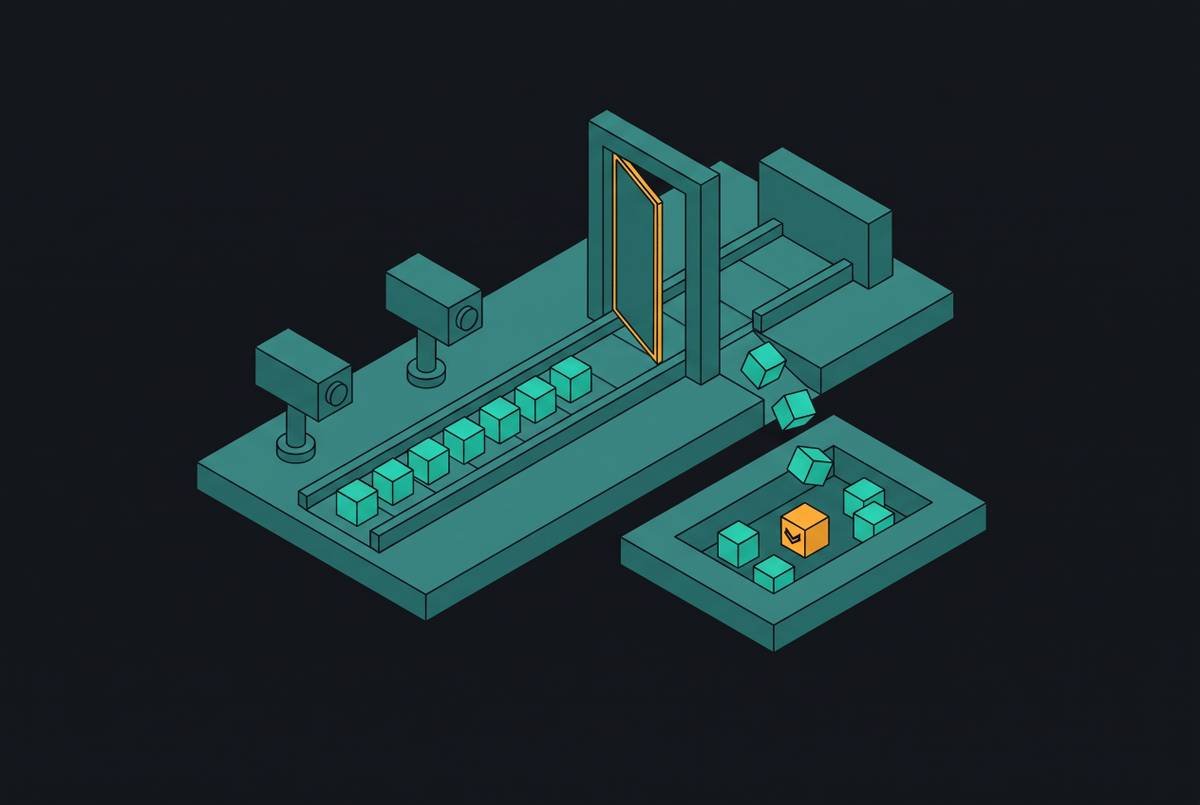
To fix the architecture, the system must make its first judgment during detection and triage, before it gives an event to an operator. Instead of alerting on any movement and asking a person to interpret it, the system evaluates context, suppresses non-actionable activity, and surfaces events that require a human call. AI-native triage systems have shown that they can cut false alarms by 60–95% before operators review them. The essential change is where reasoning takes place.
That reasoning needs more than an object label. A detected event warrants intervention depending on time of day, site-specific access rules, dwell time, behavioral patterns, and expected versus unexpected activity. A person may be expected to be there under one set of conditions, while under another someone needs to look into their presence. Context gives the triage layer a basis for making that distinction. Without it, automation risks reproducing the same raw-alert workflow under a different name.
The goal is to reserve human operators’ judgment for ambiguous situations, high-stakes escalations, and policy decisions that genuinely require it. Humans remain responsible for difficult calls rather than serving as the first-pass filter for every movement. This distinction also defines the intended result. Success depends on better access to human judgment for actionable events.
How agentic AI implements contextual triage in practice
Agentic AI applies that design by evaluating an event against the conditions that make it significant. The SARA behavioral example is a person who enters outside scheduled hours and remains beyond a threshold. Entry alone is not the complete decision. Schedule and dwell time give the activity a meaning that a motion trigger cannot supply. The system evaluates a pattern rather than forwarding an isolated movement for someone else to interpret.
SARA Verify brings AI-assisted verification to organizations that have no dedicated SOC. That makes the operating model accessible to smaller operations, where a dedicated internal review function is absent. In an example from a cannabis store, ArcadianAI reports that after-hours trespass alerts fell from roughly 40 per night to 6 per night and that evidence was better packaged for compliance audits. The example illustrates reduced review demand together with better documentation. It does not establish a universal reduction for every site.
Within this model, operators handle ambiguity, high-stakes escalation, and policy calls. Automatic logging records every event, whether escalated or dismissed, so the record does not depend on an operator reconstructing decisions after the fact. Records stay consistent even when operators are tired or different people staff a shift. An event can be removed from the human workload without disappearing from the operational record.
Where AI-native monitoring still has real limits
Moving judgment upstream makes the reliability of that judgment more consequential. Night vision, weather, occlusion, and low-quality streams remain difficult conditions, and an AI-native architecture does not guarantee competent performance under them. Poor inputs still constrain the result. Severely compressed streams, damaged lenses, and cameras operating at minimum illumination thresholds degrade AI output regardless of model quality.
Weather also introduces different forms of obstruction. Occlusion Robustness of CLIP for Military Vehicle Classification found that dispersed occlusions such as snow and rain caused greater performance degradation than contiguous occlusions. That finding applies to the model and classification task in the study, and its scope does not cover every monitoring deployment. It nevertheless gives outdoor buyers a concrete distinction to test. How well a model works behind one large obstruction does not show how well it works through dispersed rain or snow.
High-end deployments address degraded conditions through sensor fusion, pairing quality AI cameras with infrared or colour night vision and, in demanding cases, thermal sensors that detect heat signatures. These approaches do not make model selection optional. A wrong or poorly matched model can perform worse than the legacy system it replaces because it adds false confidence without improving accuracy. The practical requirement is therefore site-specific validation. Claims must hold on the deployment’s actual cameras, stream quality, lighting, and environmental conditions.
What operators and security buyers should ask before rebuilding their triage layer
For buyers, the first evaluation question is whether a proposed system suppresses non-actionable events before operator review or merely changes their order in the queue. Prioritization alone leaves the review burden intact. A prioritized queue is still a queue. Buyers should also ask which contextual factors inform suppression, including time of day, site schedule, access rules, dwell time, and behavioral patterns. Those capabilities should be validated against the actual deployment environment rather than accepted as general claims about intelligence.
The next questions concern performance and the human handoff. Buyers should require validation on real footage from the site’s camera hardware, stream quality, and lighting conditions. They should establish exactly where an operator enters the workflow and the maximum elapsed time between detection of a high-stakes event and human review. Reduced alarm volume is useful only if the workflow preserves timely access to the judgment that consequential events require.
Documentation and pricing complete the evaluation. Buyers should establish what is logged automatically and whether the record remains complete for both dismissed and escalated events, because consistent documentation serves operational and compliance needs. They should also ask whether pricing supports coverage or imposes overages that recreate pressure to mute cameras. The economics must fit the design. A rebuilt triage layer should make necessary coverage sustainable with an affordable queue.