Root-Cause Alarm Reduction Is the Only False Alarm Strategy That Keeps Every Camera Active
Fixing why cameras misfire beats muting them and losing coverage.

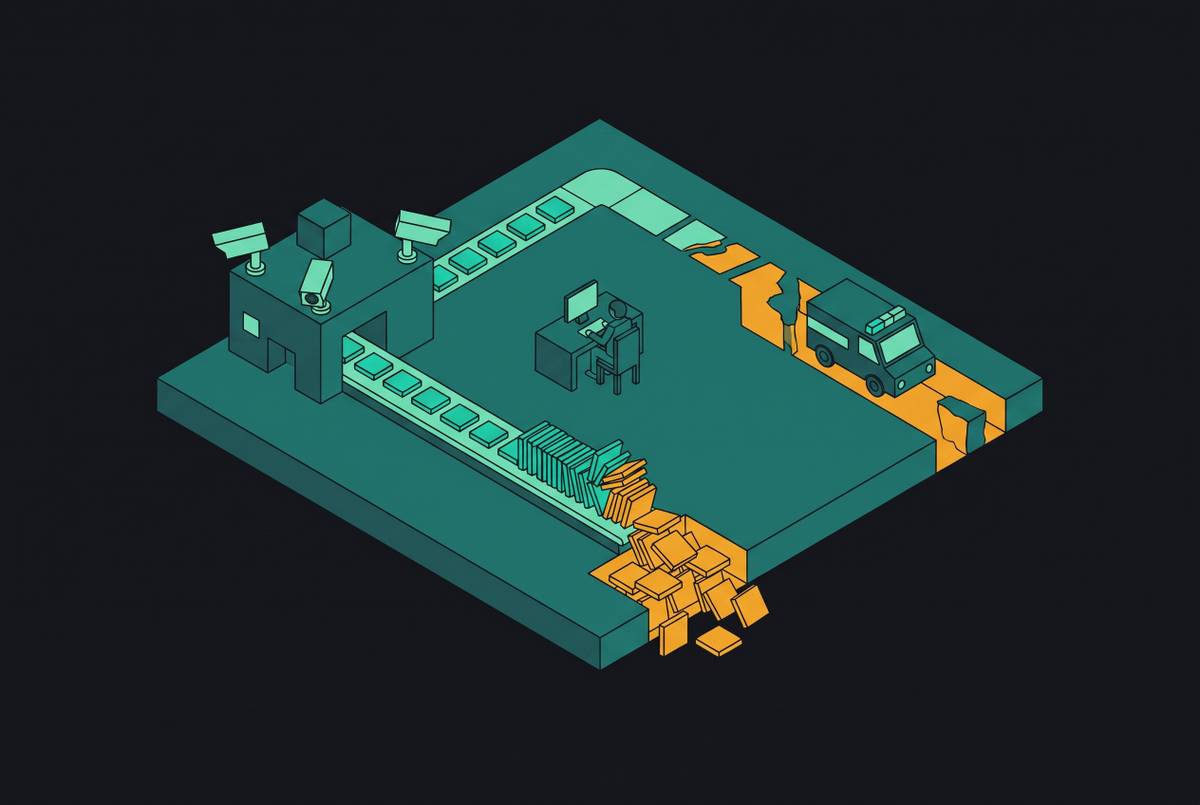
Muting noisy cameras is not a monitoring solution because it removes alerts by removing coverage, including the real events those cameras were installed to detect. Root-cause alarm reduction keeps every camera active by correcting the conditions that generate false alerts and reasoning about genuine detections before escalating them.
Why false alarms are a structural problem, not a calibration nuisance
Legacy monitoring is built to detect activity. Motion-based detection treats every pixel change as a candidate event. It cannot distinguish a person from a shadow, a delivery driver from an intruder, or a flag from a fence-climber. Those distinctions fall to the operator after the system generates an alert.
That arrangement breaks down as the number of sites grows. An operator handling dozens of sites can receive thousands of events per shift, making attentive review cognitively unworkable. More cameras add events, while higher resolution picks up more motion and cloud analytics add alerts of their own. Better sensors do not supply the missing reasoning. Greater resolution and sensitivity increase detectable activity, so hardware improvements alone can expand the workload. The central constraint is how the system interprets what it detects.
What actually generates false alarms on production cameras
Outdoor cameras encounter motion that has no security significance. Blowing trees, rain streaks, snow crossing the frame, and shifting shadows can all trigger detection. Low light makes classification harder because IR night vision produces monochrome images with less detail that the model can use. Civil twilight compounds the problem. Ambient light can fall below the sensor’s optimal range before IR illumination activates, causing the camera to boost gain and amplify noise that the model interprets as motion.
Other failures originate in the optics or configuration. IR reflected from wet pavement, a nearby window, or a spiderweb in front of the lens reaches the model as an unexplained bright shape. Retraining cannot remove the reflection at its source. Likewise, a detection zone that is too broad picks up pedestrians on a public sidewalk, while one that is too narrow misses an approach path. Neither error establishes that the detection model is defective. Both show that the camera has been asked to interpret the wrong view.
Genuine model limitations remain, but they are a different problem. A person partially hidden behind a vehicle, an animal with a human-shaped silhouette at night, or a crowd surge resembling normal pedestrian density can be difficult to classify. Treating them as equivalent to glare or a badly drawn zone obscures which part of the system needs correction.
Why muting noisy cameras and other suppression workarounds trade away coverage
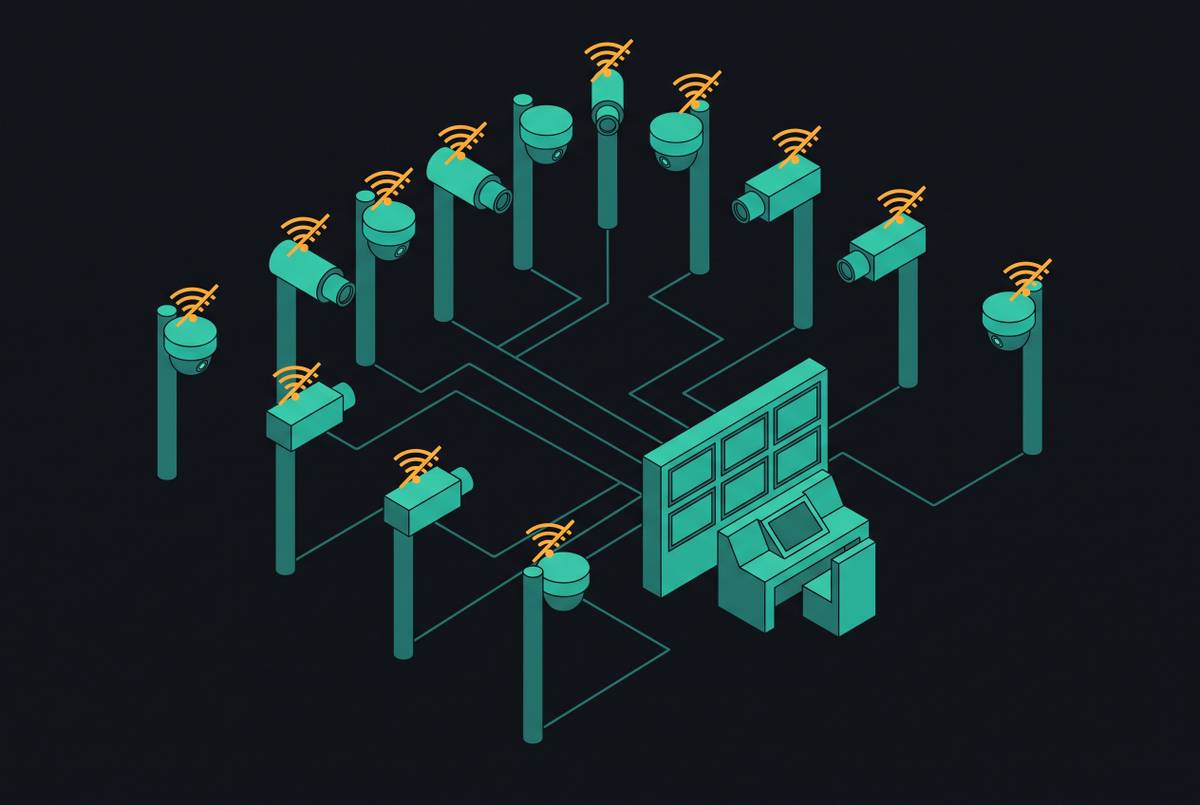
Muting, raising thresholds, and offshoring review are rational responses to an impossible queue. The weakness lies in the tools available. Muting a camera removes its events from monitoring altogether. When constant night alerts prompt that decision, the zone loses monitoring during the after-hours window when intrusion is a central concern. The camera may remain installed, but its alerts no longer provide the protection for which monitoring was purchased.
Raising thresholds makes a less visible trade. Requiring larger, faster, or higher-confidence events reduces nuisance alerts, but slow approaches, partial occlusions, and low-contrast targets can fall below the new threshold. These are also conditions under which an intruder can operate. A setting that works under average conditions can therefore suppress genuine activity at the edges. Quiet achieved through lower detection sensitivity is not evidence that the original noise source has been fixed.
Offshoring review preserves the incoming stream but adds another dependency. Lower-cost operators scrub clips before escalation, managing events that should not have required human review. Each hand-off introduces latency, and an urgent event can wait in a cross-time-zone queue. Labor costs and turnover also keep the economics under pressure. This workaround weakens timely response while leaving the source of the workload intact.
How operator alarm fatigue turns suppression into a coverage collapse
Repeated false signals erode the judgment on which legacy monitoring depends. Operators begin to downgrade new alerts, response times lengthen, and clips receive less complete review. Genuine threats then encounter the skepticism created by previous noise. This is a predictable consequence of requiring sustained attention to a stream dominated by events that do not warrant action.
Muting can consequently become an act of self-defense for an operator who needs immediate relief from the queue. The relief creates a further calibration problem. Too many false alarms lead to suppression, which reduces coverage and makes the genuine events that still come through stand out against a baseline made artificially quiet. That disrupted baseline further weakens operator judgment, closing a loop in which the attempt to restore attention undermines the coverage that attention was meant to protect.
What law enforcement and cities are doing as the false alarm burden grows
Police departments and cities are limiting the resources consumed by unverified alarms. Verified-response and non-response policies increasingly require corroborating evidence, including video, audio, an eyewitness, or a panic button, before officers are sent. These are resource decisions with direct consequences for buyers. A monitoring program that produces an alarm but cannot establish what happened has a less reliable route to police response, even when an intrusion has occurred.
Fines add weight to that change in response policy. Chicago charges a per-false-alarm fee with zero tolerance for commercial premises, while residential and certain other premises are exempt. Toronto levies per-dispatch fines and issues over 20,000 annually. Under Baltimore City Code §8-9, sites with repeated false alarms can be put on no-response status, except for hold-up or panic alarms. Dallas, Calgary, and suburbs such as Sandy Springs have introduced measures including steep fines, repeat-offender penalties, lower prioritization of unverified dispatches, and mandatory verification requirements.
The Combating Organized Retail Crime Act passed the U.S. House in May 2026 and sits with the Senate. If enacted, it would make timestamped, verified video evidence significantly more valuable to prosecutors. A quiet internal queue cannot compensate for missing coverage when a response or prosecution depends on evidence of the event.
What root-cause alarm reduction actually requires at the camera and zone level
Root-cause reduction begins with the specific camera and scene. Where IR reflects from wet pavement or a window, repositioning the lens or adding a glare shield addresses the optical trigger. A model update does not correct that geometry. Detection zones also need to cover the site’s approach paths and the areas it protects, leaving out public sidewalks or tree lines where motion poses no security threat.
Calibration then has to reflect both place and time. An entrance in the early hours does not present the same conditions as a loading dock during shift change. Thresholds set for each camera and each hour account for those differences, so one setting for the whole system need not force a choice between over-triggering and blind spots. Fora Soft describes calibration against site-specific data as necessary and frames anomaly detection around a contextual, temporal model of normal activity.
Good configuration still leaves difficult visual cases unresolved. Partial occlusion, animals that look human-shaped at night, and crowd density that is hard to judge test how well the model understands what it sees. Cameras with dedicated on-device processing and frequent model updates have an advantage in these cases. Yet better classification is only part of the remaining work. Even a correctly identified person can represent either routine activity or a developing threat.
Why object detection alone cannot close the gap that configuration opens
A clean detection does not establish a security concern. A camera can correctly identify a person in a parking lot late at night without determining whether the person is an employee leaving late, a delivery driver, or someone who has been circling the lot. Classification establishes presence. Separating those possibilities requires time, zone, duration, prior activity, and behavioral context.
Experienced operators use patterns that a presence-only classifier misses. Extended lingering in high-value sections, repeated visits, attention to camera placement, and vehicles circling a lot can change the significance of otherwise ordinary detections. The distinction is especially important in retail and parking environments. Most correctly detected people are legitimate, so alerting on every person can rebuild the queue even after glare, zones, and sensitivity have been corrected.
How agentic AI triage keeps every camera active while clearing the queue
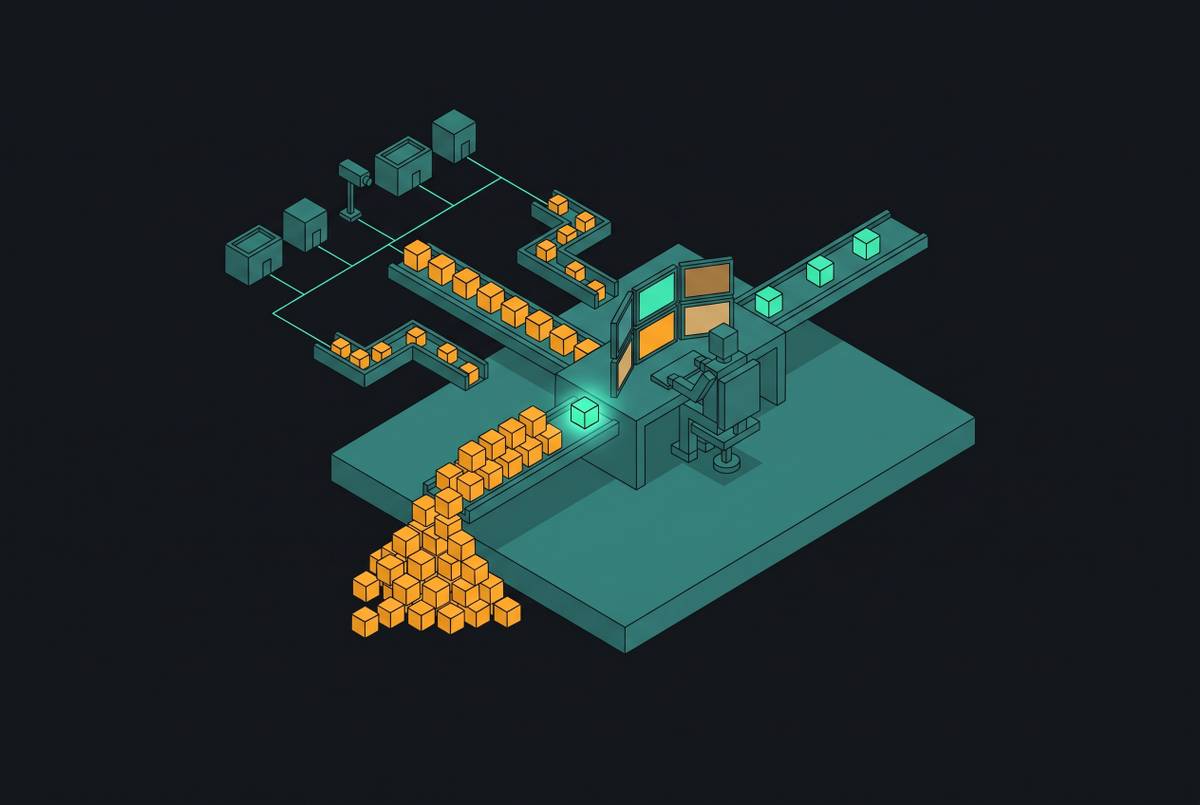
Agentic triage inserts that reasoning before a confirmed detection reaches an operator. The camera remains active, the detection fires, and the agent evaluates whether the person, vehicle, or condition warrants human attention. The agent deals with routine activity without sending the clips on for someone to scrub. This is the decisive difference from suppression. Raising a threshold prevents some events from entering the system, while reasoning evaluates detected activity before deciding whether to escalate it.
Human judgment remains part of the design. Agents handle routine and classifiable activity, while ambiguous and high-stakes events reach trained operators who can act on them. Dealing with routine events first keeps a threat from waiting behind a long line of clips that need no action. The operator’s task becomes a judgment call about an event that needs attention, rather than another attempt to find significance in noise.
That outcome depends on the quality of the underlying detection. The wrong model, or one used on footage conditions for which it was not calibrated, can perform worse than a well-configured legacy system. Site-specific calibration is therefore a prerequisite. Agentic triage cannot substitute for fixing bad optics or an inappropriate zone. Its role is to resolve the contextual uncertainty that remains after those upstream problems have been addressed.
Where agentic monitoring changes the practical economics of remote guarding
Traditional monitoring costs follow the event stream. More events demand more review time, which requires more seats or encourages compromises in sensitivity and review arrangements. Agentic triage changes that relationship by resolving the classifiable majority before humans become involved. Camera count no longer translates proportionally into operator load. One trained operator can cover more sites because the work reaching that operator is selected for judgment.
Retail and parking environments make the value of preserved coverage concrete. Scouting can involve extended lingering, repeated visits, or vehicles circling a lot, none of which becomes useful evidence of a pattern if monitoring has been disabled at the relevant camera. Suppressed thresholds can similarly exclude the subtle activity that contextual analysis needs. Active cameras supply the observations from which behavior can be interpreted. Their value is therefore not just in producing an immediate intrusion alert, but in keeping the relevant activity available to the reasoning layer.
Verified-response policies add another economic consideration. A timestamped, verified event package supports a substantiated dispatch request and helps avoid penalties associated with unverified alarms, without guaranteeing a particular police response. The business case consequently depends on more than the cost of a review seat. It includes the coverage retained, the operator attention available for consequential events, and the ability to support a response with evidence.