Why Camera Count Does Not Equal Monitoring Coverage
More cameras mean nothing without the capacity to actually watch them.
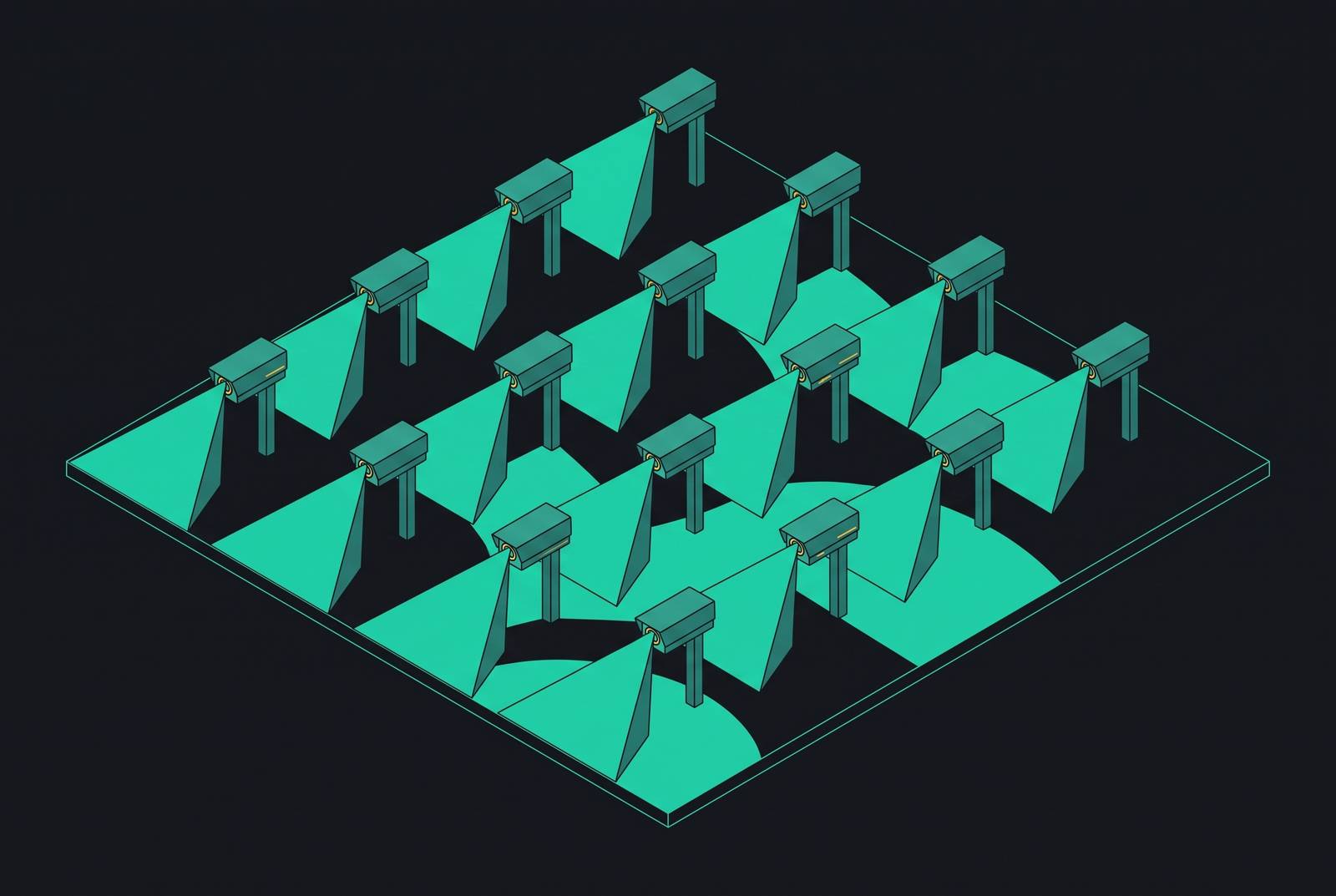
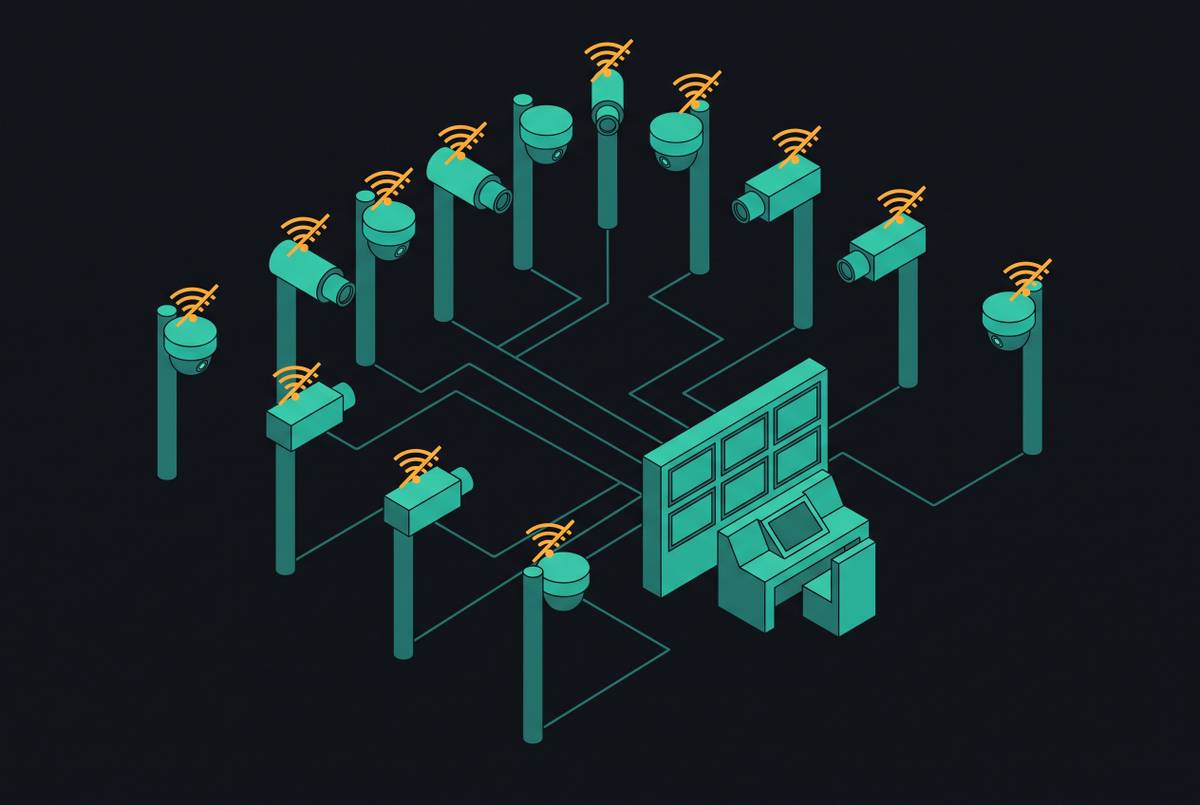
The instinct runs deep in physical security: if a property has a blind spot, add a camera. If a parking lot feels exposed, add three more. The assumption behind that instinct, that camera count and coverage are the same thing, breaks down against a simple follow-up question: who is reviewing what each camera sees, and how fast? Camera count expands what could be watched. It does not expand what is actually watched, because that depends on review capacity, not the number of lenses pointed at a parking lot. Every camera you add to a monitoring system generates more alarms, and each alarm adds load to the same finite pool of human attention that has to review it. Research on control room operators has long documented a vigilance decrement, a drop in detection accuracy that sets in after a short stretch of continuous monitoring, and no amount of staffing can repeal it. If you add cameras without changing how alarms get reviewed, the gap between what's recorded and what's actually seen gets wider, not narrower.
How alarm volume turns a monitoring center into a queue
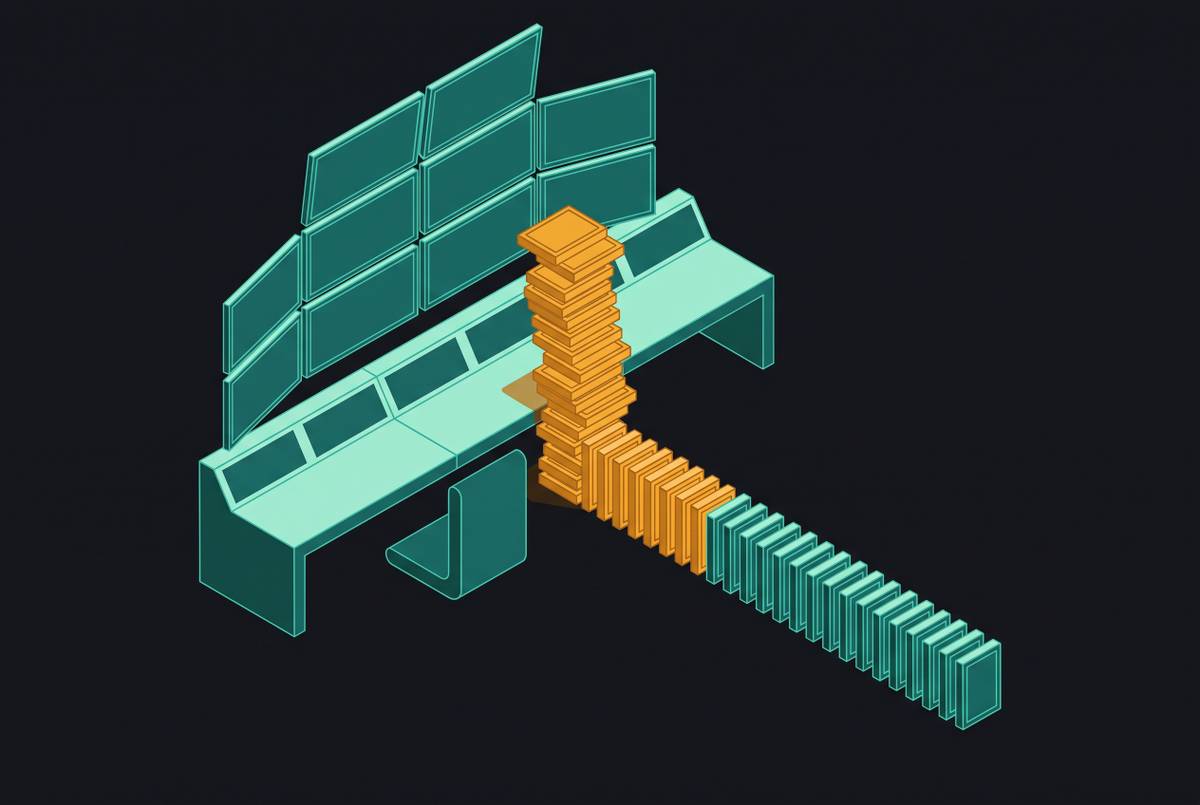
When the number of alarms arriving exceeds what operators can evaluate one after another, a monitoring center stops behaving like a watch post and starts behaving like a backlog. Real threats end up waiting in line behind false positives, with no mechanism to jump the queue. Motion-based detection and simple rule triggers, wind moving a branch, a shadow shifting with the sun, a delivery truck idling at a dock, generate a near-constant stream of alerts across any multi-camera facility, and that queue does not stop growing on its own. The overwhelming majority of those activations require no response at all, so operators end up spending most of their attention on events that don't matter. The rational human adaptation to that environment is to treat every incoming alert with a little less urgency than the last one. That is a sensible response to a signal-to-noise ratio that has gone wrong, and it happens to operators regardless of how experienced or diligent they are. Hiring more operators does not solve the queue, because more headcount applied to the same unfiltered stream just scales the backlog. It does not change the architecture producing it.
A wall of monitors has stopped functioning as a reliable sign of operational control. In many cases, it has become a symptom of information overload, one that buries the very crises it was installed to catch. Genuine threats blend into the background noise, and when an operator does catch something serious, it's often because of sheer persistence against the system. The costs of that compound over time. Security leadership loses the ability to show that the camera investment is paying off, operator burnout drives turnover, and the staffing shortage the cameras were supposed to solve gets worse.
How traditional monitoring vendors respond to the queue, and why none of it works
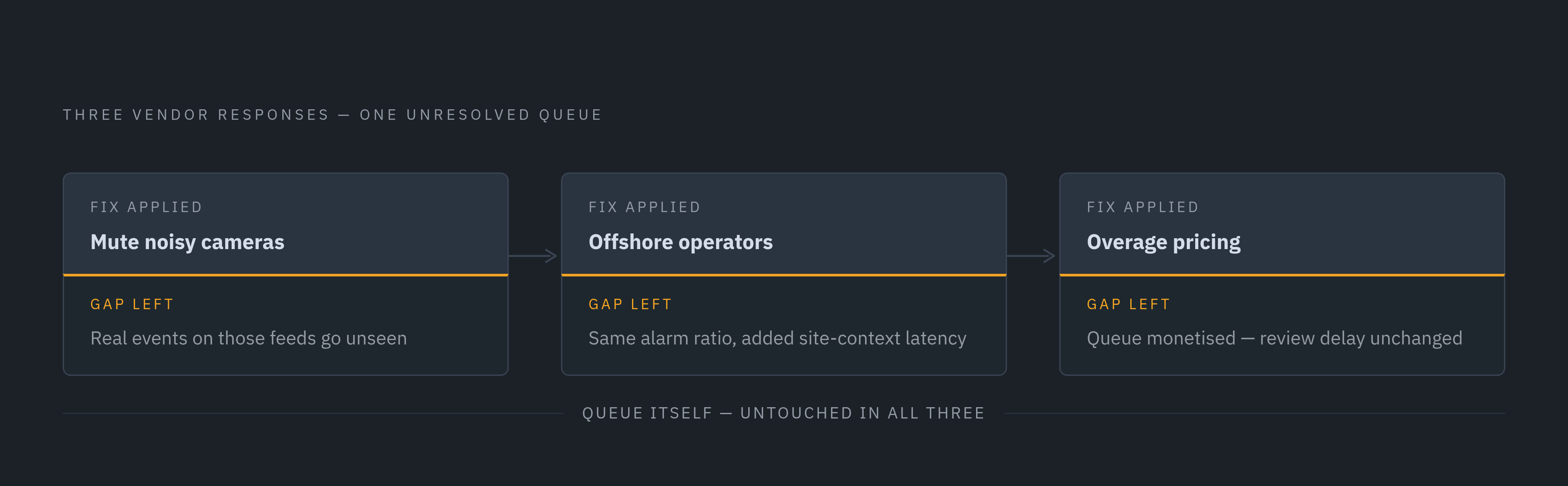
Legacy monitoring vendors have responded to the queue. They've responded to it, just not in ways that fix the underlying math. The most common response, muting or suppressing cameras that trigger too often, trades away coverage to reduce alarm volume: the camera keeps recording, but it has effectively stopped being monitored, which is exactly the false assurance a buyer was trying to avoid when installing it. This is a direct answer to why muting noisy cameras is not a monitoring solution: the alert volume goes down, but so does the odds that anyone sees a real event on that camera when one occurs. Offshoring operators to lower-cost labor markets cuts cost, but it doesn't touch the ratio of alarms to operators; a cheaper operator facing the same unfiltered queue produces the same delay, often with added latency because that operator lacks site-specific context. With overage pricing, a vendor charges more during high-volume periods, so the cost of peak alarm traffic passes to the client, but there's no promise that alarms during those peaks get reviewed any faster. It monetizes the queue.
None of this reflects bad faith on the part of these vendors. Muting cameras, offshoring labor, and charging for overages are all rational short-term responses to a system that generates far more alerts than any team of humans can meaningfully evaluate. Staffing alone cannot outrun a biological limit on sustained attention. The fix has to change what reaches the operator in the first place, not push the operator to work harder against a queue that keeps growing no matter how fast they clear it.
What it would take to know that every alarm gets reviewed in time to matter
Genuine coverage has three measurable properties that camera count cannot stand in for: whether every alarm gets reviewed, how fast a verified threat reaches a human who can act on it, and whether the system has enough site-specific context to tell a real event apart from noise. Review completeness matters just as much as speed. A system that reviews alarms selectively, skipping low-priority queues, suppressing certain feeds, batching reviews to catch up during quiet periods, has gaps in coverage that no camera-count figure will ever reveal to a buyer looking at a proposal. Site-specific context is the third piece, and whether the first two hold up under real conditions depends on it: an alarm classification that ignores whether an event is happening during authorized hours, in a zone with a scheduled maintenance crew, or at a site with its own after-hours protocol will generate false positives at a rate that degrades both review completeness and speed at once. A monitoring SLA that promises round-the-clock coverage but does not specify alarm review time, queue discipline, or false-positive filtering is only measuring inputs, cameras powered on, a center staffed around the clock. It says nothing about outcomes: threats actually found, responses actually dispatched. Any buyer evaluating a monitoring contract should treat those three properties, review completeness, speed to verified threat, and site-specific context, as the actual spec, with camera count and staffed hours as secondary details.
How AI agents change the ratio before an alarm reaches a human operator
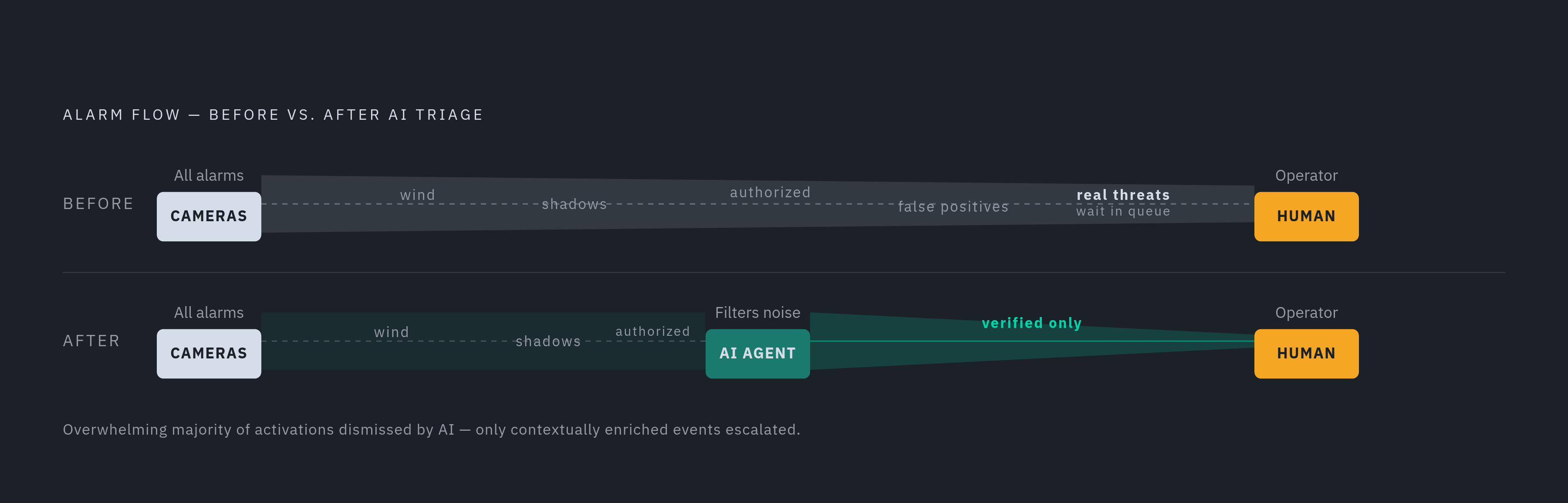
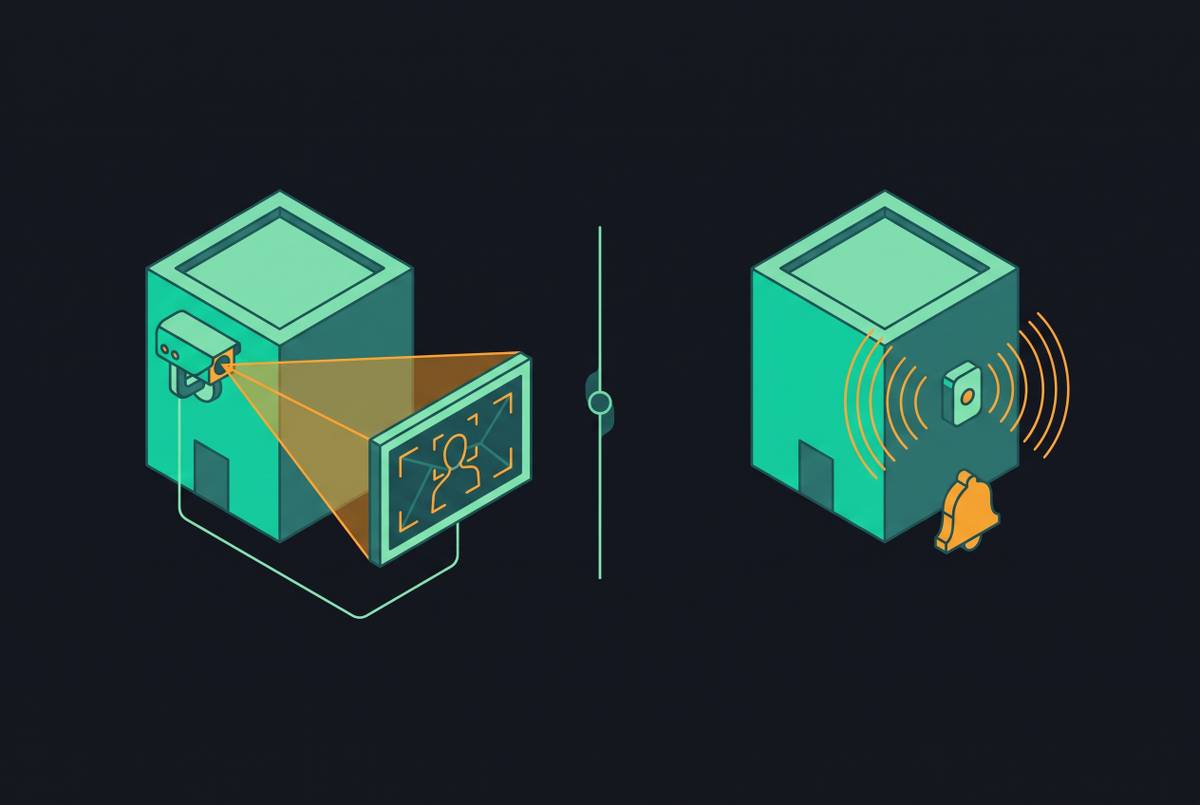
The only architectural fix for a growing queue is changing what reaches the human operator before it gets there. AI agents can review every alarm first, dismiss environmental noise and known authorized activity, and escalate only verified events, fixing the ratio at its source. Video analytics built for this purpose can analyze footage as it's captured, generate metadata describing what's in frame, and flag only relevant events, so most false alarms from common nuisance triggers like weather and animals get cut out before an operator ever sees them. Services like Verdun invert this dynamic by deploying AI agents to filter alarms before they reach human operators, removing false positives and environmental noise at intake so operators focus only on verified threats rather than drowning in a backlog of routine activations.
The agent's ability to reason about an event, rather than simply flag motion, depends on context. Site policy, time of day, known authorized activity, and recent event history are the inputs that let an AI agent tell a genuine deviation apart from routine operations at that particular property. Without that context built into the reasoning layer, even a correctly classified event can trigger the wrong response, or none at all, because the system has no way to know whether the activity was authorized. Pixel detection without protocol context is filtering, and what an operator trusts in what lands in front of them depends on verification. The human operator's role in this arrangement does not shrink. It improves: operators who receive only verified, contextually enriched events make faster decisions, experience less fatigue, and work from a signal they can trust. AI agents and trained human operators don't compete for the same job. Filtering before the human sees anything, rather than muting the feed, is how security teams handle alert fatigue without turning off camera notifications.
Applying this architecture across commercial, multifamily, and industrial sites
The same gap, cameras installed, alarms left unreviewed, threats arriving late, appears differently depending on the property type, and the protocol layer that makes AI filtering useful has to be tuned to each one.
In commercial settings, retail stores, employee parking lots, truck yards, after-hours theft is the dominant threat, and the single most important protocol variable is the line between authorized hours and closed hours. If an AI agent can't reason about business hours and staff schedules, it can't reliably tell a closing employee apart from an intruder. Alarm verification also carries weight with law enforcement response: video-verified alarms, where a responding officer gets visual confirmation of an active event, receive prioritized dispatch, while unverified alarms increasingly face delayed or no response at all as more municipalities adopt verified-response policies.
In multifamily residential properties, common areas, parking structures, and entry points generate constant ambient activity, and a system without resident schedule context will keep flagging ordinary tenant behavior as something to review. The expected standard for residential security is shifting as AI-based video analytics become affordable: a monitoring gap that was once tolerable simply because better technology cost too much is harder to justify once that technology is within reach.
In industrial sites, warehouses, yards, logistics facilities, shift-change periods create the sharpest test of a protocol system. A loading dock camera during off-hours and that same camera during an active shift should trigger entirely different response chains, and a system without dynamic protocol logic cannot draw that line. The coverage gap in industrial settings also carries physical safety consequences alongside theft risk: unauthorized entry into a zone with active equipment is a different category of event from a perimeter intrusion, and the system's context layer has to encode that difference.
Across all three settings, the same diagnostic stands. If an alarm fires right now, how long before a human with the context to act on it actually sees it, and is that person looking at a verified event or stuck behind everything else in the queue?
Evaluating a monitoring vendor on coverage rather than camera capacity
A buyer who evaluates monitoring vendors by camera capacity, coverage area, or number of supported feeds is measuring inputs, not the thing that actually matters. You should start by asking a vendor for its median time from alarm trigger to human operator review, measured at peak volume, not a general staffed-hours claim that says nothing about how long alarms actually sit before anyone looks at them. It continues by asking what share of alarms reaching operators are verified events rather than noise, and how that ratio holds up as the vendor's client base grows, since a ratio that only looks good at small scale tells a buyer little about what happens under real load. A third question to put to any vendor is how the system incorporates site-specific protocol, authorized schedules, known personnel, zone-specific rules, and at what point in the review chain that context actually gets applied, because a system that only applies context after a human is already looking at the alert has already spent the time it was supposed to save. What happens to review time when alarm volume spikes: does the queue grow, or does the architecture absorb the spike without added delay? And finally, a buyer should ask what the vendor's SLA actually guarantees, and whether it specifies alarm review time at all or only covers uptime and staffing hours, since the latter promises a center is open without promising anyone inside it is keeping pace with what comes in.
If a monitoring service can't answer the queue-time and false-positive questions with real measured data, it's describing inputs, and its cameras are recording evidence. Verdun's architecture is one example of a system built to answer each of those questions directly: AI agents review every alarm first, filtering out environmental noise and authorized activity before anything escalates, so a verified threat reaches a trained human operator quickly instead of waiting behind an undifferentiated queue, and site-specific protocols shape what the AI reasons about, not simply what it flags. The right number of cameras for any property is the number whose alarms can actually be reviewed, in time to matter, with enough context behind them to act. That ceiling is set by the monitoring architecture behind the cameras, not by how many of them are mounted on the wall.