How Queued Alarms Cascade Into Unrecoverable Response Gaps During Live Incidents
Alarm backlogs, operator errors, and silent drops erase the window to intervene.
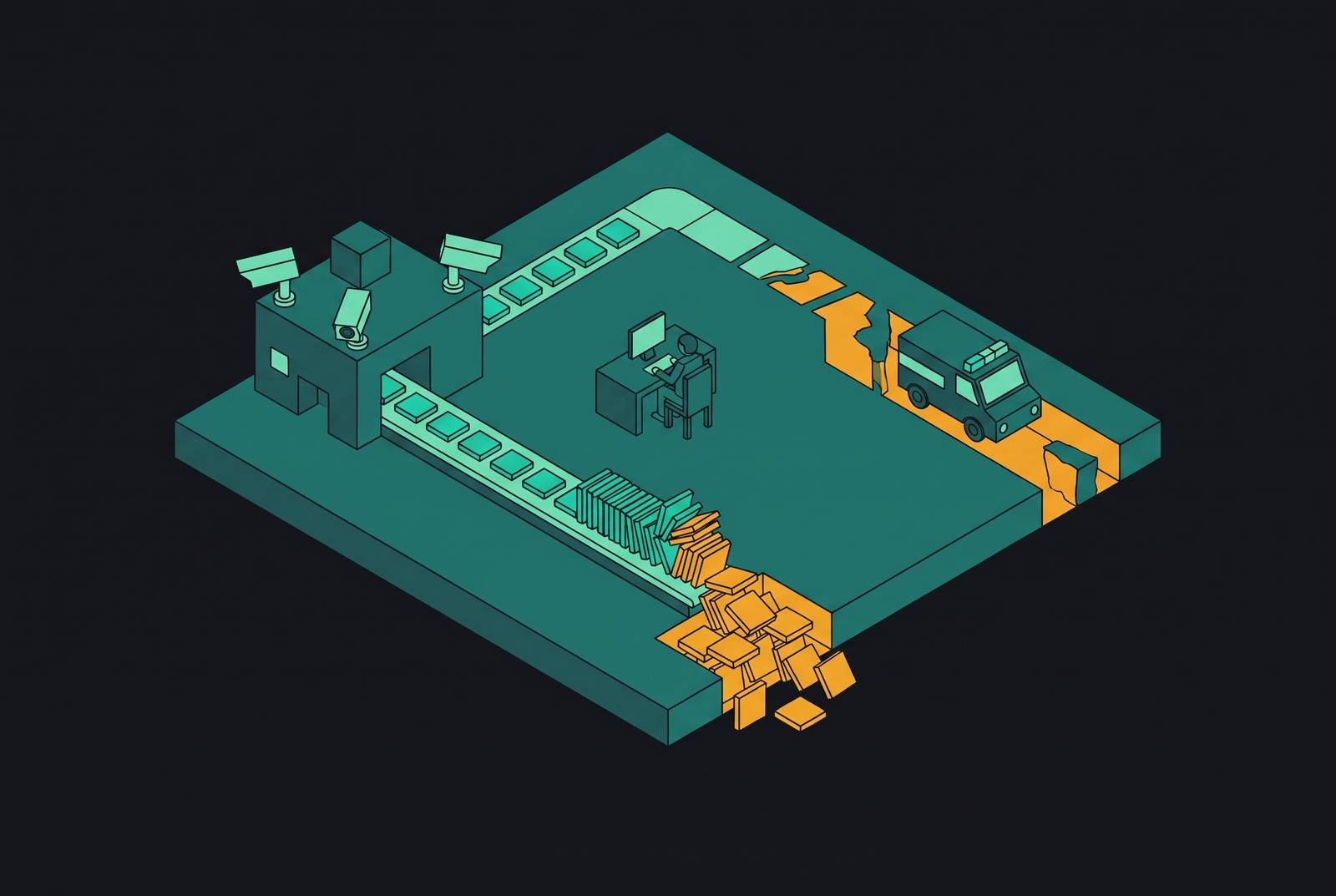
Alarm response time failure in traditional video monitoring centers starts when more alerts come in than people can review accurately. The backlog then grows as non-threats take up attention, operators make more mistakes, and live incidents go on without anyone stepping in. Preventing unrecoverable response gaps requires an architecture that filters noise before human review, rather than relying on operators to clear every raw alarm.
Why alarm queues don't just slow response — they erase it
An alarm trips at a truck yard after hours. It joins a queue already deep with motion and environmental events, each waiting for an operator to decide whether anything requires action. The new alarm may represent a genuine intrusion, but its urgency does not automatically move it ahead of earlier alerts. The incident continues while the alarm waits. What appears to be a temporary processing delay can therefore consume the period in which intervention would still be useful.
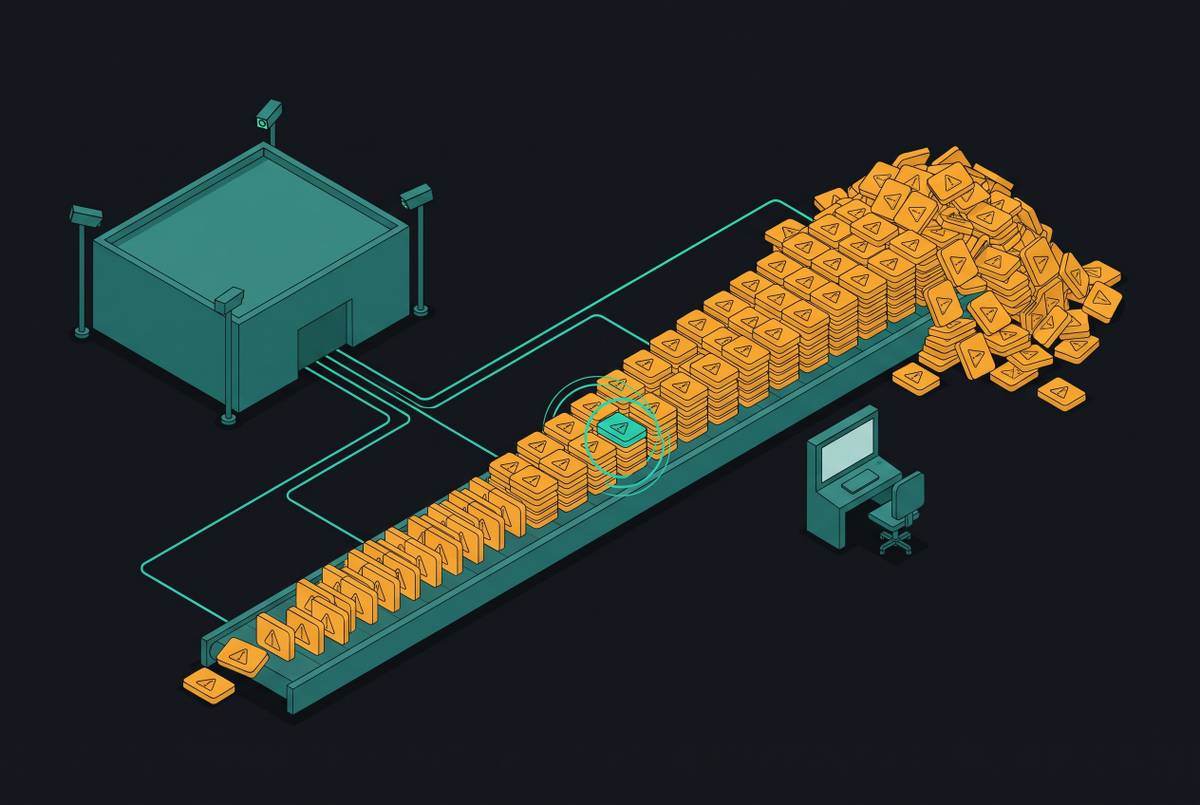
The expectation that “someone is watching, they'll get to it” assumes that operators can drain the queue faster than events fill it. When incoming volume exceeds review capacity, each new alarm inherits unfinished work. The queue creates a priority inversion, as older non-threats take up attention that a newer threat needs right away. Adding staff can increase throughput, but it does not change that ordering problem. Nor does it prevent a surge from overtaking the new capacity. Preventing that requires changes to the design as well as staffing.
Why do monitoring centers fall behind on alerts during high-volume periods?
Traditional monitoring queues fill mostly with non-threats because generating an alarm and assessing a threat are separate tasks. A device detects a condition, but the operator must establish whether that condition represents a security event. Motion and environmental activity consequently demand review even when no response is needed. This is a familiar industry problem. The real-threat signal is rare within the stream, while the work required to find it remains attached to every activation.
In the legacy model described here, there is no meaningful separation of signal from noise before human review. Every alarm enters the same queue and requires an attention cycle, regardless of its likely significance. More harmless activity thus adds work for the same people who have to spot real threats. The additional work is the cost of using human judgment as the first filter for a noisy signal stream.
That design also pushes operators to clear events quickly when they look familiar. Seeing false activations over and over encourages operators to decide from patterns and what they expect, with less fresh scrutiny of the evidence. Faster closure can make the queue appear healthier while reducing the quality of review. The apparent relief has a hidden cost. A system can process more alarms without becoming better at distinguishing the few that require action.
How operator attention degrades as the queue builds
A growing queue becomes a cascade when the people clearing it also become less accurate. Demand rises while effective review capacity falls, because an operator's useful output is the number of sound decisions completed while action remains possible. Speed alone is an inadequate measure of capacity. Operators managing many screens already divide their attention under ordinary conditions, and a sustained backlog adds pressure to shorten each assessment.
Under that pressure, operators may close low-severity alarms without reviewing them fully so they can get to events marked urgent. This strategy depends on the labels being accurate. A genuine intrusion that arrives mislabeled can be cleared without a decision about what the evidence actually shows, while an unchecked label during a volume spike can produce the same result. The alarm leaves the queue, but the threat has not been assessed.
Delay and misclassification are therefore parallel outputs of the same overloaded system. Some threats remain unreviewed because operators cannot reach them, while others disappear from the workload through premature closure. Queue length alone cannot distinguish those outcomes. A shorter backlog may reflect completed verification, or it may reflect reduced scrutiny. This is why evaluating performance under load requires attention to review depth as well as processing speed.
The hardware layer that makes queue overflow structurally invisible
Overflow can also prevent an alarm from reaching the visible workload at all. GitHub issue #161 describes a device-level queue with a drop-newest policy, in which a new record is refused before receiving a sequence number. The server therefore cannot detect the loss as a missing number in the alarm sequence. The absence looks like an absence of activity. This is a failure specific to this implementation.
The associated defect set the latch marking a condition as “reported” even when the queue had rejected the record. An active condition could consequently remain silent until it cleared and re-tripped or the device rebooted. PR #217, merged on 2026-10-01, made that latch conditional on an accepted push. An operator can eventually examine a waiting alarm, but cannot review an event that was never admitted to the queue.
This creates a gap that does not announce itself as an outage. The monitoring record contains no sequence break to expose the lost event, even though a condition on site remains active. A quiet record is therefore not, by itself, evidence that nothing happened. Software queue statistics and operator response reports cannot account for an alarm they never received.
Where the time actually goes — the response chain from sensor trip to dispatch
The response chain begins before an operator sees a ticket and continues after the operator opens it. Sensor recognition and entry delay precede review, which is followed by call-list outreach, verification, and handoff to the public safety answering point, or PSAP. The PSAP queue and dispatch process add more time before arrival, and that delay varies. These stages do not contribute equally to total latency. The queue-dependent work around operator outreach and the dispatch handoff absorbs most of the delay.
An alarm's place in the queue sets when verification can start, but verification also affects what happens next. A verified threat can receive a faster dispatch priority than an unverified alarm treated as routine. Waiting therefore has a second potential cost. It can consume the opportunity to establish the evidence needed for a higher-priority response, leaving subsequent stages to proceed without that advantage. Clearing the alarm from the monitoring queue does not mean the response chain has caught up.
Noonlight's 2025 emergency response report publishes a time-to-first-operator-touchpoint benchmark, which marks a human handoff. A prompt first touch does not establish when a verified determination reached a dispatcher, or whether intervention was still possible then. The unmeasured interval can contain substantial work. An SLA that ends at ticket opening describes access to an operator.
Why the gap becomes unrecoverable past a certain point in a live incident
A live incident has a response window that exists independently of the monitoring queue. If waiting and verification consume that window, faster processing afterward cannot restore the opportunity to intervene. A completed theft cannot be prevented retrospectively. An unauthorized person who has left the site cannot be intercepted there by a response that arrives later, and damage already done cannot be undone by clearing the backlog. Later action may still serve other purposes, but it is not the intervention that the earlier alarm could have enabled.
Each period in which arrivals exceed completed reviews adds unfinished work, and each waiting threat continues to develop during that period. If reviews also become less accurate, the center can make fewer sound decisions even as its workload grows. The resulting loss is nonlinear because an additional delay can move an incident from recoverable to completed, rather than merely making the same outcome arrive later.
Shared staffing extends this exposure across sites. A volume spike at one location consumes the operator capacity available to every other location served by the same pool, so a local burst can become a portfolio-wide response problem. Once a response window has closed, recovery of queue performance is not recovery of the lost outcome. What architecture could prevent that cascade before the raw event stream reaches the operators?
What the architecture would need to look like to prevent the cascade
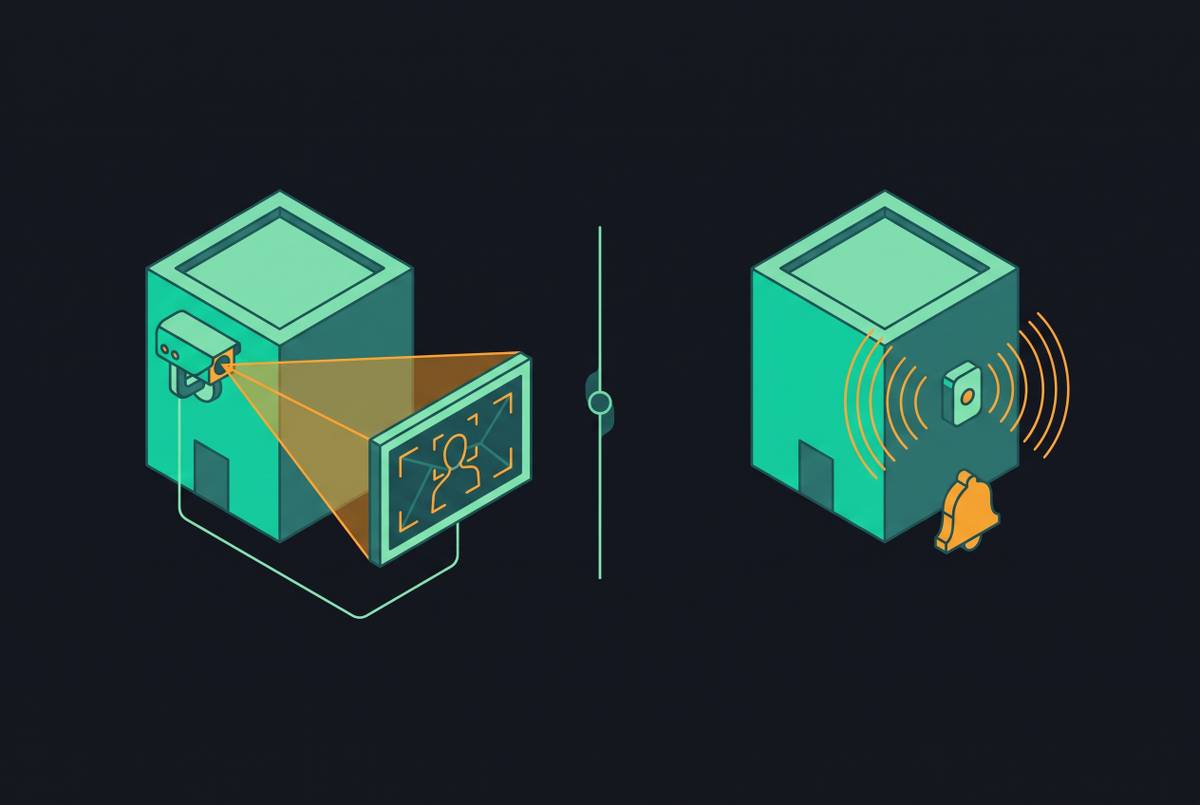
A filtering layer must review incoming alarms at machine speed and dismiss noise before it enters the human-review queue, while a human layer receives escalated events with the context needed for a decision. The operator workload must be structurally smaller than the raw stream. Adding people lets the center process more alarms, but non-threats still create work. AI-augmented human review changes that relationship by assigning filtering and response judgment to different layers.
The filtering layer must judge what happened rather than just pass on motion detections under a new label. AI agents need site-specific context, including schedules, authorized activity, and expected movements, to distinguish an ordinary event from a threat. An expected delivery truck at a designated dock can then be dismissed without human review. Without that context, the same arrival competes with a genuine intrusion. The system needs site knowledge to make decisions from the start, so that knowledge must be in place when the system is deployed.
Context also separates meaningful triage from a threshold rule. A system that flags less motion may send fewer alarms, but that alone does not show that it is better at picking out threats. An architecture that reproduces the original false-alarm stream at a different layer has relocated the bottleneck. Its human queue may still fill with events that a properly contextualized assessment could have resolved earlier.
In this design, human operators retain responsibility for response decisions. They receive verified, contextualized events, directing their training toward judgment. The role becomes narrower and more consequential. A center can consequently cover more sites with the same headcount because fewer non-threats compete for human attention.
What buyers should actually be asking monitoring vendors about queue behavior
For buyers, the practical test is how the system behaves when demand exceeds capacity. What is the alarm review process when inbound volume surpasses operator throughput, and in what order are waiting alarms resolved? The answer should distinguish admission, prioritization, and completed review. Normal-volume performance cannot show how a system behaves when demand exceeds review capacity. A vendor needs to explain whether alarms generated during a spike are queued, dropped, or examined at the same depth as other alarms.
What is the false-alarm rate on video events reaching operators, and how is that rate measured? How do schedules, authorized personnel, and expected activity shape pre-review triage, and who maintains that context over time? These questions expose what the filtering layer actually does. A structural solution will describe both a pre-human triage process and the shorter human-review queue it produces.
The SLA deserves the same scrutiny. Does it measure first operator touchpoint, or the time to verified determination and dispatch? A buyer should be able to distinguish the start of human attention from the delivery of an actionable conclusion. Ticket opening is not response completion. The vendor's explanation should make clear which interval is measured and what happens to the remaining work when the queue is under load.
Alarm muting leaves less work in view, offshore staffing adds coverage, and overage pricing changes how much capacity costs, but none of these measures on its own separates threats from noise before human review. Buyers can assess those measures without accepting them as proof that the cascade has been prevented. A vendor that has solved it can explain its queue behavior directly, while one that cannot is describing the legacy model in new language.