Operational Workarounds Security Teams Use When Alert Volume Outpaces Staff Capacity
Muting and delaying alerts may ease staffing strain but leave real threats unreviewed.

Muting noisy cameras fails as a monitoring solution because it removes alerts by removing active coverage and leaves false alarms mixed with threats. Muting, raising thresholds, batch processing and rotating analysts help security teams cope with overload, but leave the underlying queue problem intact. For monitoring to work, continuous alert investigation must be separate from human response so real threats do not wait behind noise.
Why alert volume outpaces staff capacity in the first place
Detection tools are deliberately tuned to minimize missed threats, so noise is a built-in consequence of their sensitivity. Each new tool or camera source adds its own alert stream, often with its own rules for how severe an alert is. Those streams do not coordinate their demands on human attention. One event can then set off several separate alerts in overlapping systems, and each alert needs to be reviewed. Detection can grow faster than people can investigate.
Fidelis Security identifies tool sprawl, overly broad detection logic and lack of enrichment as compounding causes of overload. Together, they increase the number of alerts while leaving analysts without the context needed to resolve them quickly. The overwhelming majority of traditional alarm signals are false, yet each enters the queue and demands a review step. An operator must spend attention before knowing whether that attention was warranted.
Environmental growth makes the imbalance worse. Cloud infrastructure, remote systems, IoT and expanded camera coverage all add sources to the stream. Even when things run as usual and teams have enough well-trained staff, the queue may never empty. Triage then shifts from investigation toward data entry as people focus on clearing items to stay afloat, leaving threats unverified. The workarounds that follow are rational adaptations to that baseline.
Why muting noisy cameras is not a monitoring solution
Muting a source that sends many alerts cuts the queue at once, but it also cuts coverage along with the noise. The decision has a clear operational logic. A camera or rule producing hundreds of false positives and almost no true positives consumes attention that could go to more useful sources. Silencing it makes the remaining workload more manageable. It does not establish that the activity previously generating those alerts is safe.
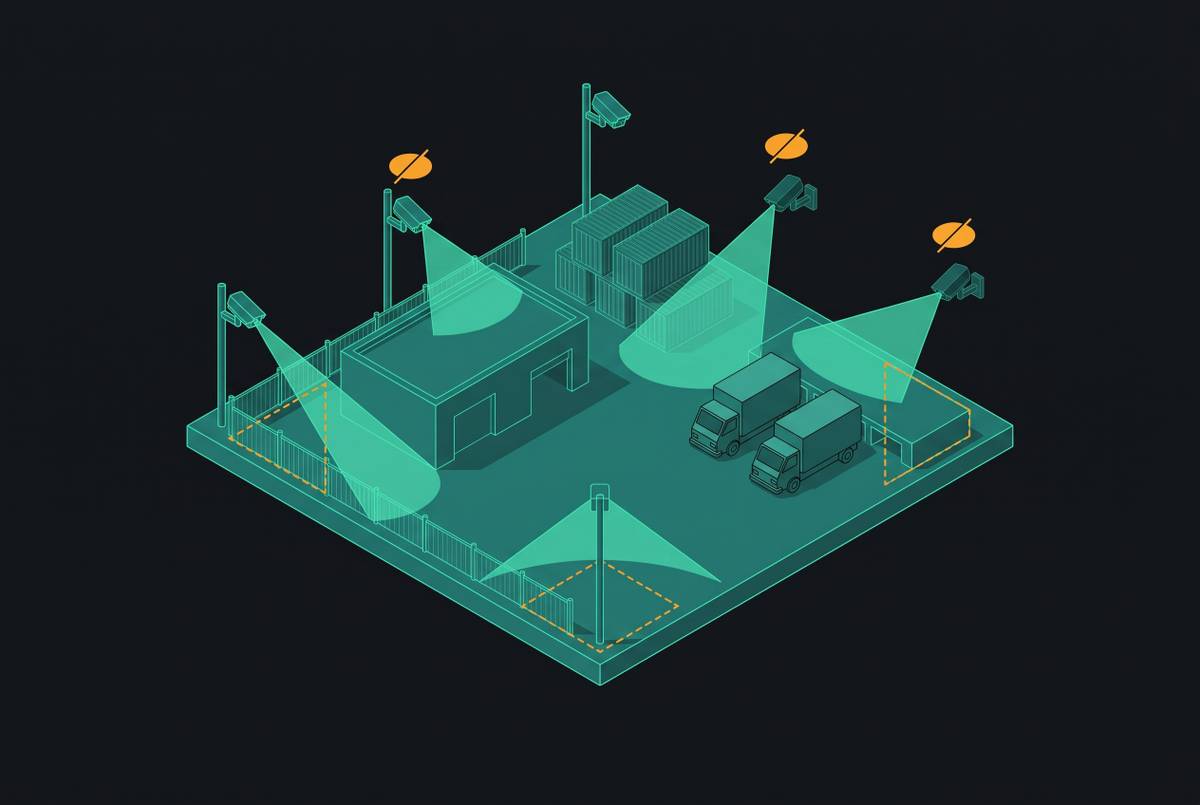
In physical monitoring, a muted camera is effectively off for alert-driven response. Its location no longer receives active attention through that source, even though the camera still appears in the camera count. Installed coverage and monitored coverage have now diverged. The apparent completeness of the camera estate can conceal a gap in what operators actually review.
The same withdrawal can happen informally in a security operations center. Repeated false positives from a rule create pattern blindness, so analysts begin ignoring that alert type even when it fires legitimately. Formal muting makes that loss of trust explicit. An attacker who understands this behavior can also generate noise deliberately to push useful signals into a muted or deprioritized area.
MITRE ATT&CK does not formally classify alert-flooding as a named technique. Its related subtechnique T1562.011, Spoof Security Alerting, covers generating false alerts to mislead defenders. Suppression creates a consequence an adversary can exploit. Once operators stop reviewing a source, malicious activity in the area it covers no longer has to look convincing to them.
Raising thresholds and the threats that fall below the new line
Raising a threshold cuts the number of alerts while leaving the source switched on. That makes it appear more disciplined than muting. Tuning rules, retiring outdated detection logic and adjusting sensitivity to the environment are legitimate practices. The problem arises when reducing workload becomes the basis for deciding what qualifies for attention. A quieter queue can then reflect narrower detection even if threats have not decreased.
Thresholds set against historical baselines determine which future events become visible to reviewers. An attacker below the new threshold can go unseen because of how the threshold is set. In physical monitoring, increasing the motion threshold can exclude slower or subtler movement, including a person walking slowly or a vehicle coasting without headlights. Such activity never reaches the review stage. The site looks quieter because the system has stopped presenting some of what happens there.
Default detection configurations reflect a generic threat model without accounting for the authorized activity of a specific environment. Applying them unchanged can itself be a misconfiguration, but narrowing them without local context introduces the opposite error. Whether an event is ordinary or suspicious depends on shift schedules, expected movement patterns and vendor access windows.
Broad rules generate complaints because their false positives remain visible, while overly narrow rules conceal their omissions. This makes the coverage gap harder to audit through the queue itself. Threshold-raising and muting differ in scope, but both can remove threats from consideration before anyone has judged them.
Batch processing and triage queues, and how backlog becomes the default state
Batch processing preserves alerts but postpones their review. Analysts group similar alerts and work through them in blocks instead of switching between alert types all the time. This can be a legitimate efficiency gain when the alerts are genuinely routine. Their significance has not yet been established. A real threat grouped with fifty false positives waits with the rest of the batch.
Physical video monitoring exposes the cost of that delay. In a sequential queue, alerts are reviewed one at a time in arrival order. Weather, power coming back on or coordinated activity can cause a surge in alerts that makes every later alert wait, including one for a real incident during that time. Arrival order becomes the practical basis for access to attention. Even an urgent threat has to wait its turn if nobody has spotted it yet.
Once backlog becomes normal, delayed review becomes part of the service's operating model. A threat entering a deep queue at 2 a.m. may reach an operator only after the incident has concluded. The monitoring service was technically running, but the site was functionally unmonitored during the available response window.
Sustained queue processing also weakens the quality of review. An operator handling the fortieth queued alert is not giving it the same attention as the first, because of the cognitive constraint of declining vigilance during repetitive monitoring. Batching therefore adds two costs to the earlier coverage trade-offs, namely delayed response and less reliable attention when review finally occurs. The alert can remain in the system while its operational value expires.
Rotating analysts and what institutional knowledge walks out with every shift change
Rotation distributes repetitive monitoring across people rather than leaving one operator exposed indefinitely. The UK's National Protective Security Authority documents that concentration begins to decline after just 20 to 30 minutes of continuous monitoring. Rotation is therefore a sound human-factors response to vigilance decrement. It protects individual attention and helps distribute the load. It does not reduce the volume requiring judgment.
The trade-off is continuity of contextual knowledge. An operator familiar with a site may recognize the authorized vehicle arriving every Tuesday at 3 a.m., the door that triggers on windy nights or the camera angle that catches passing traffic as apparent intrusion. A rotated operator seeing the same alert without that context must investigate fully or decide whether to dismiss it with limited understanding.
Burnout makes this continuity problem more persistent. Repetitive manual triage contributes to attrition, while departures remove the informal detection intuition that experienced personnel have developed. ISACA's 2024 State of Cybersecurity data shows that a majority of cybersecurity professionals reported higher stress levels, with an increasingly complex threat landscape, low budgets and hiring and retention challenges among the major drivers. New analysts then begin the learning curve again. During onboarding, weaker familiarity can increase false positives and slow triage.
Rotation can relieve exhaustion without resolving those underlying pressures. In physical monitoring, expanding domestic operator capacity also raises labor costs until further monitored-site growth becomes economically unworkable. More people can distribute the queue, but they still need time to understand its contents.
What all four workarounds have in common
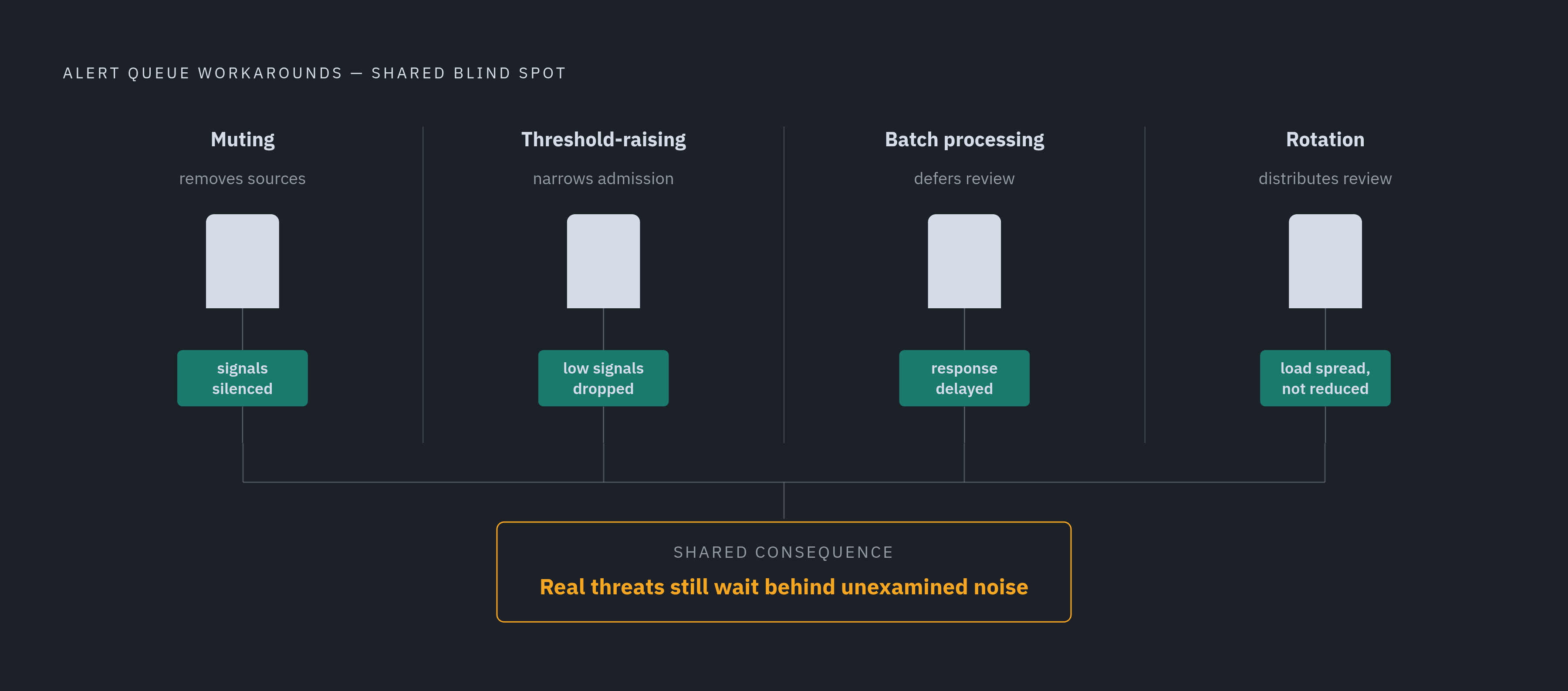
All four workarounds change how the team encounters the queue and leave the process of distinguishing threats from noise unchanged. Muting removes sources, threshold-raising narrows admission, batching defers processing and rotation distributes review across people. None reduces the activity in the protected environment that needs attention. Their immediate success is measured as a more manageable workload. That is not the same outcome as reliable threat detection.
The shared assumption is that the team's task is to get through alerts. Its actual task is to catch real threats, and those objectives diverge when most alerts are noise. A smaller queue can hide lost coverage, while an orderly queue can conceal an expired response window. Where a workaround reduces or delays review, it also narrows what an attacker must avoid.
Adding staff postpones this mismatch. More tools, sources and environments bring more alerts, while each new person has only so much attention to give. Offshoring changes the cost per operator-hour while leaving the underlying depth of the queue and the quality of reasoning about its contents unchanged. Diagnosis therefore requires looking beyond how much more backlog a team can process to ask why a real threat must wait behind unexamined noise before response can begin.
What solving the queue problem actually requires
To keep real threats from waiting behind noise, noise filtering must be separate from threat response. Reviewing every alert, dismissing environmental noise and authorized activity, and correlating related signals are repetitive, pattern-dependent tasks suited to AI agents operating continuously at scale. Response has a different purpose. Judging a verified threat, communicating with on-site staff or first responders, and exercising discretion require trained people. An AI agent should not replace that human responsibility.
This division changes what reaches the operator. Instead of receiving raw alerts and establishing their significance one by one, humans receive verified escalations after continuous investigation. Dropzone AI documents that autonomous investigation of every alert dramatically reduces the interval between alert generation and a confirmed verdict. Correlation further reduces duplicated work by treating related signals as one case. A suspicious login, a privilege change and an unusual file transfer can then be investigated together as three related events.
For physical video monitoring, the corresponding architecture reviews every alarm before escalating a verified threat. Environmental noise and authorized activity are filtered without disabling the source that detected them. The architecture is intended to deliver a real threat to a human operator in seconds, bypassing the wait behind false positives. Human attention is reserved for response.
Authorized schedules, expected movement patterns, known vehicles and protocol definitions provide the basis for distinguishing ordinary activity from an incident. Without them, an AI agent makes the same context-free guesses as an unfamiliar rotated operator. Automation alone does not supply that knowledge. For automation to be useful, it must use the site's context throughout the incoming stream.
For security buyers, evaluating the path from alarm to action means examining what happens to a real threat from the moment it triggers an alarm to the moment a human acts. That includes whether suppression, sensitivity changes, batch delays or lost context get in the way of a response after detection. A quieter console, by itself, provides no evidence that the site is safer.