Sequential Alarm Processing and Why Monitoring Centers Structurally Cannot Scale During Surge Events
Verifying alarms before operators see them solves the queue bottleneck.
Alarm response time failure in traditional video monitoring centers is a queue architecture problem. Sequential processing makes each alarm wait behind those that arrived earlier, while the amount of work people can review stays the same during a surge. The structural alternative is to verify and filter alarms before they reach operators, so human attention goes to actionable threats.
Why sequential processing creates a hard ceiling on monitoring capacity
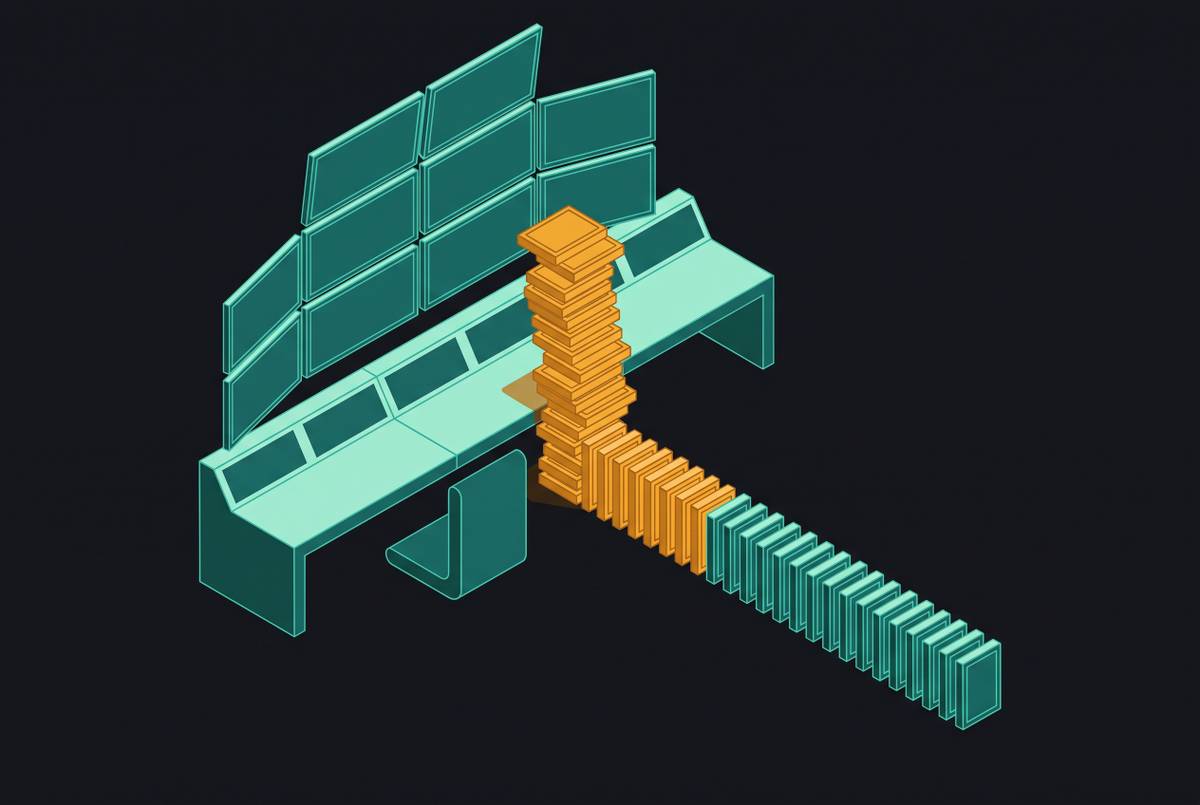
A sensor trips, a signal reaches the central station, and an operator works through open alarms one at a time. In a sequential workflow, alarms are processed in the order they arrive, whatever the severity of the threat. A wind-blown door and an armed break-in therefore enter the same queue without the evidence needed to distinguish their urgency. The threat must wait for its turn.
The system’s throughput is headcount multiplied by the rate at which one person can disposition an alarm. More staffed positions increase that product, but the workflow still depends on a person reviewing each event. Poorly managed systems routinely receive 1,000 to 2,000 alarms per day per operator position, far more than a person can respond to effectively. A real threat arriving during a busy period cannot bypass that workload merely because it is serious. At any given staffing level, the architecture imposes a hard ceiling.
What the queue actually looks like under normal conditions — and why normal is already strained
False activations go through the same review process as events that need action, taking time that an operator could otherwise spend verifying another alarm. LAPD states that it responds to more than a hundred thousand privately installed burglar alarm calls each year, with nearly all determined to be false alarms. Chicago also records hundreds of thousands of activations, and nearly all of those are false too. These examples describe the baseline burden.
Police false-alarm rates show how little actionable information can emerge from a large volume of alarm activity. Operators must still examine the signals that precede those outcomes. Repetition consumes attention as well as processing time. The clinical term “alert fatigue” comes from medicine, where nurses exposed to constant monitor alarms gradually stopped reacting to individual ones. The same thing happens when harmless security alerts keep calling for a decision, leading operators to triage faster and trust the next signal less.
That adaptation leaves operators cognitively taxed before demand rises. Dismissing a false alarm takes time, and doing it over and over becomes most of the job. A genuine threat arrives within that pattern. It calls for careful judgment from someone whose work up to that point has mostly been finding that nothing needs action.
Why do security monitoring centers fall behind on alerts during high volume periods?
A surge pushes arrivals above the system’s throughput limit. If one operator can disposition N alarms per hour and alarms keep arriving at a rate above N, unfinished work builds up even while that operator is busy the whole time. Doubling arrivals near the saturation point can therefore more than double waiting time. The operator must clear the earlier backlog while new alarms continue to accumulate.
In the sequential architecture described here, that backlog cannot be reordered by threat severity before someone establishes what each alarm represents. A critical event at the back remains behind the alarms ahead of it. The strained queue fails to deliver a timely response to that critical event while operators continue reviewing alarms. Continued activity at the desk is not evidence that the system is keeping pace.
Weather events, power fluctuations, shift changes, and after-hours activity at commercial sites can cause many alarms to go off together. Their types are predictable, but their timing is not. A center already burdened by routine noise has little spare capacity to absorb simultaneous activations. Once the surge creates a backlog, that work remains to be processed even when the arrival rate begins to fall.
Why staffing adjustments cannot repair the queue at the moment the surge arrives
More operators can raise total throughput once they are ready to work. A fresh operator needs site context, familiarity with open alarms, and an understanding of ongoing dispositions before contributing effectively. The time to respond right away can run out during that handover. Scheduling extra staff for anticipated peaks helps only where the peak can be anticipated with enough precision to have those operators ready.
Standing overstaffing instead makes spare capacity a permanent expense against intermittent demand. Operators reserved for unpredictable peaks sit idle during normal periods, making that approach economically unsustainable. Staffed coverage also remains exposed to wage inflation and turnover pressure. Offshoring and distributed operator pools may spread labor costs, but they do not remove human review from the path of every alarm.
Muting takes the opposite approach by reducing what receives attention. It relieves the queue by trading away coverage rather than distinguishing verified threats from benign activity. Overage pricing addresses the commercial burden of excess alarms, but does not itself verify an event or shorten its wait. Overstaffing, offshoring, and muting therefore leave the central dependency intact or avoid it by accepting reduced coverage. None removes the requirement that routine signals compete with real threats for human processing time.
What the downstream consequence looks like for the responder who actually rolls
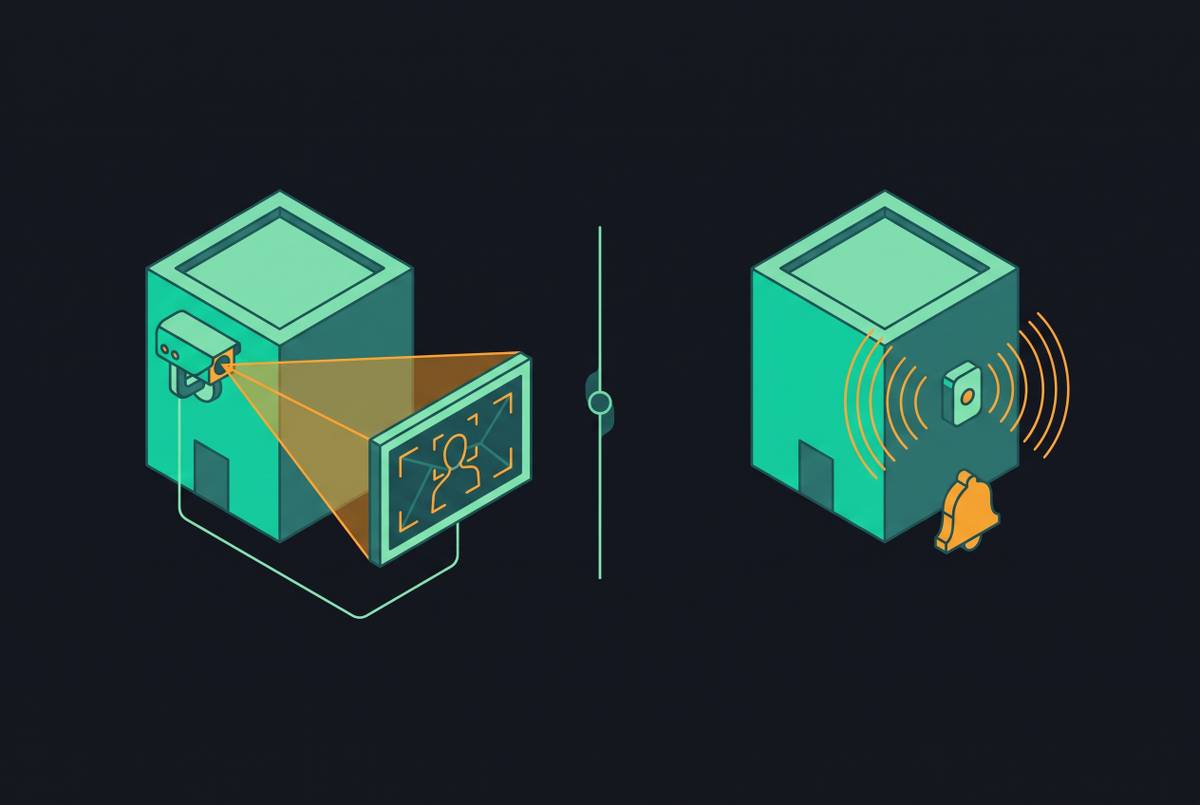
The delay does not necessarily end when an operator reaches the alarm. If the event leaves the monitoring center unverified, it enters a separate police dispatch process without evidence that a crime is in progress. Most computer-aided dispatch systems use verification when assigning priority. An unverified residential or commercial burglar alarm almost never receives Priority 1 and typically enters as Priority 3 or 4. A patrol car then rolls when one is free.
Video verification changes that dispatch decision materially. Police departments typically elevate video-verified alarms to “crime-in-progress” status, producing priority dispatch and substantially faster average response times than unverified alarms. The monitoring queue and the dispatch queue are distinct delay systems. However, they become linked when time spent awaiting review postpones the evidence needed for higher-priority dispatch. The responder receives an older alarm with fewer grounds for urgency.
NPCC policy also makes repeated false calls consequential at the system level. An alarm system receiving a Unique Reference Number will have police attendance withdrawn after three false calls in a rolling 12-month period. That policy shows how false alarms affect whether police will respond, though it alone does not show what caused each false activation. Faster forwarding of raw signals cannot resolve that weakness. The missing link between an alarm entering the center and a responder receiving an actionable incident is the verification gap.
How AI agents break the sequential architecture rather than accelerate it
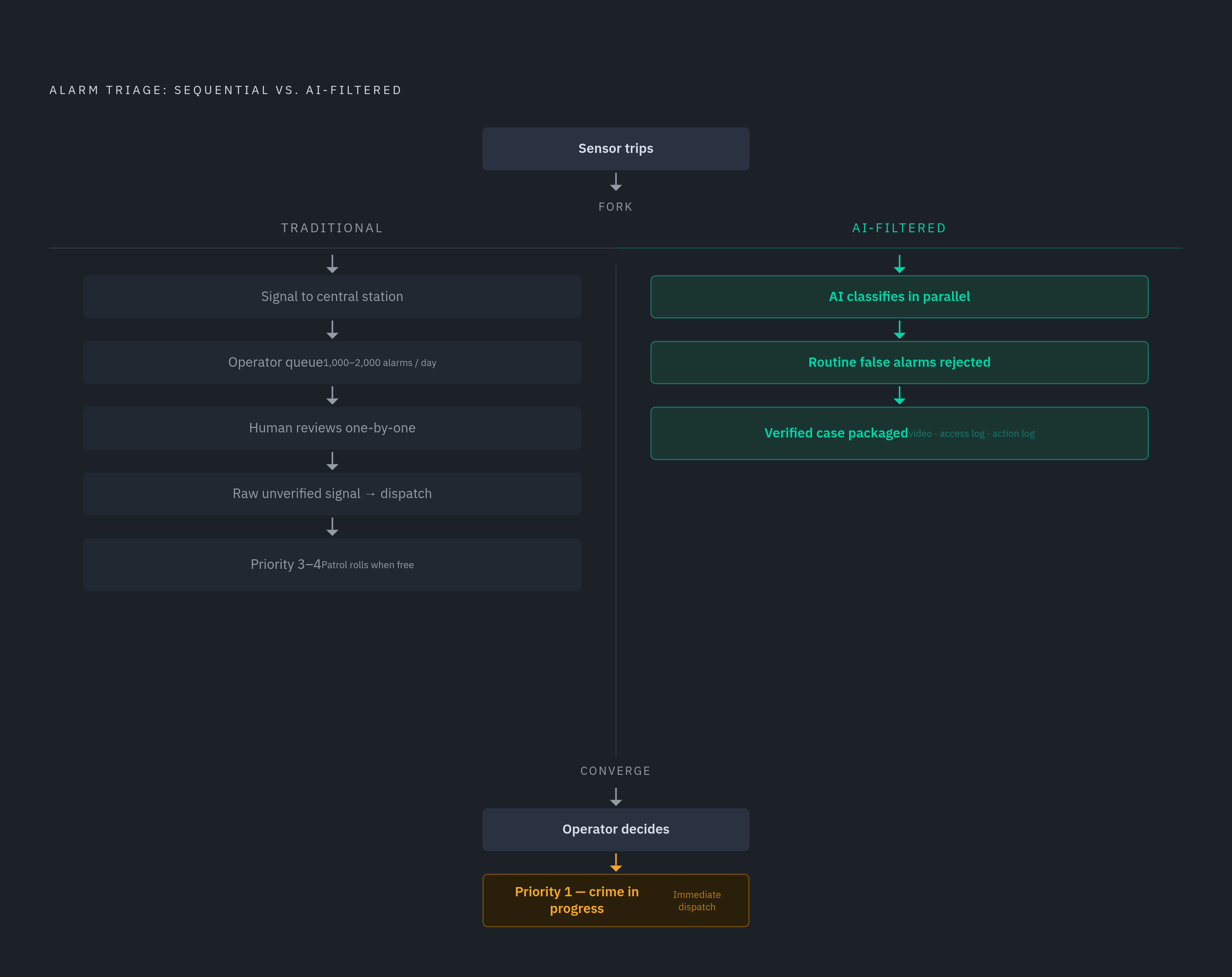
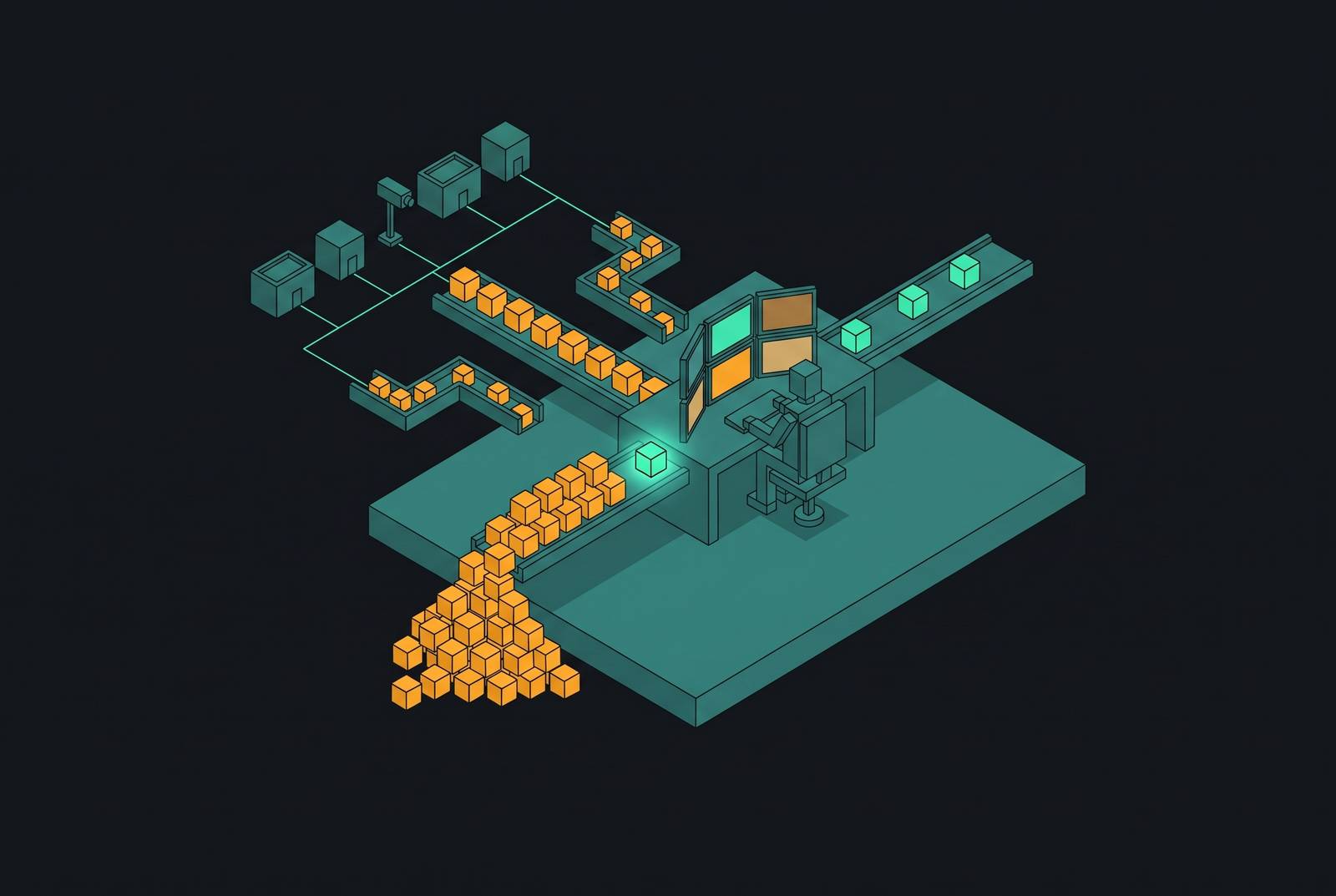
AI agents change the workflow when they analyze routine alarms before those alarms enter the human queue. That differs from first-generation video AI, which automated object search, tracking, and alarm generation while leaving operators to process every flagged event. The architectural change is to filter and package events upstream, reserving operator attention for verified, actionable incidents and cases that require judgment. Human operators remain responsible for decisions and response.
An agent can assess an intrusion, initiate preliminary steps such as sounding an alarm, and propose final decision options to an operator. At the same time, it can generate a report containing real-time video, access records, and a log of its actions. The operator receives a package rather than a raw signal. This changes the starting point of human review from discovering what happened to deciding what the evidence warrants. It does not eliminate the need for that decision.
Vision-language models provide a mechanism for examining the clip behind an alert and producing a human-readable explanation of whether it is real or false. NVIDIA’s Video Search and Summarization blueprint 3.2.1, updated July 2026, includes an Alert Verification Service that marks upstream alerts confirmed, rejected, or verification-failed. The intended architecture processes detection and classification work in parallel, while keeping human decisions sequential where necessary. Cases that remain uncertain still need review, since that uncertainty is no proof that nothing happened.
Why site-specific context is what separates AI filtering from AI noise
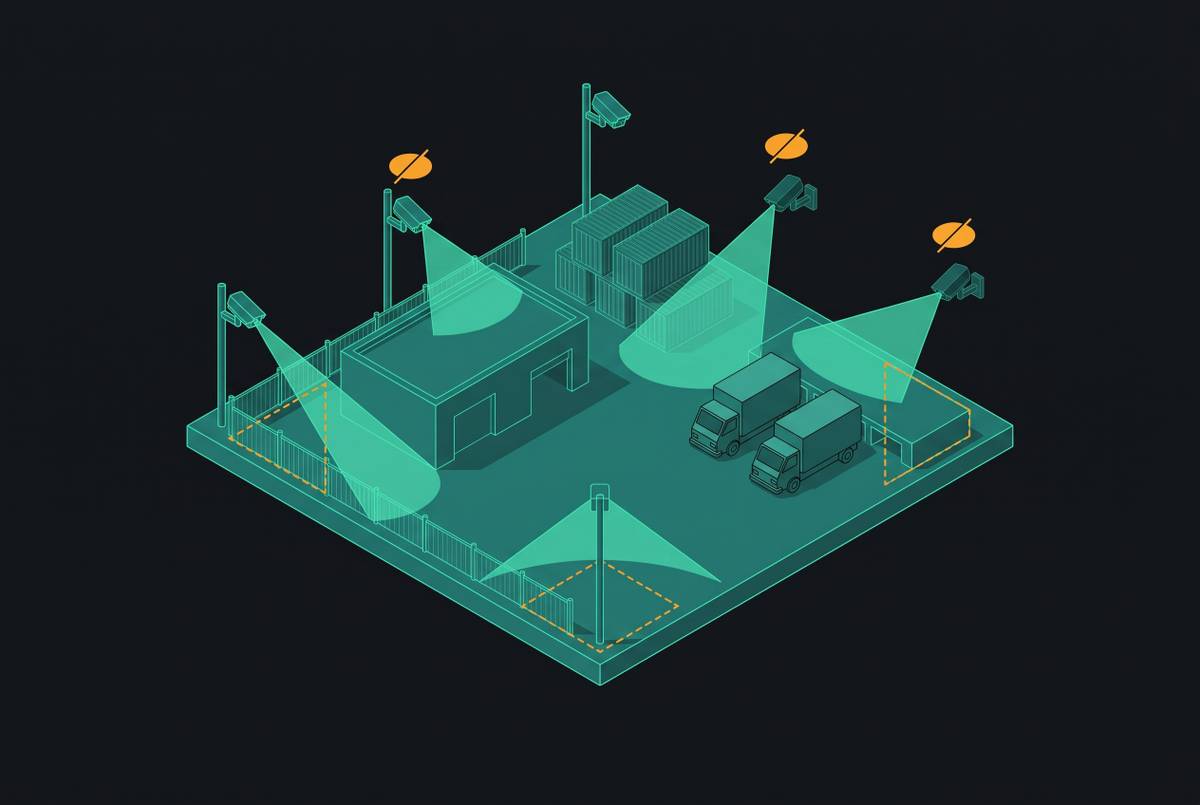
Parallel analysis is useful only if the agent understands the site. A person in a lot at 2 a.m. may be authorized or unauthorized depending on the shift schedule. Known personnel patterns, authorized vehicle lists, access control integration, site-specific motion zones, and response protocols supply the context needed to make that distinction. Without those inputs, an agent can generate false positives at machine speed.
A truck yard and a retail lot cannot be treated as interchangeable environments. An authorized forklift at midnight may fit one site’s schedule and break another’s protocol, even though the object detected and the hour are the same. A generic monitoring contract can therefore direct attention to the wrong activity. Miscalibration also creates false negatives when apparently authorized behavior masks a threat because the system was never told what authorization looks like at that site. Context governs both what gets rejected and what passes through.
NFPA 72 and ANSI/SIA CP-01 define equipment and monitoring behaviors that underpin response steps. They establish minimums. Meeting the standards cannot tell an agent which vehicle is expected on a given shift or where it is allowed to move. That knowledge must come from site calibration. Intelligent filtering depends on the fit between the event, the local rules, and the evidence available to the system.
What a monitoring architecture that does not break under surge actually looks like
AI agents handle detection and classification in parallel, passing verified exceptions and uncertain cases to operators. More cameras, alarms, or sites therefore need not produce a proportional increase in the human queue. The key distinction is where volume is absorbed. Routine noise is processed before it can consume the review capacity reserved for intervention.
Operators then focus on escalating to police, communicating with site personnel, and handling edge cases the agent cannot resolve. With this arrangement, people still have limits on how much they can handle, especially if many actionable threats arrive at once. It removes the routine false-positive workload that otherwise competes with those threats during a surge.
The 90-second benchmark is useful only when the starting point is explicit. An operator acting on an already verified threat begins from a different position than one opening an unexamined alarm after a long wait. Time-to-detection, time-to-verification, and time-to-response make those stages visible. Together, they show whether apparent speed at the final step conceals a delay earlier in the chain. The decisive measure is how long a real threat waits before a human with decision authority knows about it.
Commercial, multifamily, and industrial sites share this need during after-hours surges, weather events, and coordinated activity. The economics follow from moving classification out of the labor-bound queue, because monitoring one more camera or site does not inherently require another operator at a desk. The resulting system scales machine analysis separately from human judgment. Its defining output is a verified threat delivered in time for a person to act.